
Stainless Shaft Passivation: Define The Order
Stainless shaft passivation needs a defined material condition, treatment requirement and verification plan. A note saying passivate does not resolve every purchasing decision. Agree the governing specification, preparation, critical surfaces and release evidence before accepting the order.
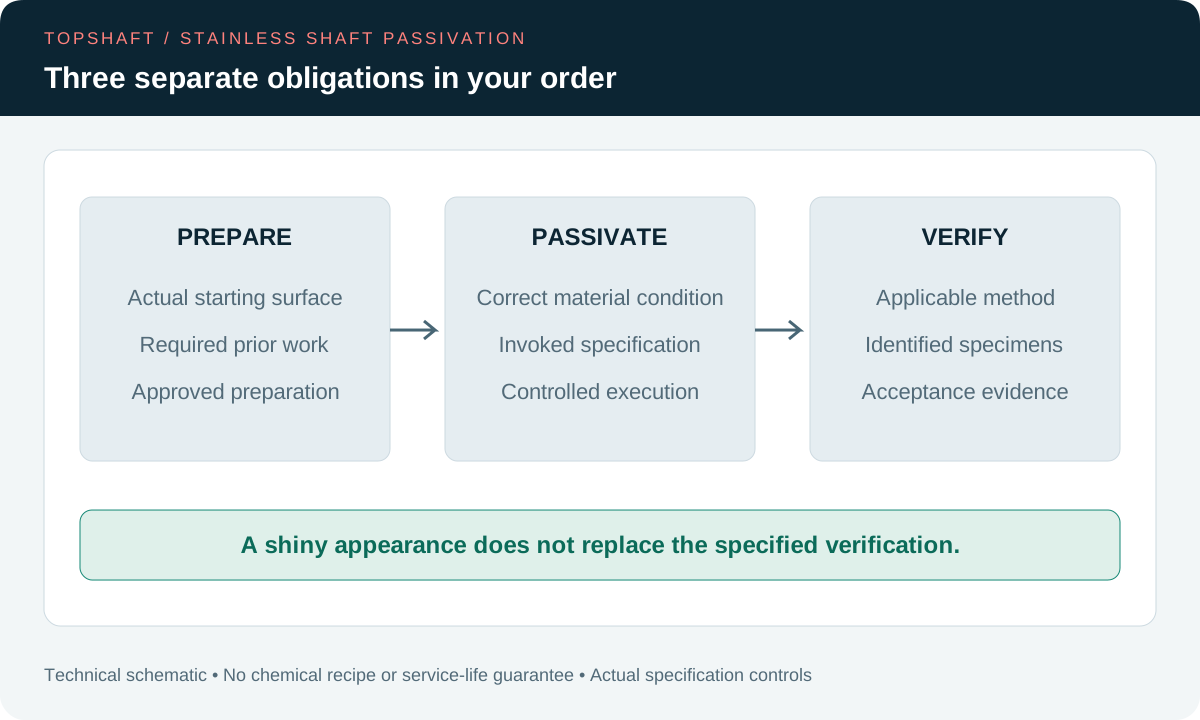
Define The Outcome You Need
Your passivation requirement should identify the intended surface treatment and its acceptance basis. Start with the actual application and released product definition. Ask your engineering authority why the treatment is required. Then identify the specification and evidence that support that decision. Do not replace this review with a general assumption that every stainless component needs an identical process.
Carpenter Technology's passivation explanation describes a protective passive oxide film and contamination introduced during manufacture. It explains why a shiny machined surface can still carry unwanted contamination. Use that background to separate appearance from treatment effectiveness. It does not establish your shaft's corrosion life or approve its suitability for every environment.
Keep the scope of the claim realistic. Passivation does not turn an unsuitable alloy into the correct material for your application. Your design team remains responsible for material selection and service requirements. This guide helps you specify purchasing information. It does not provide a chemical recipe, a corrosion guarantee or evidence of a particular TOPSHAFT processing capability.
Identify The Exact Alloy And Condition
You should provide the stainless grade and delivered condition before a processor selects the treatment arrangement. Include the applicable material specification and any required heat treatment. Identify relevant surface treatments already present. A description such as stainless shaft may hide important differences. Your processor needs the actual definition, not a guessed equivalent based on appearance.
Carpenter's explanation also identifies grade and acceptance criteria as factors in selecting the passivation approach. Do not transfer one grade's procedure to another without technical approval. Free-machining grades and high-strength conditions deserve appropriate process review. This statement is a review prompt, not a prescribed procedure for those materials. Leave chemical selection and operating controls to the responsible qualified organization.
Connect the material definition to your order and manufacturing records. The stainless steel shaft page provides related material discussion for your inquiry. Your material traceability requirements should preserve the identity connection through outside processing where applicable. A correct material record supports that connection. It does not replace the evidence required for the treatment itself.
Name The Governing Specification And Edition
Your purchase package should identify the invoked passivation document and its applicable edition. The ASTM steel standards catalogue lists separate documents for chemical passivation and broader stainless surface preparation practices. A967/A967M addresses chemical passivation treatments. A380/A380M addresses cleaning, descaling, pickling and passivation. These titles identify distinct documents, not interchangeable order instructions.
Obtain the actual requirements when your contract invokes a standard. A public catalogue is not the full process or acceptance procedure. Record the customer specification and any permitted choices. Identify who may approve a proposed alternative. Do not assume that citing a standard number resolves every treatment, testing and reporting question for your order.
Resolve conflicting notes before production. Your drawing may name one specification while a purchase attachment lists another requirement. Ask the authorized customer contact to establish the controlling interpretation. Use the drawing revision guide to manage formal changes. The processor should not choose whichever instruction is easiest without the required approval.
Separate Cleaning And Descaling From Passivation
Your plan should establish the required starting surface before the passivation step. Carpenter's article distinguishes cleaning from passivation and explains why preparation comes first. It also states that passivation is not intended to remove heat-treatment scale, paint, coatings or existing rust. Do not treat an acid treatment name as a substitute for an agreed preparation plan.
Ask the process owner to identify the actual surface condition after machining and any thermal processing. Record required preparation without inventing a universal sequence. Some conditions may need a separate technical review before treatment. Your approval should address the actual shaft, material and finish. A clean-looking surface alone does not document that all preparation requirements were met.
Keep cleaning acceptance identifiable when your order requires it. The shaft cleanliness guide helps define separate contamination evidence. A passivation result should not silently replace a specified cleanliness test. Equally, a cleanliness record does not automatically establish passivation effectiveness. Tell the supplier which outcomes need distinct records and which procedure controls each outcome.
Review Shaft Geometry And Critical Surfaces
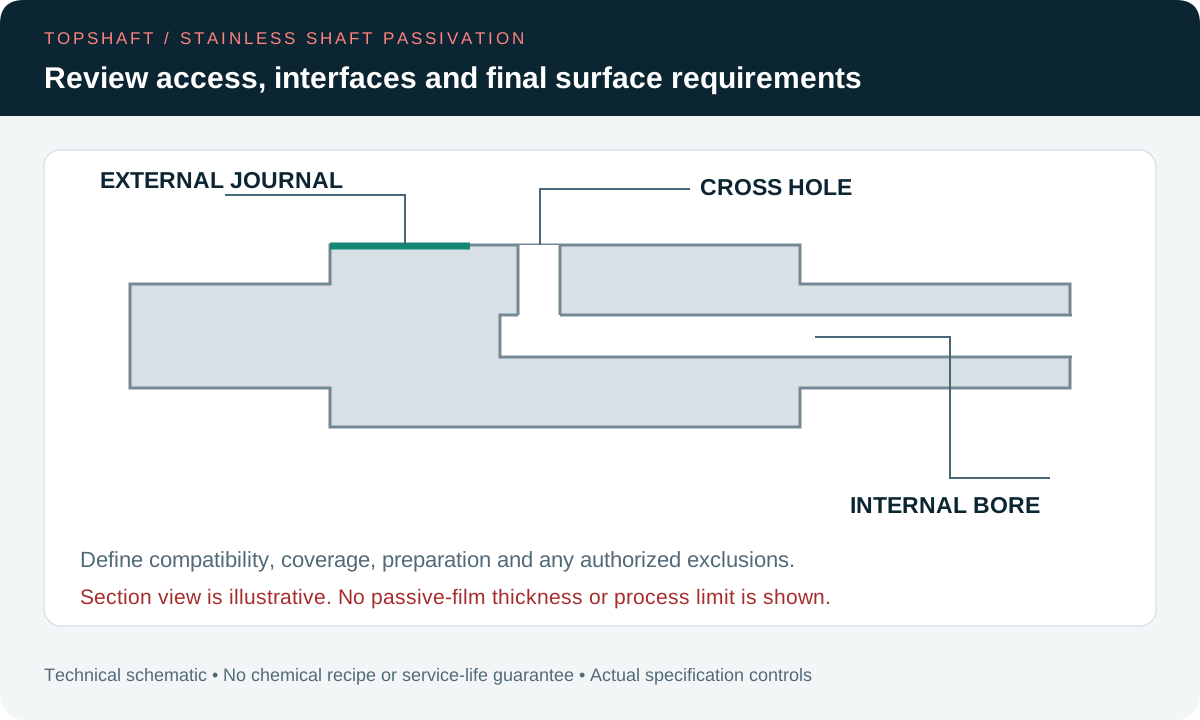
Your treatment review should include the features that complicate access, drainage or protection. Identify bores, cross holes, threads, grooves and transitions where relevant. Show the finished surfaces that the drawing controls. Ask the process organization how its arrangement addresses them. This list supports a review; it is not an instruction for operating a chemical treatment line.
Clarify whether the order covers a complete shaft or an assembly with other materials. Inserts, joined components or existing coatings may need a compatibility assessment. Do not assume an arrangement suitable for one bare component also suits an assembled product. Identify any masking or exclusion proposal explicitly. Obtain the necessary authority before accepting an untreated area within the specified scope.
Review the final size and finish requirements alongside the proposed route. The surface finish guide helps identify texture requirements that remain applicable. Do not use passivation as a dimensional correction or cosmetic rescue instruction. Any proposed preparation that changes a controlled feature needs technical assessment. Confirm the required final condition rather than promising universally unchanged dimensions.
Place Treatment In A Controlled Manufacturing Sequence
Your sequence should ensure that the required treatment and verification represent the delivered condition. Identify the operations before passivation and any work afterward. Later machining, handling or contamination can require review of the accepted surface condition. Do not assume an earlier certificate automatically describes every later state. Establish any necessary additional treatment or checks through the responsible authority.
Ask how the process owner controls preparation, treatment, rinsing, drying and final handling under the applicable procedure. You do not need to invent operating settings to ask these questions. The actual procedure and qualified process controls govern execution. Confirm the boundary between the machining supplier and any outside processor. Responsibilities should remain clear when pieces move between organizations.
Coordinate protection and packaging with the required final condition. Your shaft packaging guide provides related shipment planning questions. Specify compatible preservation and handling requirements where needed. Do not add an unapproved oil or finish merely because it is convenient for transport. Resolve the final delivery arrangement before treated pieces enter the shipping container.
Agree Verification Before The Treatment Starts
Your inspection plan should define the required verification, acceptance criteria and reporting scope before processing. Use the invoked specification and approved customer requirements. Ask the responsible technical team to identify applicable tests and their limitations. Do not demand every possible test without explaining the decision. Conversely, do not assume visual appearance alone establishes every required treatment outcome.
Define the processing lot and the specimens selected for verification. Keep those decisions connected to the actual treatment records. Your inspection sampling plan should identify the agreed selection and reporting quantities. A test result from an identified sample needs its proper scope. Do not present it as individual testing of pieces that were never examined.
Clarify what happens to test specimens afterward. Some evaluations may require a separate disposition before a specimen returns to deliverable stock. Follow the applicable method and order requirements. Record any permitted substitute specimen and its approved basis. A convenient coupon does not automatically prove the condition of every feature on a finished production shaft.
| Order Element | What You Should Define | Evidence To Connect |
|---|---|---|
| Material | Grade, condition and applicable specification | Product identity and material record |
| Preparation | Starting surface and required prior work | Controlled process reference |
| Treatment | Invoked document and approved choices | Processing lot and execution record |
| Verification | Method, specimens and acceptance criteria | Results and stated limitations |
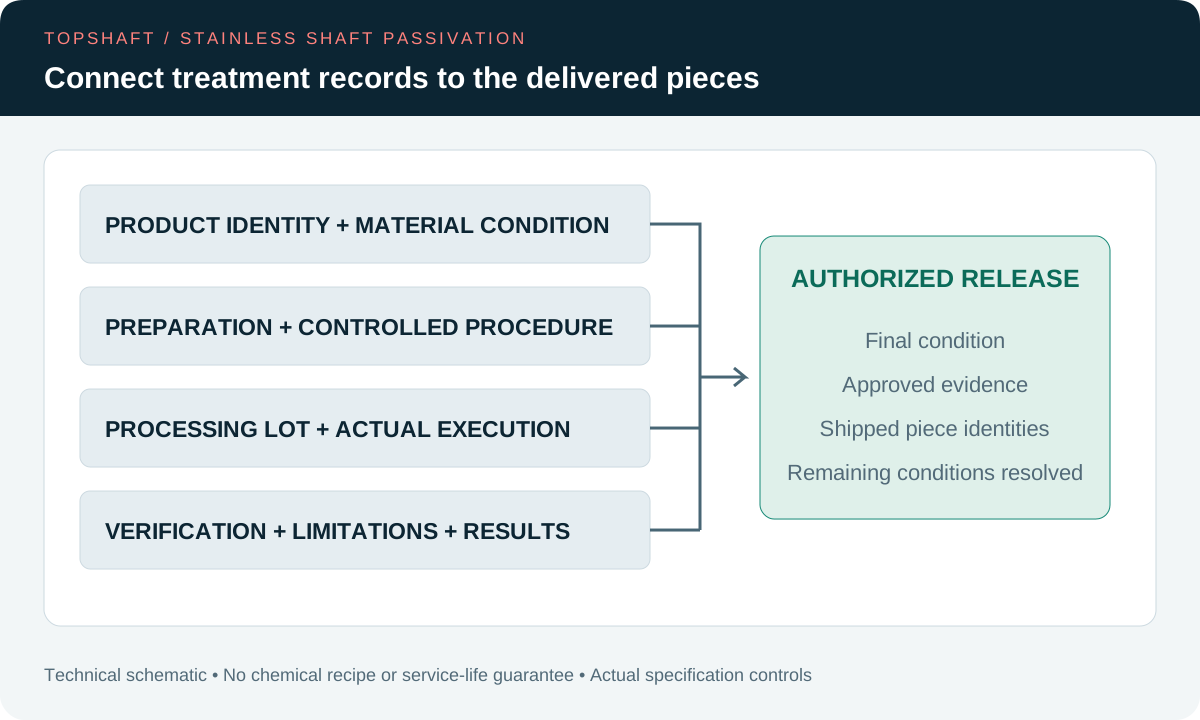
| Delivery | Final condition and release authority | Approved records linked to shipped pieces |
Keep Passivation Evidence Within Its Proper Meaning
You should separate treatment effectiveness from other product requirements and service predictions. A satisfactory specified verification supports the decision defined by that method. It does not automatically establish unlimited corrosion resistance in your application. Your service environment and design requirements still matter. Avoid turning a treatment certificate into a broad performance warranty that nobody approved.
For example, a hypothetical shaft order requires passivation and a controlled bearing-seat diameter. Record the treatment evidence against its agreed requirement. Record the diameter against the applicable dimensional limit. If one record is missing, identify the gap. Do not treat the other record as a replacement simply because both concern the same piece.
Use the same discipline for roughness, marking and cleanliness requirements. Each specified characteristic needs the evidence required by the order. A visual observation can document a visible condition without proving every chemical or dimensional property. Your report should state what was actually checked. Missing evidence should remain visible until the authorized reviewer resolves it.
Control Nonconforming Results And Repeat Processing
You should hold affected pieces when the required verification fails or necessary evidence is missing. Preserve the original results and identities. Identify which processing lot or suspect group needs investigation. Do not assume one failure defines every piece without reviewing the evidence. Likewise, one satisfactory replacement result does not automatically clear the original group.
Obtain technical authorization before repeating treatment or adding corrective preparation. The proposed action may affect other requirements or fall outside the original approved route. Your rework and concession process should define the decision and required final evidence. Approval to attempt recovery is not proof of successful recovery. Retain both the authorization and verified outcome.
Review whether the issue also requires a process change. Your manufacturing change guide addresses that separate approval question. Correcting a held lot does not establish that the cause has been removed. Preserve applicable limits on any accepted disposition. A permission for identified pieces should not become automatic approval for later production.
Prepare A Confirmed TOPSHAFT Inquiry
You should send the complete passivation requirement before treating it as an accepted supply commitment. Provide the released drawing, stainless grade and delivered material condition. Identify critical surfaces, invoked specifications and required verification. Include quantity, lot sampling, report expectations and final packaging requirements. Make unresolved choices visible rather than asking the supplier to infer your acceptance basis.
Ask TOPSHAFT to confirm the actual treatment and reporting arrangement for your order. This article does not verify a particular chemical line, certificate or outside processing source. Any proposed arrangement needs order-specific review. If the requested requirement cannot be supported, resolve that limitation before acceptance. A defined, confirmed scope is more useful than an unsupported claim covering every stainless application.
Review cost and scheduling factors during quotation. Preparation condition, geometry, handling, lot size, verification and documentation can affect the proposed arrangement. Do not assume a universal price or turnaround. For repeat orders, confirm the approved material, process and acceptance requirements still apply. Use the shaft RFQ checklist to assemble the commercial and technical package before committing to production.
Frequently Asked Questions
Your answers should follow the actual alloy, invoked specification and approved order requirements. These questions identify common purchasing boundaries, not universal chemical processing instructions.
Does A Shiny Shaft Prove Successful Passivation?
No. Appearance does not replace the verification required by your specification. Identify the applicable treatment and acceptance evidence. Keep a visible-condition observation separate from other required results. Ask the authorized reviewer to resolve any missing evidence.
Can Every Stainless Grade Use The Same Treatment?
You should not assume that. Grade, material condition and acceptance requirements need process review. The responsible organization must select an appropriate approved arrangement. Do not copy a treatment from another alloy without the necessary technical authority.
Does Passivation Replace Cleaning Or Scale Removal?
No blanket substitution should be assumed. Define the required starting surface and any separate preparation under the applicable procedure. Passivation and cleanliness verification address different requirements. Confirm the actual sequence before accepting the treatment plan.
Does A Passivation Certificate Guarantee Corrosion Life?
Not by itself. The record must state its applicable requirement and verification scope. Your application still needs appropriate material selection and service evaluation. Do not infer an unlimited corrosion guarantee from evidence supporting a narrower treatment decision.
Send Your Passivation Package
You can avoid ambiguity by agreeing preparation, treatment and verification before production. Contact TOPSHAFT with your drawing and passivation requirements. Request confirmation of the actual process scope, responsible organization and release documentation.