
Shaft Material Traceability: Heat Numbers, Certificates And Lot Control — An OEM Checklist
Shaft material traceability links your finished parts to identified source material and agreed supporting records. Specify that link before ordering. A material certificate alone cannot prove which shafts came from that material. You also need identification controls throughout production and shipment.
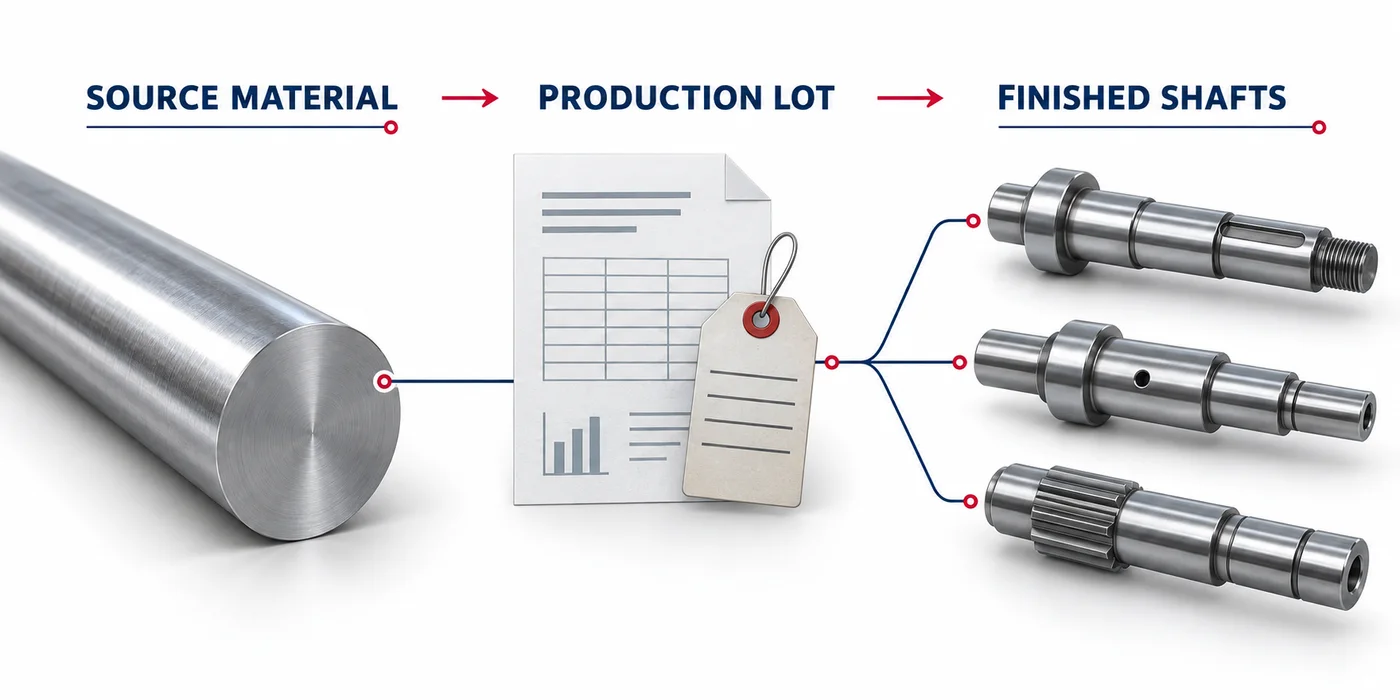
*Technical illustration, not a TOPSHAFT production record or customer project.*
What Shaft Material Traceability Should Prove
Your traceability system should connect delivered shafts with their source material and relevant processing records.
Start with a practical question: can you select a delivered shaft and identify its documented material source? Then ask whether you can identify other parts sharing that source.
The first question supports acceptance. The second supports containment when you discover a problem. Neither requires identical tracking arrangements for every application.
For some orders, controlled batch identification may be sufficient. Others require individual serial numbers linked to manufacturing and inspection records. Your contract, application risk and customer requirements determine the appropriate level.
Avoid specifying “full traceability” without defining its meaning. State the records, identification method, retention period and required links. Agree which organization maintains those records and supplies them when requested.
You should also define the tracking boundary. Does your requirement stop at the material heat? Does it include forging, heat treatment, coating and final inspection?
Heat Numbers And Production Lots Are Different
A material heat identifier and a production lot identifier describe different groupings.
A heat number generally identifies a melt or heat under the material producer's numbering system. A production lot groups parts under an agreed manufacturing definition. A purchase order identifies a commercial transaction, not necessarily one material source.
One production order may consume several material heats. One heat may supply several production orders. Your records must preserve these relationships rather than assume a one-to-one match.
| Identifier | What You Should Establish | What It Does Not Prove Alone |
|---|---|---|
| Material heat number | Connection to source-material inspection documentation | Finished shaft dimensions or processing history |
| Incoming material lot | Connection to received stock and supplier records | A unique melt, unless explicitly mapped |
| Production lot | Defined manufacturing group and material inputs | Common heat treatment, unless recorded |
| Processing batch | Parts included in a particular processing operation | Original material identity without upstream links |
| Serial number | Identity of an individual shaft | Conformity without supporting records |
For split lots, retain the parent-child relationship. If a batch divides between two subcontractors, identify both resulting groups. Record the corresponding processing references separately.
Treat leftovers the same way. A usable bar remnant needs a retained identity before returning to stock. Appearance and rack position are weak substitutes for controlled identification.
What To Check On A Material Certificate
Review a material certificate against your order requirements and the identity of the received material.
First, confirm the issuing organization and document reference. Check the material designation, applicable specification, product form and stated delivery condition. Then compare the heat identifier with received stock markings and purchasing records.
Review actual reported results against the applicable requirements. Do not accept a familiar grade name as evidence of every required property. Similar designations can differ across standards, product forms and delivery conditions.
Your shaft material selection decision should establish those requirements before certificate review begins.
Use this document-review sequence:
- Match the certificate to the received stock and supplier delivery references.
- Confirm the specified material grade and governing specification.
- Verify the stated product form and delivery condition.
- Review the chemical results required by that specification.
- Review applicable mechanical results and their stated test conditions.
- Check supplementary testing required by your purchase order.
- Resolve omissions or contradictions before releasing stock into production.
Mechanical results describe the documented test material and condition. They do not automatically establish every finished shaft's properties after further processing. Subsequent heat treatment requires its own agreed verification and records.
An incoming-material certificate also does not replace dimensional inspection. Your finished shaft still needs acceptance against its drawing and approved inspection plan.
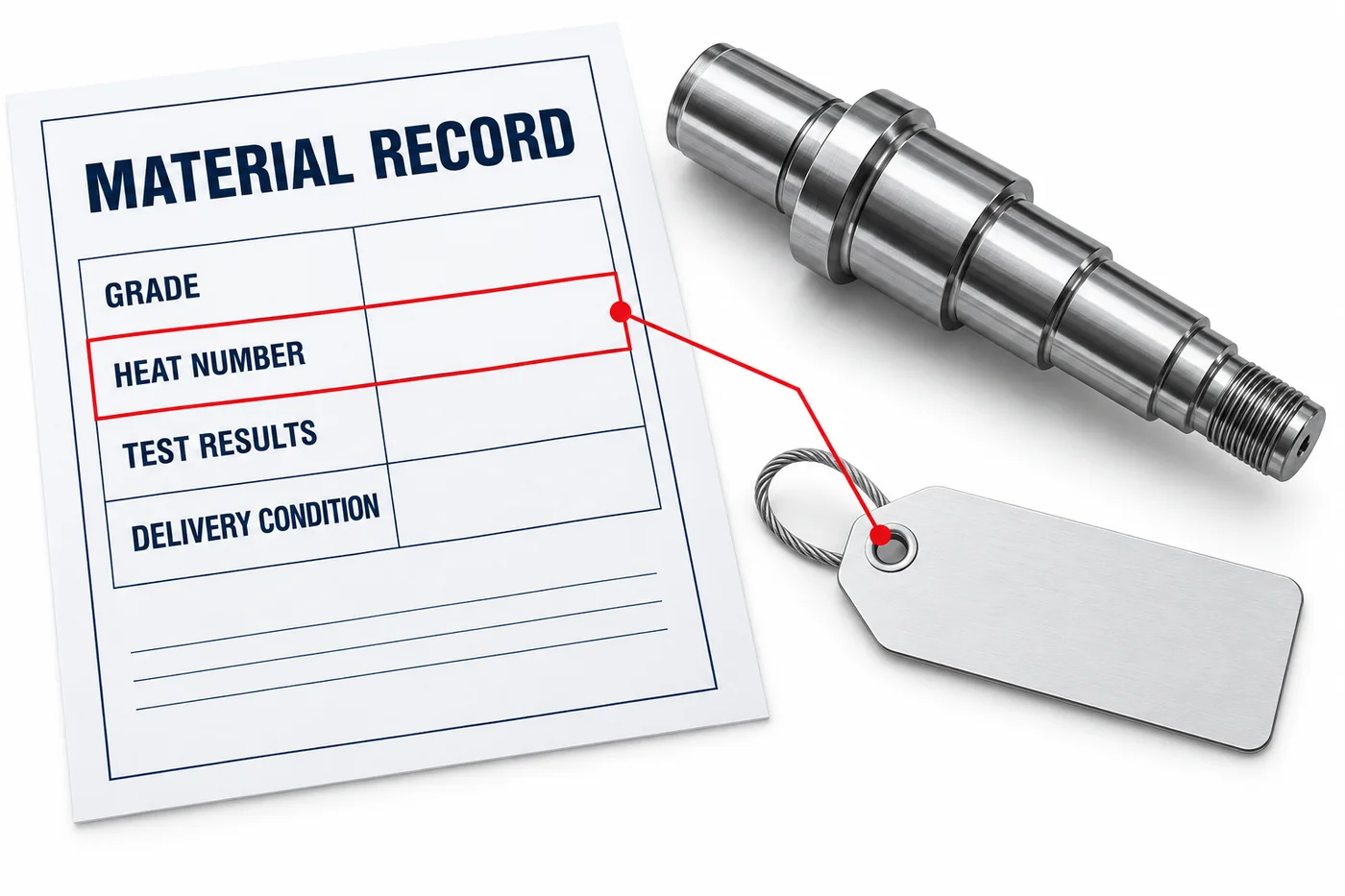
*Illustrative document layout only; not an authentic inspection certificate.*
Agree The Certificate Type Before Buying Stock
Specify the required inspection document before material procurement, not after the shafts are finished.
If your project invokes EN 10204, identify the required document type explicitly. Do not assume “material certificate” means the same document to every supplier.
Type 3.1 and Type 3.2 have different validation arrangements. The latter includes additional independent verification arrangements. Consult the applicable standard and contract for the exact requirements. RINA's certification overview explains the distinction and associated inspection activities.
Do not request Type 3.2 simply because it sounds more comprehensive. Establish whether your application or contract requires it. Arrange the inspection and witnessing scope before relevant manufacturing stages pass.
Retrospective document collection can reveal missing evidence. It cannot automatically recreate unperformed inspections or restore lost material identity. Confirm feasibility, responsibilities and scheduling during quotation.
Similarly, a distributor's delivery note and a material producer's inspection document serve different purposes. Where stock passes through intermediaries, maintain the connection between supplied stock and its underlying documentation.
Do not apply metallic-material documentation terminology indiscriminately to ceramic or polymer shafts. Agree documentation appropriate to the material and application.
How Identification Survives Shaft Manufacturing
Identification must remain controlled when cutting, machining or processing removes the original material marking.
Before cutting, verify the parent stock identity against the job records. Transfer identification to the cut pieces or their controlled containers using an approved method.
A traveler can connect the job number, material reference and quantity. Its value depends on keeping the correct parts with that record. A sheet beside mixed components provides little protection.
During machining, define how operators manage trays, work in progress and rejected parts. Separate unidentified material from released material. Avoid returning loose parts to a batch based on visual similarity.
For external heat treatment or coating, identify the outgoing lot and quantity. Require the processor's records to reference that identification. Check the returned quantity and records before accepting the parts back into production.
If parts are scrapped, replaced or reworked, update the lot history. Your shipped quantity should reconcile with the released parts. Investigate unexplained additions rather than treating extra pieces as harmless.
Final inspection should reference the correct part number, drawing revision and lot identity. Use your first article inspection plan to confirm the documentation chain alongside physical features.
Choose Identification That Protects Functional Surfaces
Select an identification method that preserves both traceability and shaft function.
Individual marking is not automatically the best solution. Stamping, engraving and laser marking can affect surfaces differently. Review location, depth and method with your engineering team.
Avoid unspecified marks on bearing journals, sealing surfaces, fatigue-sensitive transitions or critical fits. Show approved marking zones on the drawing when individual identification is required.
Where permanent marks are unsuitable, controlled tags, containers or packaging labels may support batch identification. Their suitability depends on your handling process and contract.
Check whether labels survive cleaning, oil exposure and storage. Confirm they remain readable and attached without contaminating functional surfaces. Do not attach adhesive labels to precision contact surfaces without approval.
At assembly, preserve the required relationship between the shaft and its assembly record. Otherwise, receiving traceability may disappear after packaging is discarded.
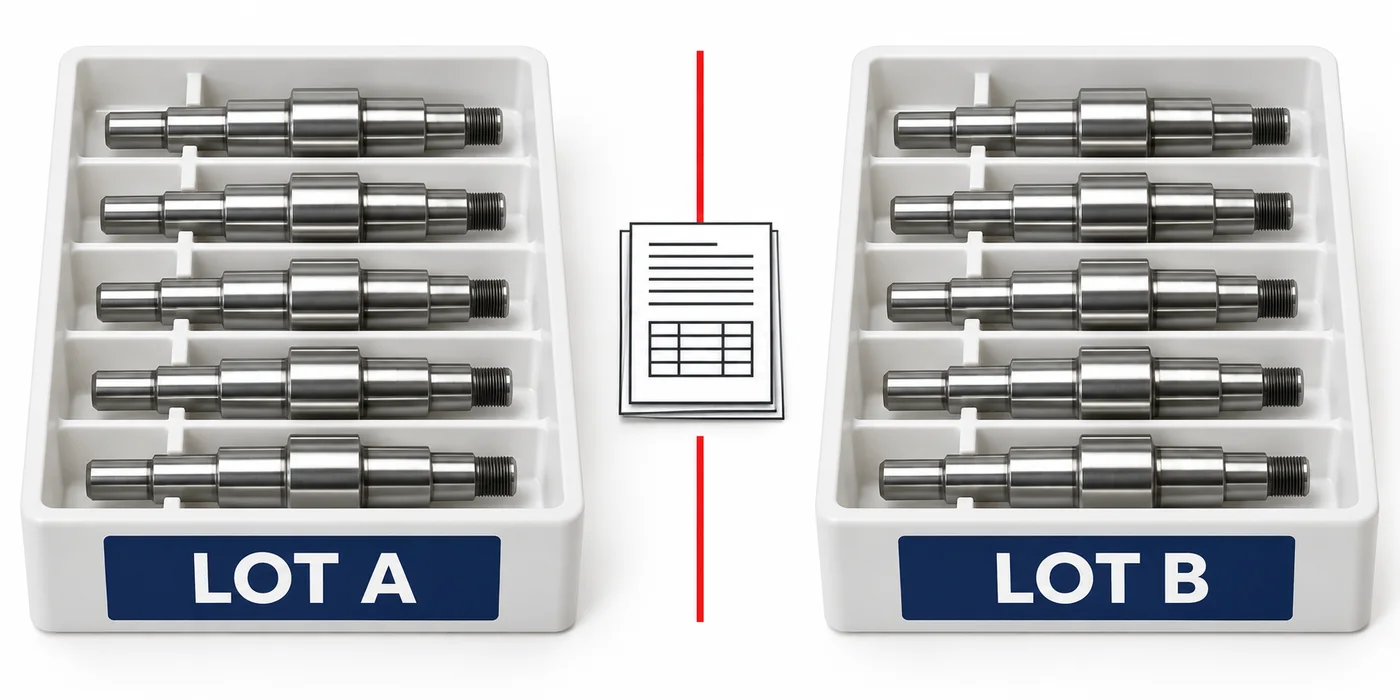
*Technical illustration showing segregation principles, not an actual shipment.*
Why PMI Does Not Replace Complete Traceability
Positive material identification can support material verification, but it cannot reconstruct a missing manufacturing history.
Choose the test method for the elements and distinctions you need to verify. Instrument selection, calibration, surface condition and sampling all affect the result.
Handheld XRF cannot measure carbon. Therefore, it cannot by itself distinguish grades whose required difference depends on carbon content. Thermo Fisher's method comparison explains this limitation and alternative analytical approaches.
A suitable chemistry result does not prove heat-treatment condition, mechanical properties or fatigue performance. Nor does it identify the original heat without an established record connection.
If your purchase order requires PMI, define the method, acceptance criteria, sampling scope and report identification. Specify whether testing occurs before or after coating and how any test marks are managed.
Do not substitute PMI for required material documentation without an approved disposition. They answer different questions and may both be necessary.
What To Put In Your RFQ And Purchase Order
Your RFQ should define the traceability evidence needed for acceptance and the supplier's pricing assumptions.
Include your drawing, material specification and requested quantity. Add annual demand where it affects stock sourcing or lot planning. Identify any prohibited substitutions or approval requirements.
Then specify these documentation points:
- Required source-material inspection document and certificate type, where applicable.
- Tracking level: material heat, production lot or individual shaft.
- Rules for multiple heats within one delivery.
- Approved marking method and location, or controlled container identification.
- Required links to heat-treatment, coating and inspection records.
- Timing for document submission and customer review.
- Retention period, retrieval expectations and responsible organization.
- Handling of remnants, rework, replacements and split deliveries.
For example, you might prohibit mixed heats within a labeled packing unit. Alternatively, allow them with separate identification and document mapping. Choose deliberately rather than leaving the supplier to guess.
Use the broader precision shaft RFQ checklist to align documentation with geometry, finish and inspection requirements.
Additional controls can affect cost and lead time. Separate stock procurement, serial marking, document review and witnessed inspections require planning. Ask suppliers to identify these effects without weakening required controls.
Verify Traceability At Receiving
Receiving inspection should test the connection between physical parts, packing labels and submitted records.
Start with the purchase order and approved drawing revision. Compare the packing list against the labeled quantities and lot references. Confirm each required material document is available and readable.
Then select a packing unit and follow its identification backwards. Locate the corresponding production reference and source-material document. If individual serialization is required, check the serial-number mapping rather than relying on the outer carton label.
Use a receiving checklist with named responsibilities. Purchasing can confirm document delivery, while quality reviews technical acceptance. Neither review should silently replace the other.
Preserve identification when you transfer parts into internal storage. Record the new location without discarding the original lot reference. For partial withdrawals, ensure the remaining quantity retains its identity.
You can also perform a simple retrieval exercise before approving repeat production. Ask the supplier to retrieve one lot's agreed records. Review whether the returned documents actually connect, rather than counting the number of files supplied.
Specify the sampling and review scope according to your approved quality plan. This example does not prescribe a universal inspection frequency.
If you find an inconsistency, hold the affected population pending investigation. Do not assume an attractive certificate compensates for an unidentified tray of parts.
How To Handle Missing Or Conflicting Records
Hold affected material or shafts when their required identity or documentation cannot be established.
Record the discrepancy and define the potentially affected population. Preserve labels, delivery records and available processing documents. Ask the supplier to investigate using original records.
Distinguish a document omission from a broken identification chain. A missing copy may be retrievable. An unknown material source presents a different problem.
Do not rewrite identifiers merely to make documents match. Corrections should remain authorized, explainable and linked to supporting evidence. Keep the original discrepancy visible in the disposition record.
Additional testing may support an engineering decision, but its scope must address the actual uncertainty. Chemistry testing cannot establish every missing processing requirement.
Release, return, replacement or concession should follow your authorized quality process. A purchasing deadline is not evidence of material conformity.
Review TOPSHAFT Requirements Before Production
Agree project-specific documentation with TOPSHAFT before accepting a manufacturing route or placing your order.
Send the material specification, drawing revision and traceability requirements together. Ask which records will accompany delivery and which will be retained. Confirm any external inspection arrangements before production begins.
Do not assume every material source supports every certificate request. Availability and supporting evidence must be confirmed for the proposed supply route. This checklist does not promise a particular certificate or inspection service for every order.
Frequently Asked Questions
Your acceptance plan should answer these traceability questions before production starts.
Does Every Shaft Need Its Heat Number Engraved?
No. The required tracking level and permitted marking method depend on your contract and application. Controlled batch identification may suffice.
Can One Delivery Include Multiple Material Heats?
Yes, if your order permits it and the identification remains clear. Define segregation and document mapping requirements beforehand.
Is A Material Certificate A Finished-Part Inspection Report?
No. Source-material documentation and finished-part inspection cover different requirements. Link both to the delivered lot where required.
Does PMI Prove Heat Treatment?
No. Chemistry identification does not establish the required thermal history or resulting mechanical properties.
Can XRF Confirm Low-Carbon Stainless Grades By Itself?
No. XRF cannot measure carbon. Select an appropriate analytical method and acceptance criteria when carbon verification is necessary.
Can Missing Traceability Be Restored After Machining?
Sometimes original records can resolve the gap. Testing alone does not recreate a lost identification chain or unavailable historical evidence.
How Long Should Records Be Retained?
Set a period consistent with your contract, product obligations and quality system. Avoid assuming one universal retention period.
What Should You Send For A Documentation Review?
Send your drawing, material specification, quantity, required certificate type and tracking scope. Include customer-specific inspection and retention requirements.
Define The Evidence Before Ordering
Traceability works when identity and records remain connected throughout manufacturing. Define that connection before buying stock. Contact TOPSHAFT with your drawing and documentation requirements to review the proposed supply route.