Shaft Cleanliness Requirements: Particles, Residues And Acceptance — An OEM Checklist
Shaft cleanliness requirements should identify contamination, critical surfaces, inspection methods and the condition required at delivery. “Clean before shipping” leaves too much unspecified. You need an agreement that connects machining, cleaning, protection and receiving inspection without inventing a universal limit for every shaft.
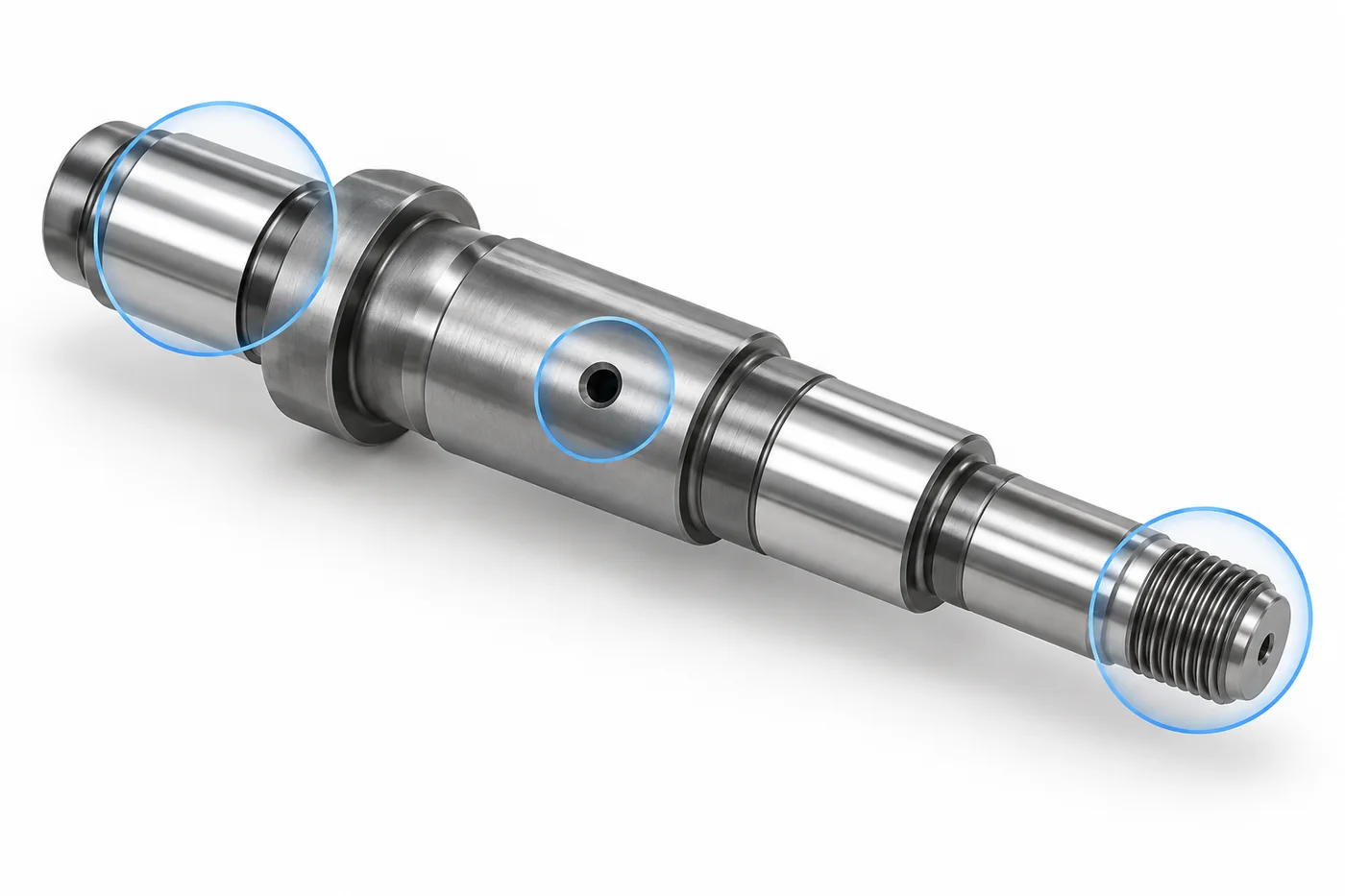
Technical illustration, not a TOPSHAFT production photograph. Highlights identify example areas for discussion, not a cleanliness classification.
1. Define What Clean Means For Your Assembly
Define cleanliness through the contamination that matters to your assembly, not through appearance alone.
Start with the next operation. Will the shaft enter a bearing assembly, a fluid circuit or an adhesive-bonding process? Will your receiving team clean it again? Those circumstances can require different delivery conditions.
SKF identifies cleanliness during bearing storage and mounting as important to proper performance. That supports careful handling, not a universal shaft cleanliness limit. See the SKF mounting guidance.
Separate loose particles, attached burrs, oily films, cleaning-agent residues and moisture. A process that addresses one category may not address another.
“No visible dirt” can be useful when your application permits visual acceptance. However, define the viewing conditions and surfaces. Do not present that check as quantified particle analysis.
Also distinguish technical cleanliness from sterility or regulated hygiene. A visually clean industrial shaft does not establish medical or food-contact suitability.
Describe the delivery condition in the purchase documents, not only in a conversation with the supplier. Your inspection team needs the same definition. Otherwise, the supplier may ship a protected part while receiving expects a bare, assembly-ready surface.
2. Identify Functionally Critical Surfaces
Identify the surfaces and passages whose contamination could affect the finished assembly.
A bearing journal, seal track and internal oil passage do not necessarily need identical inspection. Mark the relevant regions on the drawing or a controlled cleanliness specification.
Describe internal features as well as accessible surfaces. Include blind holes, cross-drilled passages, thread roots and retaining-ring grooves where relevant. A clean outer diameter does not establish the condition inside a bore.
Clarify whether the acceptance requirement covers the complete part or selected regions. That boundary affects extraction, handling, sampling and interpretation.
Use the bearing journal guide for related interface requirements. Consult the seal journal guide where the shaft provides a seal running surface.
Neither guide supplies a universal contamination limit. Your responsible engineer should connect the requirement with the actual system and use conditions.
For example, distinguish an open mounting bore from a passage connected to a sensitive fluid system. Their geometry may look similar. Their contamination consequences can differ. Explain the functional connection instead of asking the supplier to infer it from a model.
3. Separate Particles From Film Residues
Specify particulate contamination and film residues separately because their inspection methods and consequences differ.
Particles can include machining chips, abrasive fragments, fibers and other loose material. Films can include protective oil, coolant residue or cleaning-agent residue.
You cannot assume that an acceptable particle result proves a surface is free of oil. Equally, removing an oily film does not establish that a passage contains no loose particles.
| Contamination Category | Requirement To Define | Important Limitation |
|---|---|---|
| Loose particles | Relevant regions, limits and analysis method | Visual appearance is not quantified particle evidence |
| Film residues | Permitted substances and appropriate acceptance method | Particle extraction alone may not assess films |
| Attached burrs | Edge requirements and inspection | Cleaning is not a substitute for deburring |
| Moisture | Required dry condition and verification | An apparently dry exterior may hide trapped liquid |
| Protective media | Approved material and removal responsibility | Protection may conflict with the next operation |
For automotive applications, ISO 16232:2018 addresses methods for determining particulate contamination on functionally relevant components and systems. It excludes film-contamination detection and does not prescribe component-specific limits. See the ISO public scope.
Use the specified edition where applicable. Do not treat an automotive standard as automatically mandatory for every industrial shaft.
Identify whether a suspected deposit is permitted protection or unwanted residue before rejecting a shipment. The answer should come from the specification. A shiny appearance, a wipe mark or a photograph alone may not identify the substance reliably.
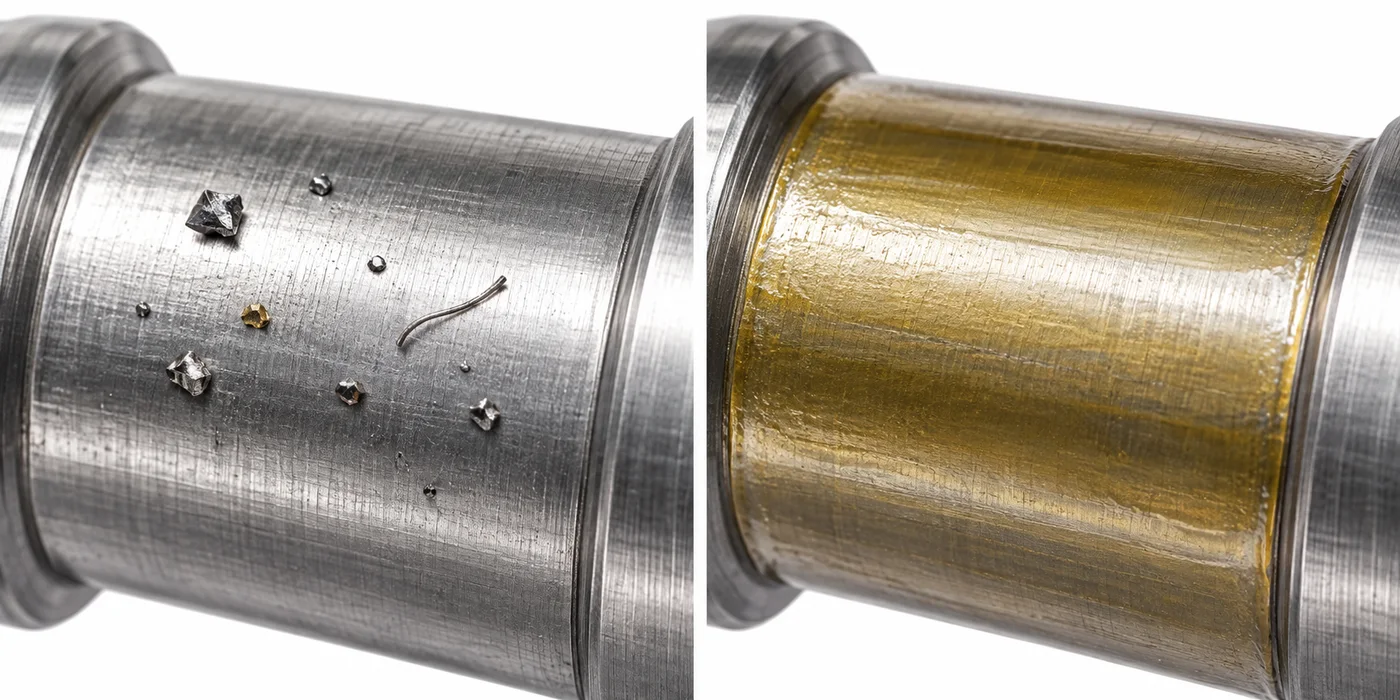
Technical illustration. Particle sizes and film appearance are exaggerated, not acceptance limits or actual laboratory findings.
4. Set Acceptance Before Selecting A Cleaning Process
Agree the acceptance requirement before choosing or approving the cleaning route.
Avoid writing only “ultrasonically cleaned” or “solvent cleaned.” Those descriptions identify processes, not necessarily the condition of the delivered shaft.
Ask what needs verification after cleaning. For particles, this may involve agreed size categories, counts or other defined measures. For films, the required assessment depends on the substance and subsequent operation.
Do not borrow a particle limit from an unrelated component. Consider the mating clearances, fluid path and consequences of contamination. Have the responsible specialist approve the actual limits.
Review material, coating and seal compatibility before selecting chemistry. Also consider access, drying and residue removal. An aggressive process can create another problem while addressing the original contamination.
Avoid prescribing universal cleaning times, temperatures or solvent recipes. These require process-specific assessment and safe operating procedures.
The acceptance agreement should remain meaningful if the supplier proposes another cleaning method. Approve changes through your agreed quality process.
Keep your final target separate from process-monitoring checks. A shop-floor check may help control production without replacing the agreed acceptance test. State which evidence releases the shipment, and which evidence merely shows that the cleaning process was monitored.
5. Agree On Sampling And Inspection Methods
Define how samples are selected, prepared, tested and linked to a production lot.
Specify whether the test concerns one shaft, several parts together or a selected region. Define the reporting basis so results can be compared meaningfully.
Where extraction is used, agree the applicable method and how its suitability is established. Geometry and access can affect recovery. A measurement cannot be interpreted properly without understanding what was actually tested.
Discuss background contamination from equipment, containers and handling. Otherwise, your result may include material introduced during inspection rather than material from the shaft.
Some methods alter the part's delivery condition. Agree whether tested samples may return to the shipment and what reprocessing is necessary.
Ask for part number, drawing revision, lot reference, sample quantity, method and results on the report. Record deviations from the agreed procedure.
Do not compare two laboratories' numbers solely because their report titles match. First check scope, preparation, extraction and reporting conventions.
Define the sample-selection point too. A sample taken immediately after cleaning represents a different stage from one taken after packaging. If delivery is the concern, decide how the qualification or inspection plan addresses subsequent handling and protection.
6. Check Bores, Grooves And Intersecting Passages
Review difficult-to-access features rather than assuming the external cleaning result represents the entire shaft.
Blind holes can retain liquid. Cross-drilled passages may contain loose debris near intersections. Grooves and thread roots can be harder to inspect than a smooth journal.
Identify features where cleaning access should influence design or process planning. Discuss whether the selected route can reach and drain them effectively.
Keep deburring and cleaning connected but distinct. A securely attached burr is a geometry or edge-quality issue. A detached chip becomes loose contamination.
Do not expect washing to remove every attached edge defect. Likewise, a deburring certificate does not establish the absence of loose debris afterward.
Use the shaft deburring guide to define edge requirements. Add the cleanliness requirements needed after those operations.
Inspection may need more than a photograph of the shaft exterior. Agree evidence appropriate to the actual internal feature and acceptance requirement.
Review inspection access before freezing the design. Where a passage cannot be viewed directly, discuss suitable verification instead of requesting an impossible photograph. Do not accept a convenient external check as a silent substitute for an internal requirement.
7. Balance Cleanliness With Corrosion Protection
Specify which protective substances are permitted and who removes them before assembly.
A bare steel shaft may need temporary protection against the expected storage and shipping environment. However, protective oil may be unacceptable for a later bonding or coating operation.
Resolve that conflict before shipment. Define the approved protection system, its compatibility and any required removal process.
Do not write “oil-free” while separately requiring an unspecified rust-preventive oil. Conflicting instructions prevent reliable quotation and acceptance.
Distinguish ready-for-assembly delivery from delivery requiring a defined cleaning step. Both can be legitimate, but they involve different responsibilities and costs.
If the receiving team removes protection, agree when the final cleanliness requirement applies. A pre-shipment inspection cannot establish the condition after uncontrolled unpacking and cleaning.
Review the shaft packaging guide for transport protection. Keep this article's cleanliness acceptance separate from the packaging specification.
Also consider the permitted storage period and conditions. A protection arrangement reviewed for immediate assembly may not suit prolonged warehouse storage. Ask for an agreed handling plan rather than assuming the same cleanliness and corrosion condition will persist indefinitely.
8. Prevent Recontamination After Cleaning
Control handling and exposure after cleaning so the accepted condition survives until the agreed handover point.
Review drying before closing the protective package. Consider internal cavities and moisture trapped under caps. Do not assume packaging materials can correct inadequate drying.
Identify acceptable handling practices and contact materials. Gloves, supports, wipes and packaging can themselves introduce contamination if unsuitable or poorly maintained.
Use plugs or caps appropriate to the feature. They should protect without damaging surfaces or leaving unacceptable residue. Define whether they are temporary shipping protectors or part of the delivered assembly.
Consider opening the package as part of the contamination-control process. Fibers or particles released during unpacking can undermine otherwise careful preparation.
For repeated shipments, assess reusable trays and supports. Define inspection, cleaning and replacement responsibilities rather than assuming reuse remains acceptable indefinitely.
Agree the protection boundary: sealed package, warehouse storage, incoming inspection or installation. That boundary tells each party what it must control.
A broken seal or damaged bag should trigger the agreed receiving procedure. It does not automatically prove that every shaft is unacceptable. Record the damage, preserve identification and assess the affected condition using the defined inspection and disposition rules.
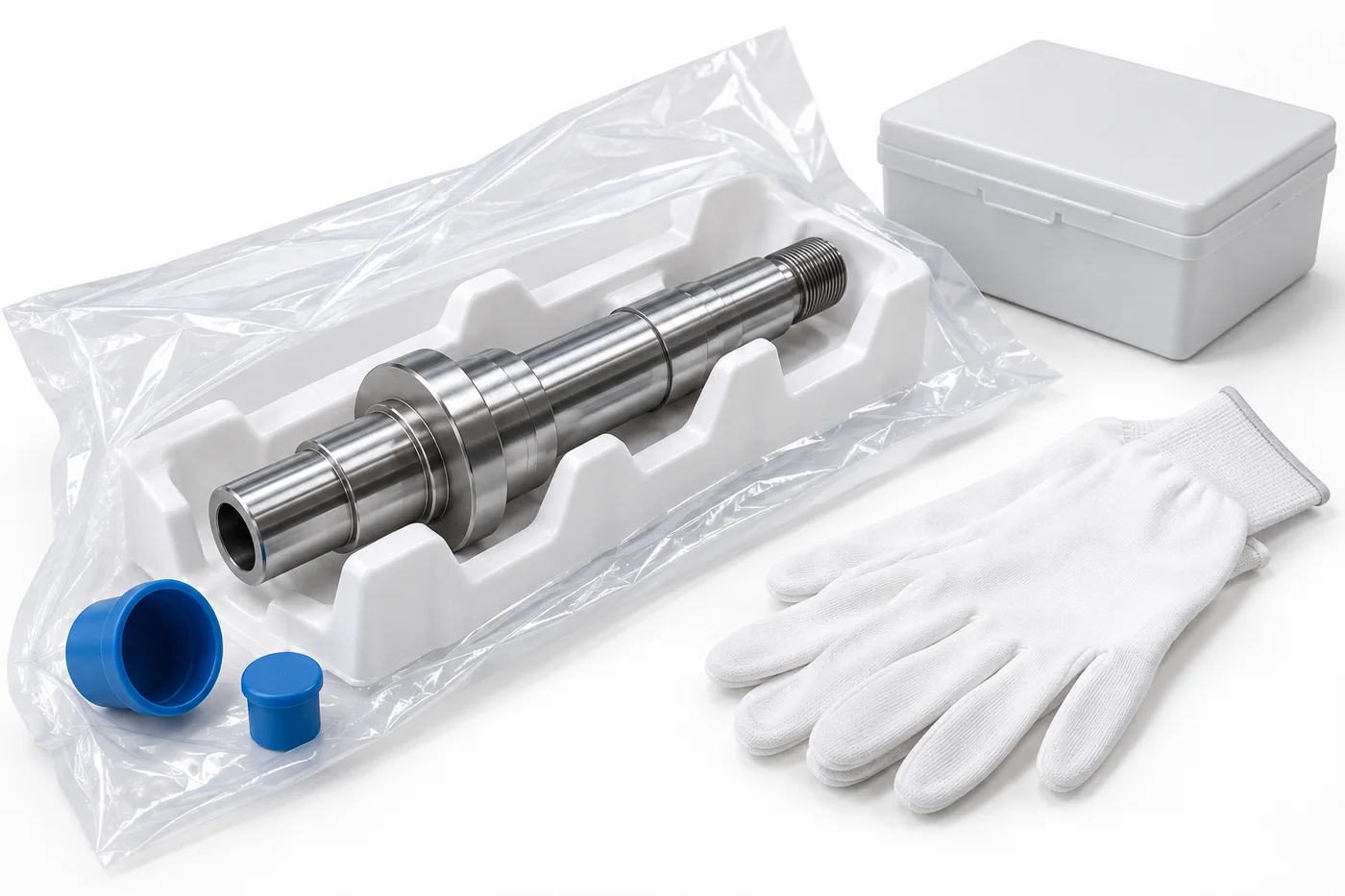
Technical illustration, not a validated cleanroom process or evidence of sterility. Actual packaging materials require project-specific review.
9. Define Receiving And Dispute Procedures
Agree receiving conditions and evidence requirements before a cleanliness concern occurs.
Identify how packages are opened, samples selected and surfaces protected during inspection. Record the condition of the packaging before handling the parts.
Retain lot identity when reporting a concern. Include affected quantities, relevant surfaces, handling history and the method used to find the contamination.
Photographs can support an investigation, especially for visible chips or damaged protection. They do not automatically quantify a particle population or identify film chemistry.
Avoid cleaning all disputed samples before agreeing on evidence preservation. That may remove the condition needed for a useful investigation.
Where retesting is appropriate, align the method and reporting basis first. Two results obtained under different conditions may not prove a manufacturing inconsistency.
Agree the disposition of affected parts. Recleaning, additional inspection, segregation or rejection should follow a documented decision, not an informal assumption.
If recleaning is authorized, define the verification afterward. Repeating a cleaning operation is not itself proof of acceptance. Preserve the original lot reference and record the additional processing so the final release remains traceable.
10. Prepare A Complete Cleanliness RFQ
Provide the information needed to price, perform and verify the required delivery condition.
- Released drawing, revision and corresponding model where needed.
- Material, heat treatment and coating requirements.
- Critical external regions and internal passages.
- Contamination categories and permitted protective substances.
- Acceptance limits approved for the application.
- Inspection method, sample plan and reporting basis.
- Drying, handling and packaging requirements.
- Delivery condition and responsibility for later cleaning.
- Quantity, annual demand and intended storage conditions.
- Required records and change-approval arrangements.
Use the precision shaft RFQ checklist for the remaining commercial inputs.
Compare quotations against the same requirement. Added inspection, controlled handling, special packaging and reprocessing can affect total cost. Do not compare only machining prices when the delivery conditions differ.
Avoid imposing unnecessary controls on every surface. Focus justified requirements on the application, then confirm feasibility before approving production.
Frequently Asked Questions
Clarify these points before issuing your cleanliness specification.
Is A Visually Clean Shaft Automatically Ready For Assembly?
No. Appearance may satisfy an agreed visual requirement, but it does not establish every particle or residue condition.
Does ISO 16232 Set One Limit For Every Shaft?
No. Its public scope does not define component-specific cleanliness limits. The applicable system and responsible specialist determine the requirements.
Can Particle Inspection Prove That A Surface Is Oil-Free?
Not by itself. Film contamination needs its own appropriate requirement and assessment method.
Is Cleaning A Substitute For Deburring?
No. Define attached edge defects separately from loose contamination. Verify the required condition after the relevant operations.
Should Every Shaft Be Delivered Without Protective Oil?
No. Balance corrosion protection with assembly needs. Identify permitted media and who removes them.
Can Inspected Samples Return To The Shipment?
That depends on the test and agreed procedure. Testing may change the part's condition and require reprocessing before packing.
Are Clean Gloves Enough To Prevent Recontamination?
No. Handling materials, work surfaces, exposure and packaging must also suit the agreed requirement.
What Should I Send With A Cleanliness Inquiry?
Send the drawing, critical areas, contamination categories, acceptance method, quantity and required delivery condition. Include protection and storage expectations.
Discuss Your Shaft Delivery Requirements With TOPSHAFT
TOPSHAFT can review your shaft inquiry against the supplied drawing. Specific cleanliness testing and delivery commitments require project confirmation. Request a drawing-based review with critical regions, acceptance criteria, quantity and packaging needs before ordering.