
Precision Shaft Packaging: Protecting Journals, Threads And Surfaces During Shipping
Precision shaft packaging must protect geometry, surface condition and cleanliness until assembly. You need more than a strong carton. Define which surfaces matter, how each shaft is supported, what corrosion protection is acceptable, and how receiving inspection works. Agree these requirements before approving the production order.
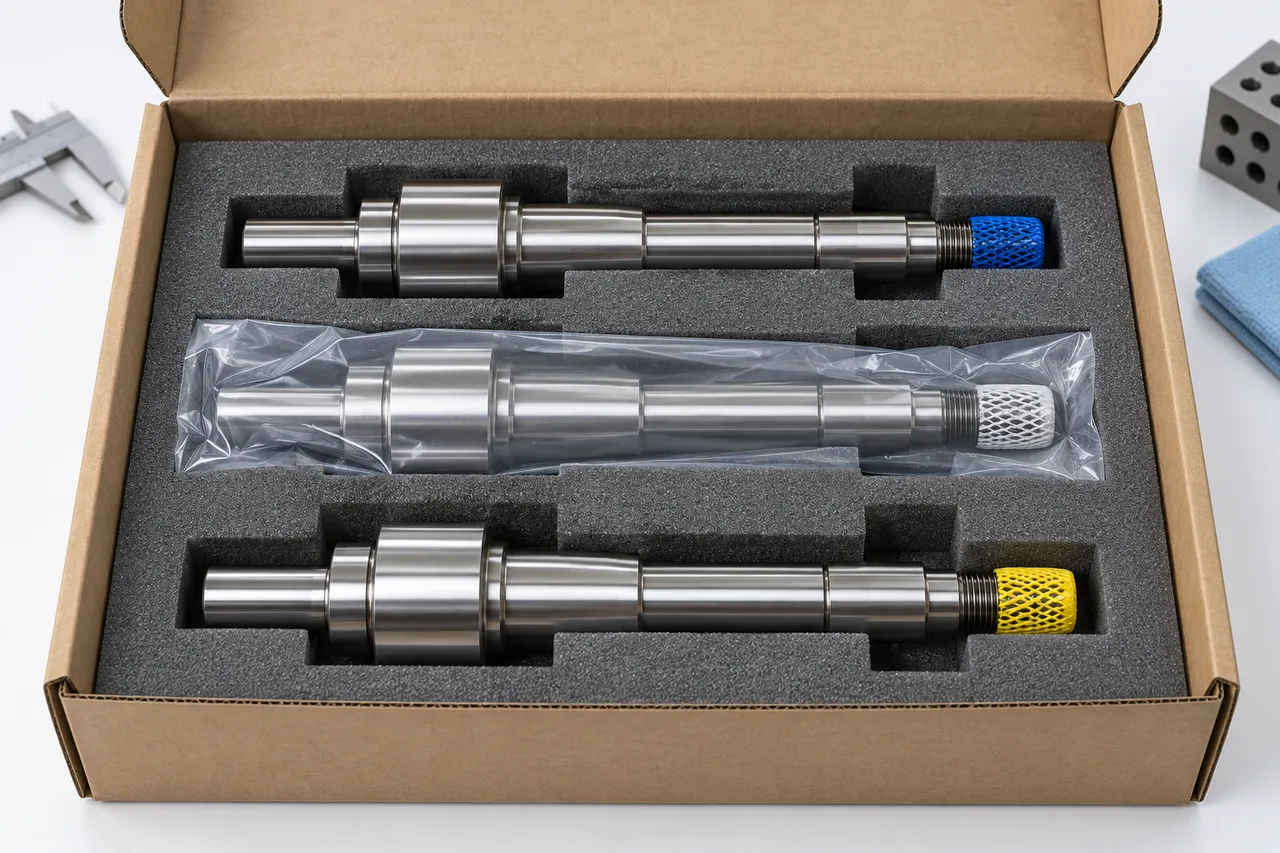
*Illustrative packaging concept. Not an actual TOPSHAFT shipment.*
Start With The Surfaces Your Assembly Depends On
Your packaging specification should identify every feature that can lose function through handling damage.
A scratch on a clearance section may be cosmetic. The same scratch on a seal track can affect sealing. A dent on a bearing journal can interfere with mounting. Damaged threads can prevent assembly, even when the shaft passed dimensional inspection before shipment.
Mark critical journals, seal tracks, splines, threads, shoulders and locating faces on the controlled drawing. State which surfaces may contact packaging. Also identify features that must remain free of adhesive, fibers or protective residues.
Connect packaging requirements with your shaft surface finish specification. Roughness requirements describe the manufactured surface. They do not automatically define acceptable scratches, corrosion or transport marks. Those acceptance conditions need separate agreement.
For a first article, request a packaging review alongside the dimensional report. Photographs should show supports, separation, caps and the closed package. A photograph of the outer carton alone cannot establish how the functional surfaces are protected.
Separate Shafts And Control Their Movement
Each shaft should be restrained so neighboring parts cannot strike or rub against its critical surfaces.
Loose metal parts can move during handling. Smooth steel surfaces become abrasive contact points when grit enters the package. Threads, keyway edges and spline teeth can damage neighboring journals.
Individual pockets, sleeves, partitions or shaped supports can reduce this risk. Select them around shaft mass, geometry and shipping conditions. The support must remain effective after the package is lifted, tilted or compressed.
A close-fitting pocket is not automatically a good design. Excessive pressure can make removal difficult or load a delicate feature. Too much clearance permits movement. Review both the restraint and the unpacking method.
Choose contact locations deliberately. Avoid using a precision seal track as the default support merely because it is cylindrical. Review whether support pressure, trapped particles or packaging texture could mark the surface.
For long shafts, define supports that limit movement and inappropriate bending loads. Do not assume end supports alone suit every geometry. The arrangement depends on stiffness, mass distribution and handling. Link the review to your shaft straightness requirements.
Protect Threads, Splines And Exposed Ends
End protection should prevent impact without introducing contamination or obstructing safe removal.
Protective caps can help shield external threads and vulnerable ends. Confirm cap size, retention and material. A cap that falls off during transport offers little protection. A tight cap can damage a surface or become difficult to remove.
Spline teeth and keyway edges need separation from neighboring parts. Protective sleeves may suit some geometries, but they must not trap loose particles. Avoid placing pressure-sensitive tape directly on functional surfaces unless you approve its adhesive and removal process.
Bores and internal threads may require plugs. Define whether these are transport protectors, cleanliness barriers or both. Their material and fit must suit the feature. Make them visible enough that the receiving team can identify and remove them.
Count removable protectors during packing and unpacking where missing pieces could enter an assembly. Include a removal note when a protector could be mistaken for a permanent part.
For mixed shaft designs, avoid one universal cap selected solely for convenience. Different end geometries may need different protection. Confirm the actual part revision during the packaging trial.
Specify Temporary Corrosion Protection Separately
Temporary corrosion protection should match the metal, shipping exposure and downstream assembly process.
An outer carton does not establish a controlled corrosion environment. Temperature changes and humidity can create conditions that threaten exposed steel surfaces. Storage at intermediate warehouses also matters.
State the material and surface treatment before selecting a protection method. Carbon steel, stainless steel, plated surfaces and mixed-metal assemblies can have different requirements. Do not approve a product simply because its label says “rust prevention.”
VCI means volatile corrosion inhibitor. Suitable materials release active substances within an enclosure to help protect compatible metals. FUCHS describes VCI protection and emphasizes clean, dry parts, temperature acclimatization and properly closed packaging. Follow the selected product's instructions rather than applying one universal rule. See the FUCHS VCI guidance.
Protective oils or films may also be considered. Their acceptability depends on surface compatibility and your cleaning process. A coating that protects shipment may interfere with adhesive bonding, coating, assembly or inspection if residues remain.
Agree the protection period and expected storage conditions. A calendar duration without environmental assumptions is incomplete. Ask how opened packaging should be restored. Define who supplies the required materials after receiving inspection.
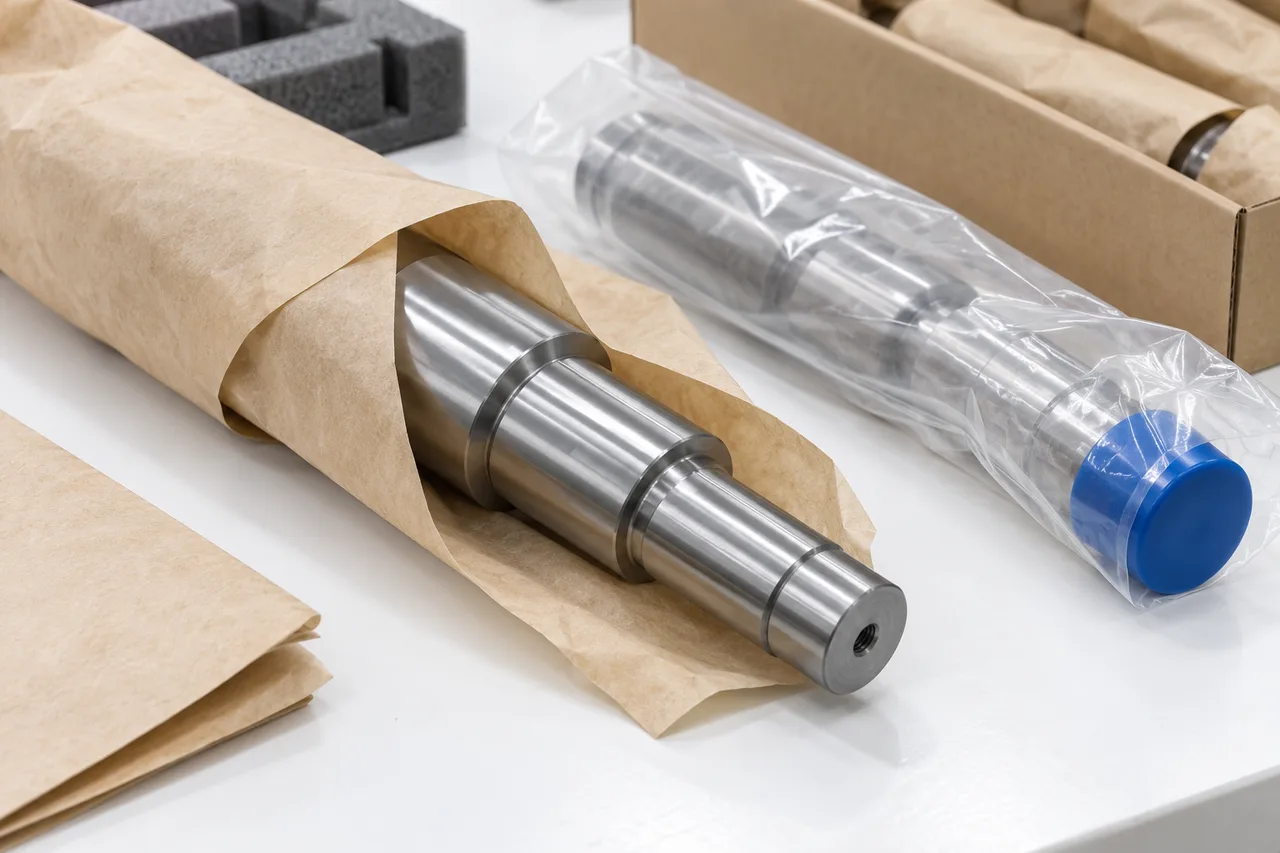
*Illustrative preservation materials. Product selection requires compatibility review.*
Treat Moisture Control As A Packaging System
Desiccant, barriers and closures must be selected together to control moisture effectively.
A desiccant sachet placed in an open carton cannot be assumed to protect precision steel throughout shipment. Its useful capacity depends on the enclosure and moisture load. Barrier materials and closure quality also affect performance.
If your protection plan uses desiccant, specify its type, required quantity and placement through the packaging review. Prevent sachets from abrading critical surfaces. Consider access for replacement if the package will be opened before final use.
Never seal visibly wet parts and expect packaging additives to correct the problem. Review drying after cleaning, temperature before packing and exposure between operations. Cleanliness and dryness must be established before the protective enclosure is closed.
SKF's storage guidance discusses condensation risks associated with humidity and temperature changes. It supports reviewing the shipping and storage environment. It does not establish a universal storage limit for custom shafts. See SKF delivery and storage guidance.
Record the packaging date when your protection period depends on it. Define what inspection or repacking is needed when the agreed period expires. This is especially useful when spare shafts may remain in stock.
Match Packaging To The Shipping Route
Your packaging design should reflect the expected handling, transport and storage conditions.
An express parcel faces different handling from a palletized shipment. Sea freight can involve longer transit and intermediate storage. Air freight does not eliminate transfers, impacts or temporary exposure.
Describe the route during quotation. Include package mass, destination handling and whether cartons will be stacked. Identify any customer handling limits. Heavy shafts require an outer structure that supports both safe lifting and part protection.
For a crate or pallet, review how restraints transfer loads into the structure. The outer package should not rely on a precision shaft as a structural brace. Define the loading direction and unpacking access.
Fragile labels communicate a preference. They do not replace effective restraint. Equally, adding more cushioning does not always improve protection. Soft material may compress under heavy components and permit movement.
Discuss reusable packaging when shipments repeat between stable locations. Evaluate return logistics, cleaning, wear and inspection of the packaging itself. Reusable supports need defined replacement criteria, especially when contact surfaces deteriorate.
Compare Protection Methods By Their Function
Choose each packaging element for a specific risk rather than treating all protective materials as interchangeable.
| Element | Main Role | What You Need To Confirm |
|---|---|---|
| Individual pocket or partition | Limits contact between parts | Restraint, contact surfaces, removal access |
| Cap or plug | Shields a vulnerable feature | Retention, compatibility, removal identification |
| Approved protective film or oil | Temporary surface protection | Residue limits and cleaning method |
| Selected VCI material | Temporary corrosion protection | Metal compatibility, enclosure and product instructions |
| Barrier enclosure with desiccant | Moisture management | Barrier, closure, moisture load and capacity |
| Carton, crate or pallet | Handling and structural protection | Mass, stacking, restraint and shipping route |
Several elements may be needed together. A foam pocket addresses movement but does not automatically provide corrosion protection. A corrosion-protection bag does not establish adequate impact resistance. Your package must address both mechanisms when both are relevant.
Approve the complete arrangement instead of isolated materials. A bag can tear against a sharp edge. A cap can loosen inside a pocket. These interactions matter during the trial.
Define Cleanliness And Unpacking Requirements
Packaging should deliver parts in a condition compatible with your next operation.
Specify whether shafts must arrive ready for assembly or ready for a defined cleaning step. These are different commercial requirements. Avoid “clean” as the only instruction when residue, particles or moisture can affect function.
Where cleanliness is critical, agree the inspection method and acceptance criteria. Do not infer medical, food-contact or other regulated suitability from visually clean packaging. Application-specific requirements need separate review.
Ask whether packaging materials shed fibers or particles during removal. Review any proposed direct-contact material with your process team. Protective residues may need removal before accurate measurement of small features.
Provide unpacking instructions when restraints or protectors are unfamiliar. Explain the lifting points and removal order. A receiving team should not need to pull a shaft by a delicate feature to free it.
Keep documentation accessible without unnecessarily opening the protective enclosure. Use external identification and separately protected records where appropriate. This lets receiving staff check identity before exposing functional surfaces.
Preserve Part Identity And Traceability
Labels should link each package to the correct part, drawing revision and agreed production records.
Include part number, revision, quantity and the agreed lot reference. Add packaging date or preservation information when relevant. Place labels where handling will not obscure them.
Avoid mixing visually similar shafts without clear separation and identification. Small differences in journal diameter or shoulder position may be difficult to recognize at receiving. A correct quantity does not establish a correct configuration.
Connect the shipment reference with inspection documents when your order requires them. Confirm whether partial shipments need separate records. Discuss how samples, replacements and production parts will be distinguished.
Your precision shaft RFQ checklist should therefore include packaging and identification requirements. Leaving them until dispatch can create unexpected cost or delay.
Validate Packaging Before Repeat Production
A packaging trial should check restraint, surface protection, removal and identification using the actual part configuration.
Use representative shaft mass and geometry. Review the packed arrangement and the condition after the agreed handling evaluation. Choose evaluation methods around shipping risks rather than an arbitrary demonstration.
Inspect the same critical features before and after the trial where practical. Look for contact marks, loosened protectors, enclosure damage and movement. If deformation is a concern, use the agreed dimensional inspection method.
Record the approved configuration with photographs and material descriptions. Define which changes require review. Substituting a cheaper support or changing carton quantity can alter loads even when the outer dimensions remain similar.
For production shipments, agree a practical packaging check. Confirm separation, caps, closure, label accuracy and quantity. Establish how deviations are recorded and resolved before dispatch.
Inspect Incoming Shafts Without Losing Protection
Receiving inspection should verify condition while preserving the agreed protection for parts awaiting use.
Check the outer package for damage, moisture and identification errors before opening it. Photograph concerns before removing restraints. Retain packaging when investigating a suspected transport problem.
Inspect accessible critical surfaces using the agreed acceptance criteria. Distinguish cosmetic marks from conditions affecting fit, sealing or rotation. Do not polish a suspicious journal before documenting and reviewing the issue.
If you open a preserved enclosure, restore it according to the approved protection instructions. Record the action when traceability matters. Store accepted parts with appropriate support and identification until assembly.
When reporting a problem, provide package photographs, lot references, affected features and measured findings. These details support a useful investigation into machining, cleaning, packaging or handling.
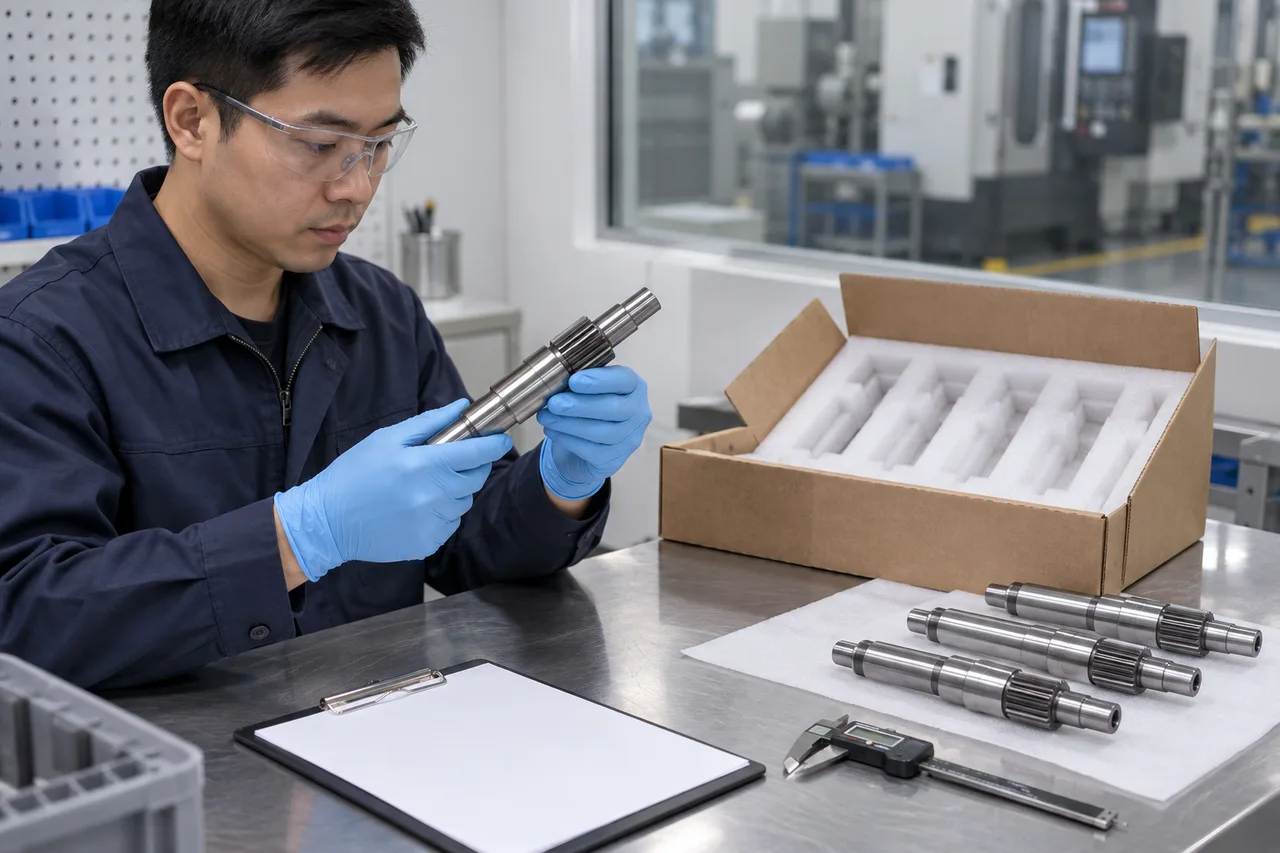
*Illustrative receiving inspection, not a photograph of a TOPSHAFT facility.*
Frequently Asked Questions
Is Bubble Wrap Enough For Precision Shafts?
It may provide cushioning, but suitability depends on mass, movement and surface requirements. Confirm separation, restraint and corrosion protection separately.
Does Stainless Steel Eliminate Corrosion Protection Requirements?
No universal conclusion follows from the material name. Review alloy, surface condition, contamination and exposure before defining protection.
Can You Use VCI Without Oil?
Some products support that approach. Confirm metal compatibility, required conditions and downstream acceptance with the protection supplier and your process team.
Must Every Shaft Be Individually Wrapped?
Not necessarily. A validated separated arrangement may be appropriate. Define the required protection outcome and review the actual configuration.
What Should You Send For A Packaging Review?
Send the drawing, critical surfaces, shaft quantity, shipping route, storage expectations, cleanliness limits and receiving process.
Request A Drawing And Packaging Review
TOPSHAFT's public service information covers drawing-based shaft manufacturing and inspection. Confirm project-specific packaging during quotation. Share your drawing and requirements, including critical surfaces, route, storage period and residue limits. The review can connect manufacturing acceptance with the condition you need at receiving.