
Shaft Rework and Concessions: Control Approval Before Release
A shaft shipment is ready except for one disputed feature. The supplier proposes polishing a journal, accepting a shallow handling mark or shipping the affected pieces under approval. Those proposals can lead to very different outcomes. Procurement needs a delivery decision, engineering needs to understand the functional effect, and quality needs evidence that the parts shipped match the authorized disposition. A short message saying approved rarely provides enough control for all three groups.
This guide explains a practical approval workflow for purchased shafts with a documented nonconformity. It is not a repair instruction or an acceptance standard. The drawing, purchase order, applicable specifications and customer authorization rules govern each case. Any proposed work and reporting scope must be agreed for the actual order; the examples do not promise that TOPSHAFT offers a particular recovery process or that an out-of-tolerance shaft can be recovered.
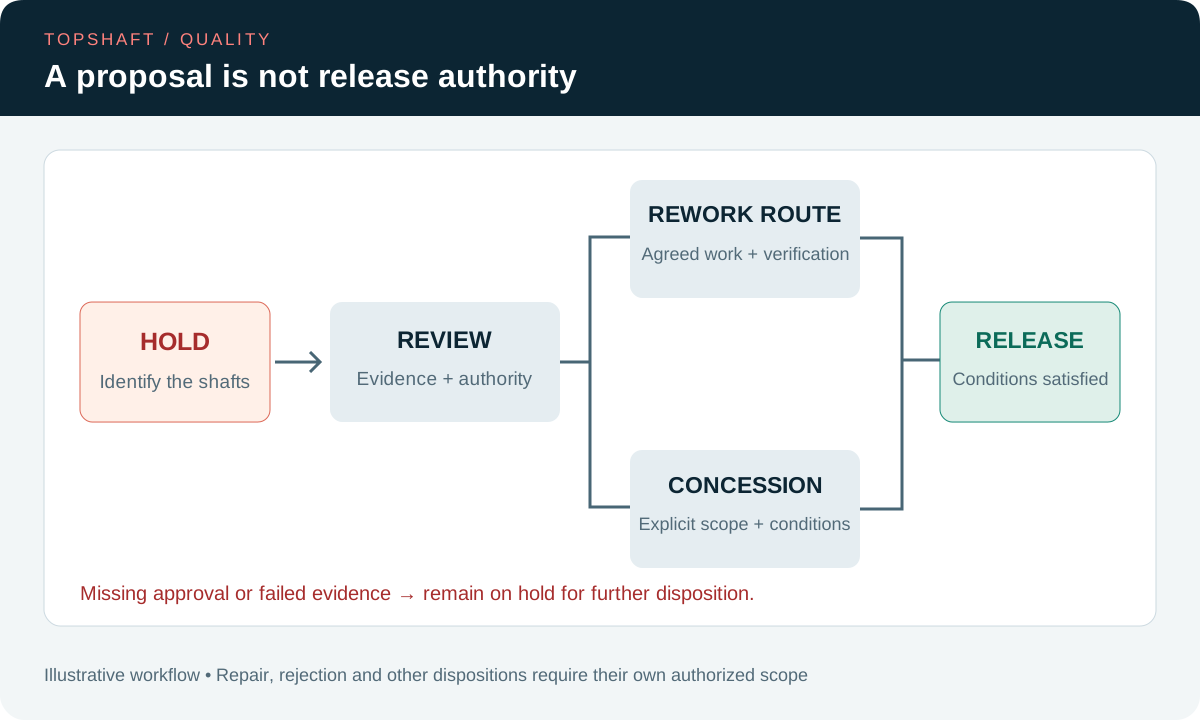
1. Define the disposition before discussing the schedule
Use distinct terms for distinct decisions. Rework aims to restore conformity to the specified requirements. Repair aims to make the item acceptable for its intended use and may leave a departure from those requirements. A concession permits an identified nonconforming item to be used or released within an authorized scope. These concepts are summarized in the ISO quality management vocabulary; they do not grant approval for an individual order.
Describe the actual operation and intended outcome rather than relying on the label. Removing material from an oversize journal might be proposed as rework if every applicable requirement will be met afterward. Adding material, changing a surface condition or accepting an undersize journal needs separate technical evaluation. Calling an operation polishing does not demonstrate that it preserves geometry, surface integrity or the specified final condition. Establish the required decision before making delivery commitments.
2. Put the affected population on a controlled hold
Identify the part number, drawing revision, order line, manufacturing lot and affected quantity. Record where the pieces are located and how conforming, suspect and confirmed nonconforming items are separated. If individual serial numbers do not exist, define a reliable container or batch identification method. An email referring to the last batch is difficult to reconcile after containers are moved, split or combined.
Keep the initial scope conservative until the inspection evidence establishes which pieces are affected. One detected result does not automatically prove that every shaft has the same condition, and one acceptable result does not clear the rest. Link the containment decision to the agreed shaft inspection sampling plan. Record any shipment already made and the responsible customer contact when the same issue could extend beyond the held material.
3. Describe the requirement and the actual departure
State the drawing requirement, its units, the measured or observed result, and the inspection method. Include relevant setup information and the condition of the part at measurement. For a diameter, identify the axial location and measurement direction when they affect interpretation. For a visual condition, use a photograph with a scale and a clear feature location. Avoid replacing evidence with vague descriptions such as slightly small or minor scratch.
Use the same characteristic identifier in the issue record, drawing markup and final report. The characteristic numbering guide explains that connection. If the result is disputed, preserve the original reading and arrange a controlled verification rather than silently replacing it. Resolve unit, revision, setup or measurement uncertainty questions before choosing a physical correction. A reporting mistake and a confirmed product defect require different actions.
4. Build an approval packet that supports a decision
The packet should let an authorized reviewer understand the affected population, proposed action and release evidence without reconstructing a long conversation. The following fields are a practical starting point. Contractual reporting forms and customer-specific requirements may add information or use different names. Keep one controlled record as the reference, with attachments identified by revision or issue date.
| Record element | Information to retain | Review question |
|---|---|---|
| Product identity | Part, revision, order, lot and quantity | Which shafts are covered? |
| Requirement gap | Specified limit and actual evidence | What is nonconforming? |
| Proposed action | Operation, affected features and sequence | What may change? |
| Verification plan | Checks, methods and acceptance criteria | How will the outcome be proved? |
| Approval scope | Authority, conditions and quantity or time limits | Who can authorize release? |
Include both the before-work evidence and the proposed after-work checks. An attached photograph can help locate the issue, but it cannot replace a diameter result, a surface specification or a required material record. If a reviewer needs more data, keep the disposition pending and identify the missing evidence explicitly. Urgency does not resolve an undefined technical question.
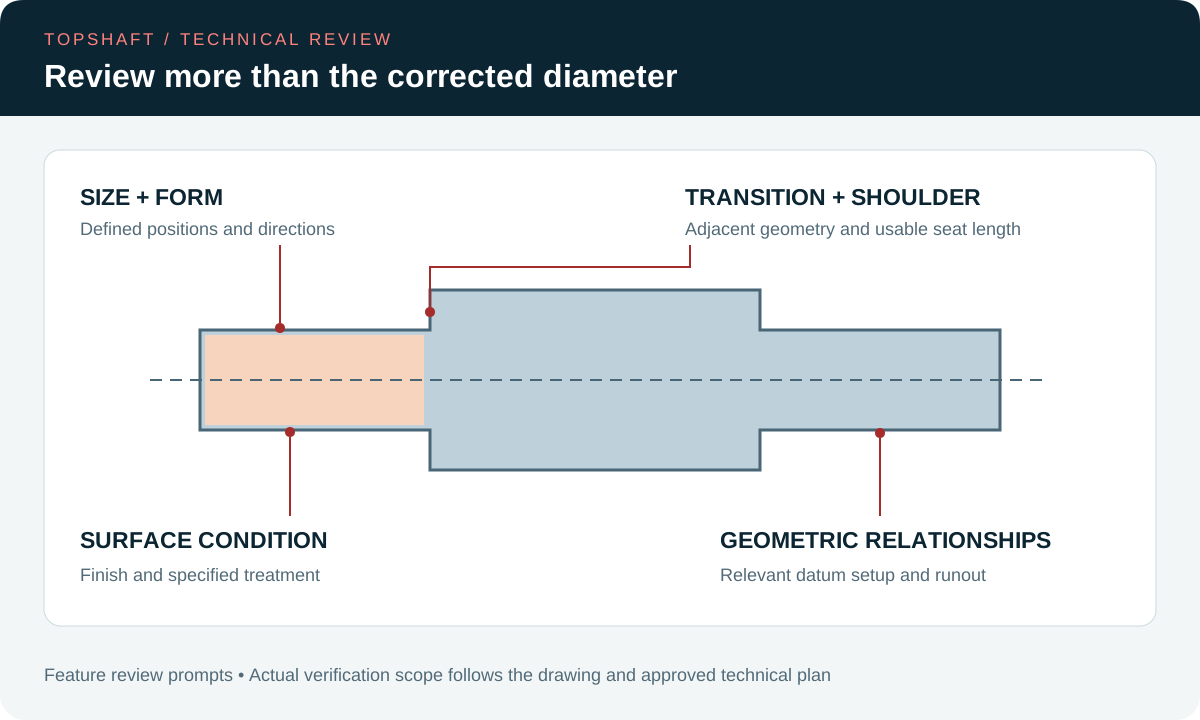
5. Evaluate the effects beyond the original defect
A local operation can affect features that were previously acceptable. Review size, form, location, transitions and surface condition as relevant to the actual process. Removing material near a shoulder may alter the usable bearing seat length or its transition. Work on a coated or hardened surface may change the condition required by the drawing. These are review questions, not a statement that every operation causes every effect.
Ask the proposed process owner to identify the potentially affected characteristics and the basis for the verification plan. Use the existing shaft surface finish guidance and heat treatment specification guide to prepare questions, while retaining the actual drawing as the acceptance reference. Do not infer a remaining hardened depth, fatigue capability or corrosion performance from a final diameter measurement alone. Escalate unresolved functional effects to the responsible design authority.
6. Agree the work instruction and the authority boundary
Define the authorized operation, responsible party, sequence, limits and required checkpoints before work starts. State whether customer approval is required before processing, before shipment or at both stages. Internal approval to prepare a proposal is different from customer authorization to change or accept product. A purchasing contact may coordinate the request without having authority to accept an engineering departure; establish the appropriate signatories for the order.
If the agreed instruction changes during execution, stop the affected activity and obtain the necessary revised authorization. A proposed second pass, a different process or a larger affected quantity may fall outside the original decision. Record who changed the instruction, why it changed and which pieces had already been processed. Preserve the distinction between an approved plan and completed work that has passed verification. Neither document substitutes for the other.
7. Example: an oversize journal awaiting disposition
Consider an illustrative journal specified as 25.000 to 25.010 mm, with a confirmed result of 25.018 mm. The result is 0.008 mm above the upper limit. A supplier proposes removing material to restore the required diameter. That arithmetic identifies the size departure; it does not establish an acceptable machining allowance, prove the proposed process is suitable or authorize the work.
The reviewer also needs to know the original surface condition, applicable geometry requirements and the features the operation may affect. The agreed plan might require checking diameter at defined positions, the relevant runout and the specified surface finish after processing. The exact checks depend on the drawing and technical review. If the final diameter is acceptable but another applicable requirement is not, the piece has not demonstrated complete conformity through the rework route.
8. Reinspect against the approved outcome
Record the executed operation and link the resulting evidence to the affected pieces. Reinspect the corrected characteristic and the other characteristics identified in the approved plan. Use the required measurement methods and acceptance rules; do not create a new limit after seeing the result. Where the agreed evidence requires more than dimensional inspection, obtain that evidence before declaring the disposition complete.
Retain original and final results with clear status rather than overwriting the initial report. A reviewer should be able to distinguish detected condition, authorized action and verified outcome. If a final result fails or the required evidence is missing, return the pieces to controlled hold for further disposition. Repeating work without reviewing its accumulated effects can move the product beyond the scope that was originally assessed.
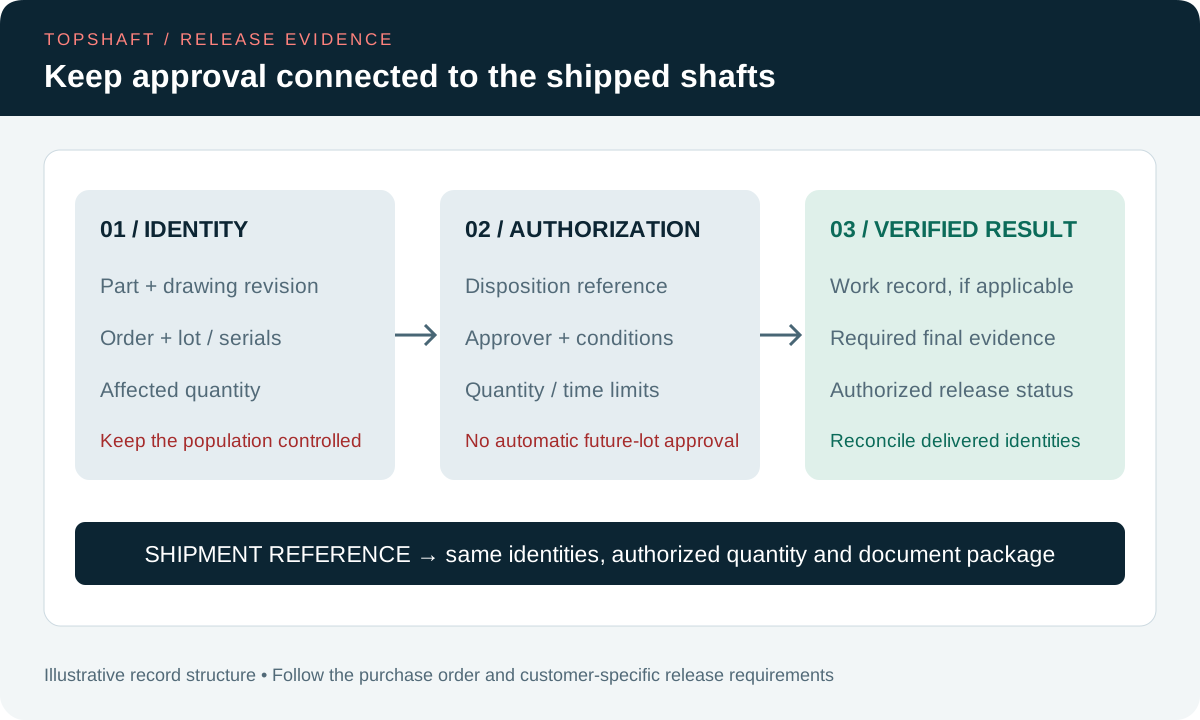
9. Make a concession specific enough to enforce
When an authorized concession is the chosen route, describe the accepted departure, covered identities and limits, intended use where relevant, and any additional conditions. A permission for ten identified pieces is not continuing permission for future production. Record expiry or quantity limits if applicable, and make the remaining authorized balance visible when deliveries are split. Do not present the concession as a revision of the general drawing requirements.
Connect the concession reference to the release and shipment records as required by the order. Receiving staff should be able to reconcile the delivered quantity and identity with the authorization. If the customer requires a specific label, certificate statement or document package, agree that requirement before dispatch. The shaft traceability guide provides related identity considerations, but it does not establish acceptance of a nonconforming feature.
10. Close the record and control repeat orders
Before release, reconcile held, processed, accepted, rejected and shipped quantities. Confirm that the approval conditions are satisfied and that the responsible authority has authorized the next step. Keep the supporting evidence with the disposition record so a later warranty or receiving question can be answered from controlled documents. Shipment timing and technical acceptance should have separate recorded decisions when their owners differ.
Finally, consider whether the event requires a broader corrective action under the agreed quality process. Correcting these pieces does not, by itself, demonstrate that the cause of the issue has been removed. Future orders should use the current approved drawing and process requirements unless a formal change has been authorized. For a new inquiry, send the drawing and reporting expectations through the contact page; confirm feasibility and review responsibilities before committing to any recovery route.
Frequently asked questions
Does successful rework require a concession?
If the completed work restores all applicable requirements, a concession for a remaining product departure may not be needed. Customer or contractual rules can still require approval of the process or disposition before work or release. Confirm those rules rather than assuming a conforming final diameter alone closes the case.
Can procurement approve an out-of-tolerance shaft?
Only within the authority assigned for that order. Procurement can coordinate cost and delivery decisions, but a functional departure may require engineering and quality authorization. Identify the decision owner, scope and conditions in the controlled record instead of relying on a job title or an informal approval message.
Is a photograph enough to approve polishing?
A photograph can show location and visible condition. It generally cannot establish dimensional allowance, remaining surface treatment or all affected geometry. The reviewer needs the requirement, actual evidence, proposed operation and verification plan. The exact evidence depends on the feature and the contractual acceptance requirements.
Can the same concession cover the next shipment?
Only if that shipment falls within its expressly authorized identities, quantity, period and other conditions. A prior approval should not be copied to a new lot by assumption. Check the remaining scope, obtain additional authorization where necessary and retain a clear link between each delivered group and its applicable decision.