
Shaft Process Changes: Agree Approval and Requalification
A repeat shaft order uses the same part number and drawing revision, but the supplier proposes a different manufacturing route, production location or outside processing source. Procurement sees the same finished specification. Engineering and quality need to know whether the change affects the basis on which the original supply was accepted. Treating both questions as identical can leave an important gap between commercial continuity and technical control.
This guide describes a practical change review for purchased precision shafts. It does not say that every machine, tool or routine adjustment requires customer approval. The purchase order, approved process restrictions and applicable customer requirements determine the actual notification and authorization rules. Confirm those rules and the available verification arrangements for each TOPSHAFT order. The examples do not claim a particular factory configuration, subcontractor network, certification or requalification capability.
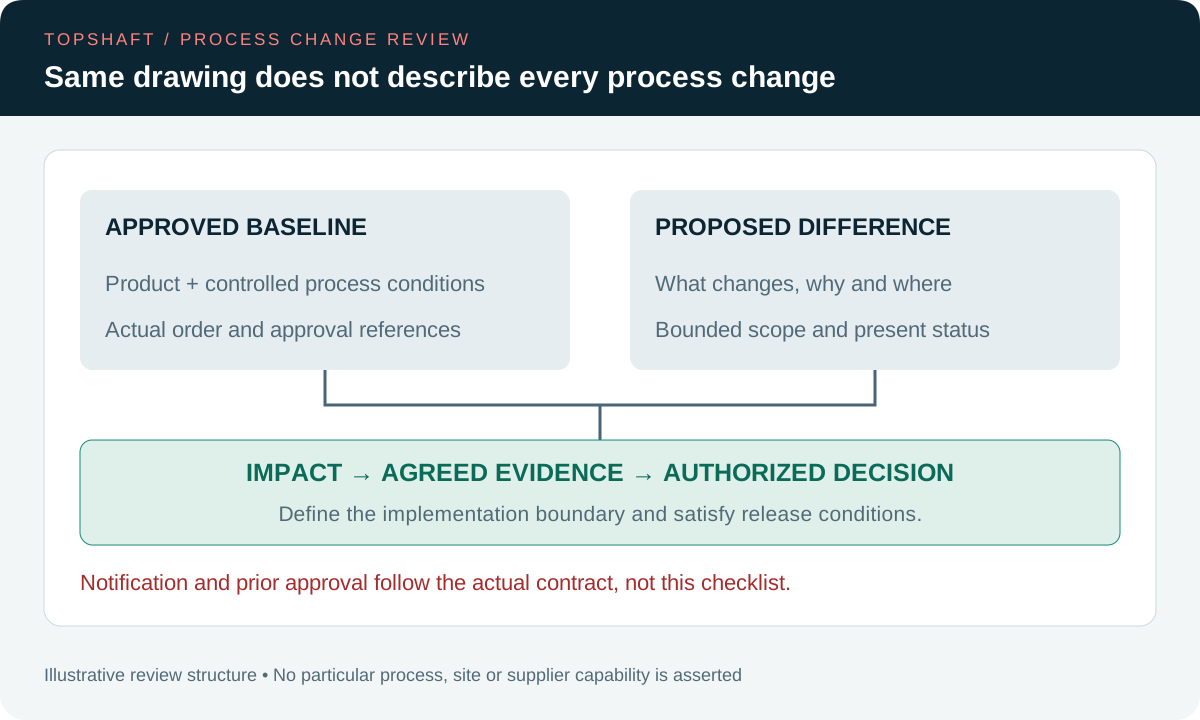
1. Define the approved baseline before comparing changes
Identify the product definition and any manufacturing conditions that form part of the approved supply basis. This may include named process specifications, customer-approved sources, agreed production locations or a qualified manufacturing route where the order actually controls them. Distinguish contractual restrictions from background information supplied for planning. An old quotation attachment is not automatically an approved restriction, nor should an explicit order requirement be treated as optional.
As background, ISO's description of configuration management guidance explains that ISO 10007:2017 addresses configuration management within an organization across the product and service life cycle. That scope supports the importance of an identified reference, but does not establish the approval rules for this individual shaft order. This article offers a practical review structure; it neither reproduces the standard nor declares that it is contractually invoked or that TOPSHAFT is certified to it.
2. Describe the proposed difference in specific terms
State what changes, why it is proposed and what is intended to remain unchanged. Relevant proposals might concern a process sequence, a controlled outside process, a manufacturing site, a material source where source approval applies, or an inspection method. A description such as equivalent process hides the information a reviewer needs. Compare the existing and proposed arrangements side by side using the actual order terminology.
Keep the scope bounded. If several changes are bundled together, identify them separately and review their combined effects. A revised sequence plus a new source may need different evidence from either change alone. Do not describe a future option as already implemented or an exploratory trial as an approved production route. The decision record should make the present status of each proposed change clear.
3. Establish notification and decision authority
Read the contract and customer-specific requirements to determine which changes need notification, prior approval or internal control only. Do not infer those obligations from a generic checklist. Identify who prepares the proposal, who evaluates technical effects and who can authorize implementation or shipment. Purchasing may coordinate cost and delivery without holding authority to accept a change to a controlled technical requirement.
Record the required decision points. Permission to perform a trial is different from permission to use its parts in a customer shipment. An approval conditional on satisfactory verification is not evidence that verification has occurred. If a requirement is unclear, obtain a controlled clarification before proceeding with the affected activity. The drawing and revision change guide addresses related document authority, while this review focuses on manufacturing changes that may leave the drawing revision unchanged.
4. Review the possible effects on product requirements
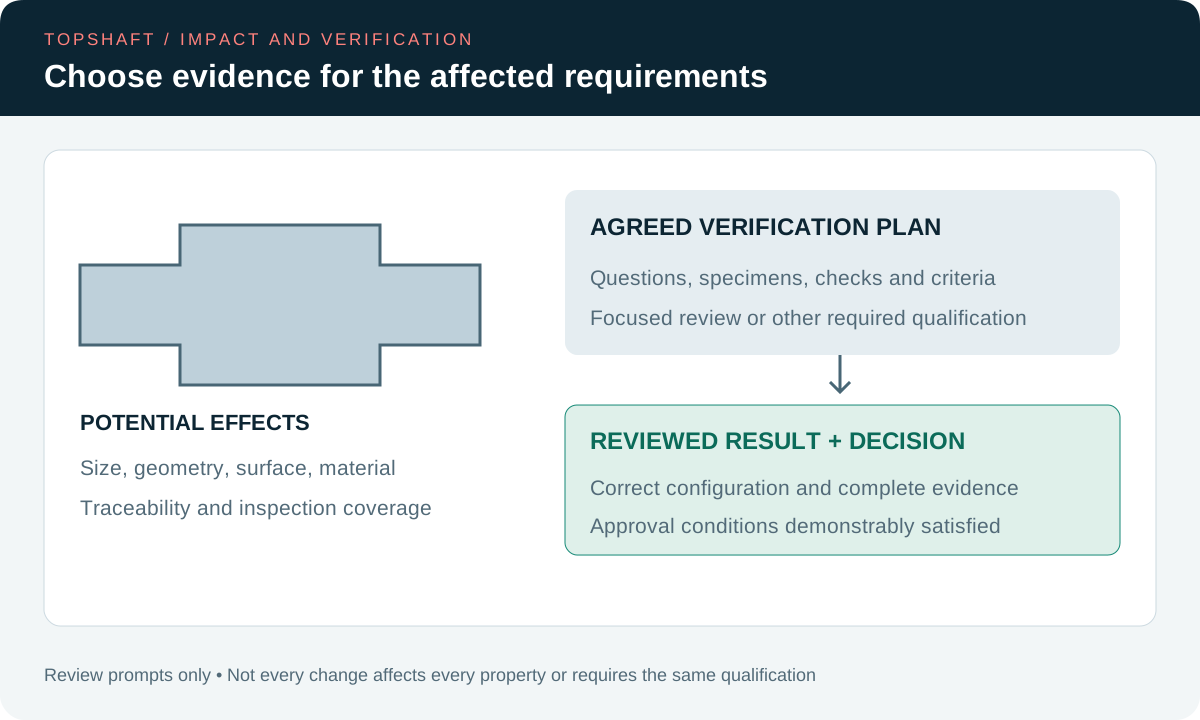
Connect the proposed change to the characteristics it could affect. Depending on the actual proposal, review dimensions, geometric relationships, surface condition, material properties, traceability and inspection coverage. These are prompts for technical assessment, not a claim that every change affects every property. The process owner and responsible engineering team should identify the relevant mechanisms and the evidence needed to address them.
For example, a hypothetical change to the order of machining and finishing operations may require review of the final condition at a bearing seat. The reviewer needs the actual route difference, applicable requirements and proposed verification; a statement that the diameter will stay the same is not a complete assessment of all potentially affected characteristics. Do not infer unchanged hardness, surface integrity or functional performance from one acceptable size reading. The necessary review depends on the specific process and product definition.
5. Agree a proportionate verification plan
Define the questions that verification must answer, then select the necessary checks with the responsible technical authority. Depending on the requirement, the plan could include dimensional inspection, review of processing records, agreed material evidence or a specified functional evaluation. It should not automatically demand every possible test, and it should not assume that the easiest available inspection proves the entire change acceptable.
Use the first article inspection guide to structure initial evidence where relevant. Confirm whether a full first article, a focused review of affected characteristics or another agreed qualification route is required. Identify the specimens, their manufacturing condition, the quantities and the acceptance rules. Do not apply a previous approval to a different route or product family without a documented basis accepted by the responsible authority.
6. Separate trial material from deliverable production
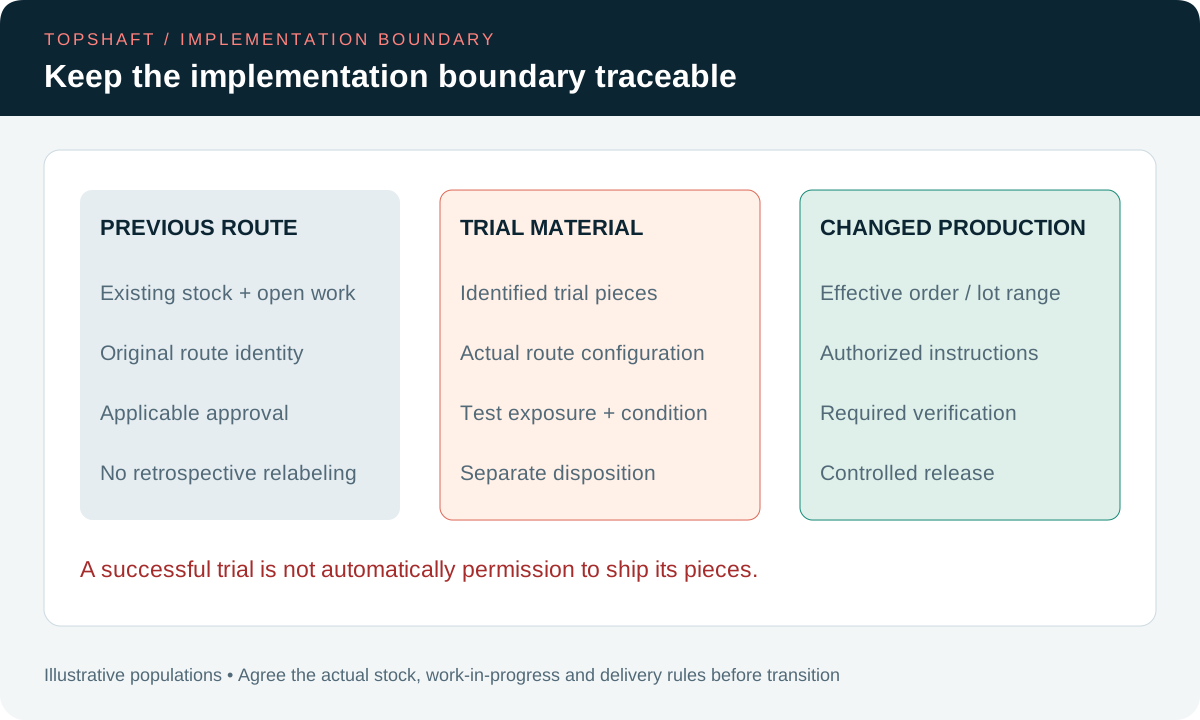
Identify trial pieces and keep their status distinguishable from released stock. Record which configuration produced them, including the actual route and relevant process record references. If trial work takes place before customer authorization is required, define that internal permission clearly and ensure it does not bypass any contractual restriction. Trial status should remain visible when pieces move between operations or inspection areas.
Agree what will happen to the trial pieces after evaluation. They may be retained, rejected, used for further testing or released only when the order permits it and all conditions are met. A successful trial result does not by itself authorize shipment. If a test consumes a specimen or changes its suitability for delivery, preserve that disposition. Keep the identities and quantities reconciled so an unidentified trial piece cannot quietly enter an ordinary production container.
7. Specify implementation boundaries and mixed stock handling
Define when the approved change becomes effective. Use a practical boundary such as an identified work order, lot, serial range or other controlled production reference. A calendar date alone may be insufficient when work in progress spans several operations. Record which pieces remain on the previous route and which use the new one, including any split or partially completed lots.
Review existing stock and open orders before implementation. Decide whether previously produced parts remain acceptable under their original approval and whether any additional customer instructions apply. Do not relabel older parts as having followed the new route. If the two configurations may be delivered during the transition, agree the required identification and shipment documentation. The material traceability guide supplies related identity principles, but it does not approve a process change or establish interchangeability.
| Review element | Information to retain | Decision supported |
|---|---|---|
| Baseline | Product definition and controlled process conditions | What is approved today? |
| Proposed change | Specific differences, reason and scope | What needs evaluation? |
| Impact and checks | Affected requirements and verification plan | What evidence is necessary? |
| Implementation | Lot boundaries, stock and work in progress | Which pieces use the change? |
| Release | Approval conditions, results and authority | What may be shipped? |
8. Update the documents people actually use
Once authorized, update the relevant manufacturing, inspection and purchasing instructions through the applicable document control process. Identify the approved revision of each affected instruction and make it available at the point of use. If a derived shop document changes while the customer drawing does not, preserve the relationship between them. The production team should not have to reconstruct the approved route from a long email conversation.
Communicate the change to the functions that need it, including outside processors or receiving inspection where applicable. Confirm that obsolete instructions are not still being used for the affected work. Record any required briefing or competence confirmation under the organization's actual process. This is a practical implementation check, not an assertion that one training form or document system is required for every shaft supplier.
9. Review verification results before closing the change
Compare the completed evidence with the approved plan and its acceptance rules. Identify missing results, departures from the planned configuration and unresolved questions. If the change was approved subject to successful checks, document that those conditions have been satisfied before authorizing the applicable release. A report containing acceptable numbers is not enough if the tested pieces were made by a different route from the one being approved.
Retain the decision, supporting records and any limits on applicability. For measurement disputes, use the agreed measurement uncertainty and acceptance approach. If product nonconformity or an unauthorized departure is confirmed, apply a controlled disposition rather than quietly treating it as part of the change approval. The rework and concession guide explains why authorization and verified outcomes must remain distinct records.
10. Confirm the basis for repeat orders and later changes
Make the accepted change status available for subsequent orders. Identify which products, routes, locations or sources the decision covers and any conditions or expiry limits that apply. A permission for one lot should not become standing approval by habit. Likewise, do not require a new review automatically when the existing authorization expressly covers the proposed repeat production; use the actual scope of the decision.
Review later differences against the current approved baseline rather than the original quotation alone. The shaft RFQ checklist helps combine delivery and reporting needs with the technical package. For a new or changed supply arrangement, send the drawing, proposed process difference and required evidence through the contact page. Confirm the applicable review responsibilities and feasible verification before treating the changed arrangement as an accepted production commitment.
Frequently asked questions
Does the same drawing revision mean no review is needed?
Not necessarily. A manufacturing change can leave the finished drawing unchanged while affecting a controlled process condition or an agreed qualification basis. Determine whether the actual contract requires notification or approval, then assess the relevant effects. Do not assume either that all changes are exempt or that every routine adjustment needs customer authorization.
Must every change trigger a full first article inspection?
That depends on the applicable requirements and the approved impact review. A full first article, focused verification or another qualification route may be appropriate. Agree the scope, specimens, checks and decision authority before relying on the result. A generic checklist cannot establish the required requalification for every shaft and process combination.
Can successful trial parts be included in the shipment?
Only if the agreed rules permit it and their identity, condition and release evidence meet all requirements. Trial completion is not shipment permission. Reconcile the pieces and record their disposition, especially if testing changed them or the trial used conditions different from the approved production arrangement.
What should a supplier include in a change request?
Include the existing baseline, proposed differences, reason, affected products and quantities, impact review, verification proposal and implementation boundary. Identify the requested decision and any unresolved questions. The customer can then evaluate the proposal against the actual order requirements instead of relying on an unsupported statement that the new arrangement is equivalent.