
Shaft Residual Magnetism: Define The Check
Shaft residual magnetism needs a defined acceptance requirement and a reproducible measurement arrangement. A request saying demagnetize before shipping leaves important questions unanswered. Specify the material condition, required limit, inspection locations and final process stage before accepting a supply commitment.
Start With The Application Requirement
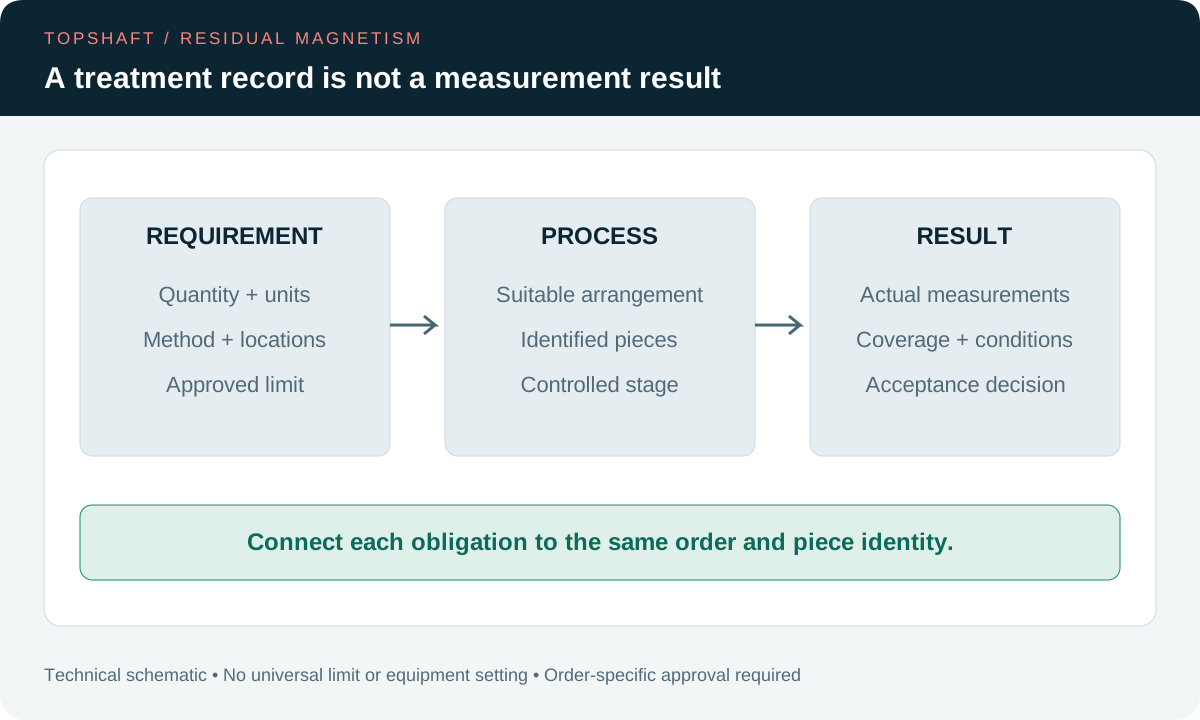
You should define why residual magnetism matters before choosing a treatment or inspection method. Your application may impose a magnetic condition at assembly or receiving. Ask the responsible engineering team to identify that requirement. Do not assume every shaft needs the same limit. A general preference for low magnetism is not a complete acceptance criterion.
Connect the requirement to the actual drawing, purchase order or customer specification. Identify the authority that can approve its interpretation. Purchasing can coordinate delivery and cost without defining an engineering limit independently. If the requirement is missing, request clarification before production. Do not let a supplier's convenient instrument range become an unintended product specification.
Keep the intended decision visible throughout the order. You may need evidence of a specified final condition, rather than proof that a particular machine operated. Alternatively, your contract may control both processing and verification. State those obligations separately. This article supplies purchasing questions, not a universal magnetic limit or an operating procedure for demagnetizing equipment.
Identify Material Condition And Magnetic Exposure
You need the actual material and manufacturing condition when reviewing a magnetic requirement. A supplier should not infer behavior from the word steel alone. Identify the specified alloy, heat treatment and relevant surface treatments. Record any controlled changes to that definition. A substitution can require another technical review, even when the finished dimensions remain unchanged.
The equipment manufacturer's measurement technology explanation describes remaining magnetization after a ferromagnetic component encounters an external magnetic field. It identifies magnetic clamping and handling among possible influences. Use that background to ask about the actual route. Do not assume every manufacturing step creates the same magnetic condition.
Review magnetic particle inspection, magnetic workholding and handling where they occur in your actual process. Include subsequent supplier or receiving operations when relevant. Your NDT requirement should identify applicable examination and post-examination obligations. Do not confuse a crack examination result with residual magnetism acceptance. They support different decisions and may need separate records.
Define The Quantity, Units And Acceptance Limit
Your specification should identify the measured quantity, units and limit before results are reviewed. Different reports may use different unit systems or instrument conventions. Ask the responsible technical team to confirm an appropriate comparison. Do not compare unexplained numbers simply because both reports mention magnetism. Preserve the original units and the approved interpretation in the record.
Distinguish the product limit from display resolution, instrument range and measurement uncertainty. Those properties answer different questions. A display reading zero does not automatically prove an absolute absence of magnetic effects. Its meaning depends on the instrument and measurement arrangement. Your acceptance statement should remain limited to the defined quantity and agreed method.
Avoid borrowing a numerical limit from an unrelated component or an equipment brochure. The responsible design or quality authority must approve the actual requirement. Include any applicable decision rule and reporting convention. If your specification invokes a standard, identify its edition and relevant requirements. This guide does not establish compliance with an unspecified standard or customer procedure.
Agree The Instrument And Probe Arrangement
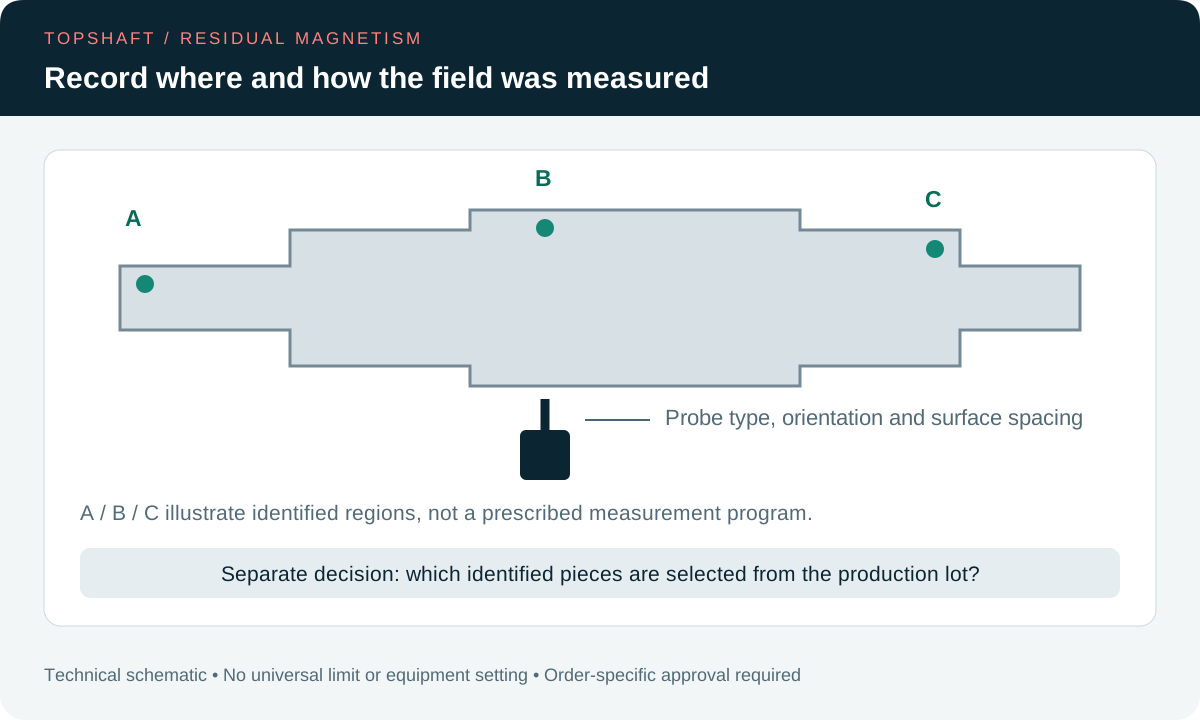
You should agree a measurement arrangement capable of supporting the required decision. Identify the instrument, probe type and relevant configuration. Confirm calibration or verification evidence as required by your procedure. Establish how the probe is positioned relative to the surface. A generic phrase such as checked with a meter may omit information needed for receiving comparisons.
The Magnaflux field indicator data sheet describes checking residual magnetism after magnetic particle testing. Its instructions distinguish external leakage field readings from flux density inside the part. That distinction limits what the reading establishes. Do not describe an external measurement as proof of every internal magnetic condition.
Follow the selected instrument's applicable instructions rather than mixing procedures from unrelated equipment. Your approved method should address probe orientation, contact or separation, and relevant surroundings. Record any required background check. Nearby magnetic influences can affect interpretation, so identify the conditions needed for reproducibility. Do not invent a correction or subtract a background value without an approved basis.
Define Surface Coverage And Lot Sampling
Your plan should separate where you measure from which pieces you select. A reading at one end does not describe every location on the shaft. Identify the required regions and search strategy through the responsible inspection team. Include accessible ends, journals, transitions or other locations when the requirement needs them. Do not present this list as a universal procedure.
Maurer Magnetic's explanation also discusses probe distance, localized magnetization and ambient field effects. These factors show why measurement conditions must accompany results. Your chosen strategy should fit the actual geometry and required decision. Record limitations such as inaccessible surfaces or assembly restrictions. Resolve them before accepting a report that implies broader coverage than was achieved.
Use your inspection sampling plan to define specimen selection across the lot. State whether results must identify each inspected piece or summarize an agreed sample. Keep lot identity linked to that selection. Thorough examination of one piece does not mean every piece was measured. Equally, measuring every piece does not repair an undefined within-part search method.
Separate Demagnetization From Final Verification
You should specify treatment and verification as separate obligations when your order requires both. A recorded demagnetization operation shows that processing occurred. It does not automatically establish compliance with the final measured limit. Define the inspection that follows and the evidence required. Keep its results connected to the pieces actually processed.
The responsible process organization should select equipment and operating arrangements suitable for the actual component. Do not prescribe settings from a generic purchasing article. Geometry, material condition and the required outcome need technical consideration. Confirm the proposed processing arrangement during quotation. This article does not claim that TOPSHAFT owns a particular demagnetizer or supports every magnetic requirement.
If a piece remains outside the agreed limit, retain its status and escalate through the approved disposition process. Repeating treatment should not erase the original result. Record the reason, responsible authorization and subsequent evidence. Avoid treating a machine cycle counter as the acceptance result. Your release decision needs the required product evidence and any contractual process records.
Place The Requirement At The Right Process Stage
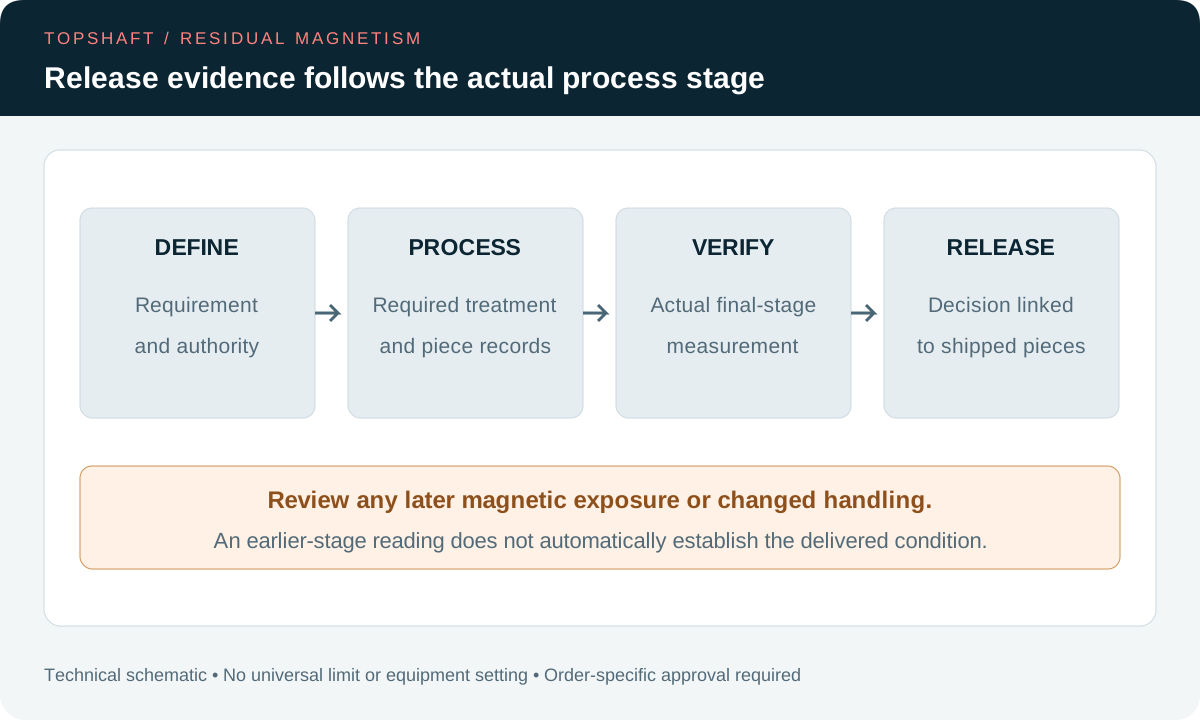
Your final verification should represent the condition your order actually requires at delivery. Review operations after demagnetization and measurement. Later magnetic contact or inspection may change the relevant condition. Identify any controlled handling restrictions through the responsible technical team. A result from an earlier stage cannot automatically certify an unchanged final state.
Coordinate this review with cleaning, protection and packaging requirements. Your shaft cleanliness specification addresses separate contamination evidence. Demagnetization does not replace cleaning, and a clean appearance does not establish magnetic compliance. Define each required outcome without assuming one operation proves the other. Confirm whether later work requires additional verification under the approved plan.
Keep delivery and receiving assumptions aligned. If the customer's handling route introduces new exposure, discuss who controls and verifies that stage. Do not promise the same reading under every future environment. Document the actual shipment acceptance condition and applicable measurement arrangement. This boundary helps distinguish a delivered nonconformity from a later change requiring investigation.
| Requirement Area | Agreement Needed | Evidence To Retain |
|---|---|---|
| Product Definition | Material condition and magnetic requirement | Drawing or specification reference |
| Measurement | Quantity, units, instrument and probe arrangement | Approved method and configuration |
| Coverage | Surface search and selected pieces | Locations, identities and limitations |
| Processing | Required treatment and manufacturing stage | Actual process record where required |
| Release | Limit, decision rule and authorization | Results linked to shipped pieces |
Investigate Different Readings Before Rejecting Parts
You should compare measurement definitions before deciding why supplier and receiving results differ. Confirm that both reports concern the same piece and condition. Compare units, locations, probe arrangement and relevant surroundings. Preserve each original record. A disagreement may reveal different measurement conditions, or it may confirm a product problem. Neither conclusion should be assumed immediately.
For example, a hypothetical supplier records an agreed end location before packaging. Receiving checks another location using a different probe arrangement. Those observations do not yet provide a like-for-like comparison. Ask both teams to reproduce the approved method on identified pieces. Record which conditions changed and what the controlled verification establishes. Do not choose whichever reading is smaller.
Use your agreed measurement uncertainty approach when it affects conformity evaluation. Do not create a new acceptance margin after seeing a disputed value. If a confirmed issue needs additional processing or concession, obtain the required authority. The rework and concession guide separates proposed action from authorized release. Preserve that distinction when delivery pressure increases.
Request Traceable Results And A Clear Disposition
Your report should identify the part, revision, lot and inspected specimen as required by the order. Include the inspection stage and applicable requirement reference. Record the quantity measured, units, instrument and relevant probe arrangement. Describe actual coverage and limitations. Where individual locations or images are required, link them to the same controlled record.
State incomplete work clearly. A blank result should not be interpreted as an acceptable condition. A treatment record should not silently fill a missing verification entry. Retain approved clarifications and repeated measurements with their reasons. Receiving personnel should understand what was established and what remains unresolved. Ask the authorized reviewer to document any disposition needed before shipment.
Reconcile processed, inspected, held and released quantities. Keep affected pieces distinguishable until the required decision is complete. Do not replace an original failed result with a later result without retaining the history. Your traceability arrangements should maintain the identity connection. Identification supports the decision, but does not itself prove magnetic conformity.
Prepare A Feasible TOPSHAFT RFQ
You should send the full magnetic requirement before treating demagnetization as an accepted service commitment. Include the released drawing, material condition and required manufacturing stages. Provide the limit, units, measurement method and surface coverage where already defined. Add order quantity, lot sampling and report expectations. Identify unresolved technical questions explicitly instead of leaving the supplier to invent answers.
Ask TOPSHAFT to confirm the actual processing and verification arrangement for your inquiry. This article verifies no specific machine, instrument, certification or quantitative magnetic capability. Any proposed internal or external processing requires order-specific review. If the requirement cannot be supported, resolve that limitation before acceptance. A confirmed scope offers more useful assurance than a broad unsupported capability claim.
Review cost and scheduling factors during quotation. Geometry, handling, equipment access, specimen selection and reporting can affect the proposed arrangement. Do not assume a universal price or turnaround. For repeat orders, confirm that material, route and acceptance requirements remain applicable. Use the shaft RFQ checklist to assemble the commercial and technical package before committing to manufacture.
Frequently Asked Questions
Your answers should follow the actual order, material condition and agreed measurement procedure. These questions clarify decision boundaries rather than prescribe universal magnetic limits.
Does Demagnetized Mean Absolutely Zero Magnetism?
Not as a complete purchasing definition. Specify the measured quantity, method and acceptance limit. A displayed zero has meaning within its measurement arrangement. Do not extend it to every location, instrument or internal magnetic condition.
Can You Use The Same Limit For Every Shaft?
You should not assume a universal limit. Application requirements, material condition and the agreed verification basis determine the actual specification. Ask the responsible engineering authority to approve it. Do not copy an unrelated component's limit into your order.
Does Magnetic Particle Inspection Prove Magnetic Acceptance?
Not automatically. The examination result concerns its specified defect detection requirement. Any required post-examination demagnetization and residual field verification need their own agreed evidence. Keep those results distinct in the release record.
Can Receiving Repeat The Check With Another Meter?
Only a suitable agreed comparison can support the same acceptance decision. Instrument and probe differences may change interpretation. Compare method, location, orientation and surroundings first. Resolve any required method change through the responsible technical authority.
Send Your Magnetic Requirement
You can prevent ambiguity by defining treatment, measurement and release evidence before production. Contact TOPSHAFT with your drawing and magnetic requirement. Ask for confirmation of the actual processing arrangement, inspection scope and reporting responsibilities.