
Shaft Storage Preservation: Corrosion Control, Reinspection and Release
A precision shaft can pass its final inspection and still arrive at assembly with an uncertain surface condition after months in a warehouse. The issue is not always transport damage. Packages may be opened for counting, protective films may be removed for measurement, and temperature changes may occur after the original acceptance. A record saying inspected at manufacture does not establish the condition of every surface at the later release date.
This article completes the November 2 editorial update and was published on November 3, 2026. It helps OEM buyers and engineers define storage preservation separately from shipping protection. The guidance is a planning framework, not a universal shelf life, humidity limit or rust-preventive product recommendation. Approve the method for the actual material, surface treatment, assembly needs and storage route, and confirm the available scope with TOPSHAFT.
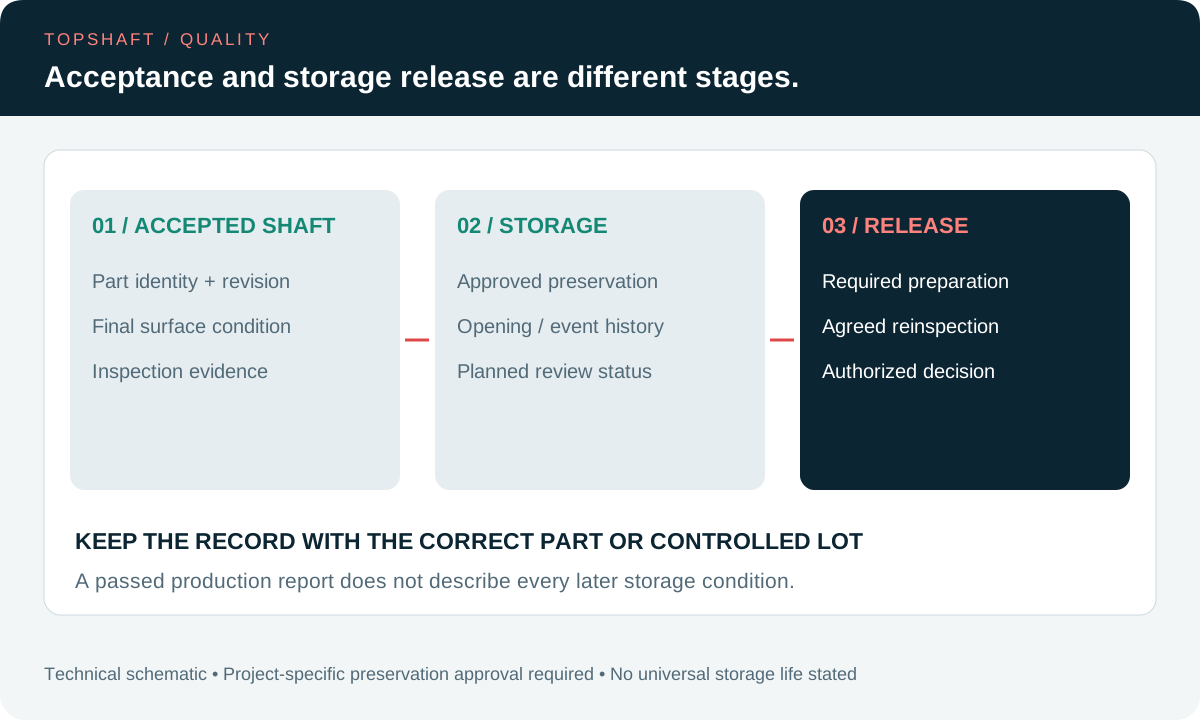
1. Define the Storage Interval and Its Owner
Start by identifying where storage begins and ends. A shaft may wait at a supplier, distributor, customer warehouse and assembly area. Each transfer can change who controls the package and who is permitted to open it. State the intended interval, expected locations and responsibility for review. Do not assume that a supplier's dispatch protection automatically covers an unspecified period in a different environment.
Separate the planned interval from an approved extension. If the customer may hold spare shafts for longer than the initial production schedule, discuss that need before quotation. The preservation approach and review evidence may differ from an immediate-assembly order. Avoid converting a convenient date on a box into an unconditional guarantee that the part needs no further assessment until that date.
Assign responsibility for maintaining the record after delivery. The receiving organization should know who checks package integrity, reviews storage conditions and authorizes release. Where responsibilities change, include a clear handover. A preservation plan that ends at dispatch leaves the customer to guess what to do when a package has been opened or the planned review date has passed.
2. Identify Surfaces and Materials That Need Protection
List the material condition and final surface treatments for the supplied shaft. A shaft may combine ground journals, threaded regions, bores, coated areas and marking zones. These surfaces need not have identical cleaning or preservation requirements. Review the actual part rather than selecting one method solely from a general material family or a photograph of another product.
Give particular attention to interfaces that depend on an approved final surface. A visible deposit on a seal track, corrosion indication on a bearing journal or residue inside a bore can require different investigation. This does not mean every discoloration is automatically rejectable. Define the applicable surface requirement and disposition process, including the authority that decides whether further inspection is needed.
Do not treat stainless steel or a specified coating as permission to ignore storage. The material name alone does not describe all environmental exposure or handling conditions. Equally, do not apply a generic corrosion treatment that changes a specified surface without approval. The material selection guide supports the broader material discussion; storage compatibility still needs its own review.
3. Approve Preservation Compatibility Before Application
Specify or approve the preservation method and its limits. Possible approaches depend on the actual project and can include a compatible temporary film, controlled enclosure or another agreed system. Naming a general product category does not establish suitability for every coating, elastomer, adhesive or assembly process. Obtain the relevant product information and resolve compatibility with the design and manufacturing requirements.
State whether protective material remains during assembly or must be removed. If removal is required, define the acceptable cleaning process and the condition expected afterward. Do not assume an operator can use any solvent or abrasive that removes visible residue. Cleaning can affect a coating, marking, surface texture or cleanliness requirement even when the shaft looks brighter afterward.
The order should identify who applies the protection and who supplies the instructions for later removal. If the customer specifies the product, keep its approved identity and relevant revision with the job record. If the supplier proposes an alternative, obtain approval before substitution. The coating specification guide helps distinguish permanent treatments from temporary storage protection.
| Storage requirement | Question to resolve | Record to retain |
|---|---|---|
| Planned interval | Where and for how long is the shaft held? | Storage plan and review date |
| Protection | Is the method compatible with the final part? | Approved method and product information |
| Package opening | Who may open, inspect and reseal? | Opening and restoration record |
| Environment | What conditions and events require review? | Agreed monitoring or event evidence |
| Release | What inspection and authorization are needed? | Release decision linked to the part |
4. Review the Warehouse Environment as a System
Consider moisture exposure, temperature changes, cleanliness and proximity to activities that can contaminate packages. The appropriate controls depend on the part and preservation system. Do not prescribe a universal warehouse limit from an unrelated product table. An environmental specification should explain what is monitored, where it is observed and what action follows a departure from the approved conditions.
NSK's bearing handling guidance notes that poor storage conditions can reduce the effectiveness of corrosion prevention. Its corrosion troubleshooting page includes moisture condensation during storage among bearing corrosion causes. These are bearing references, not a shaft-specific shelf-life specification; their relevance here is the need to review the actual storage environment.
Include transitions between environments. A package can move from a cool store to a warmer assembly area before opening. The approved handling instruction should address relevant temperature and moisture concerns rather than assuming that reaching the destination means the part can immediately be unpacked. Any waiting or preparation requirement must come from the actual preservation and assembly plan, not a generic number of hours in this article.
5. Control Opening, Inspection and Resealing
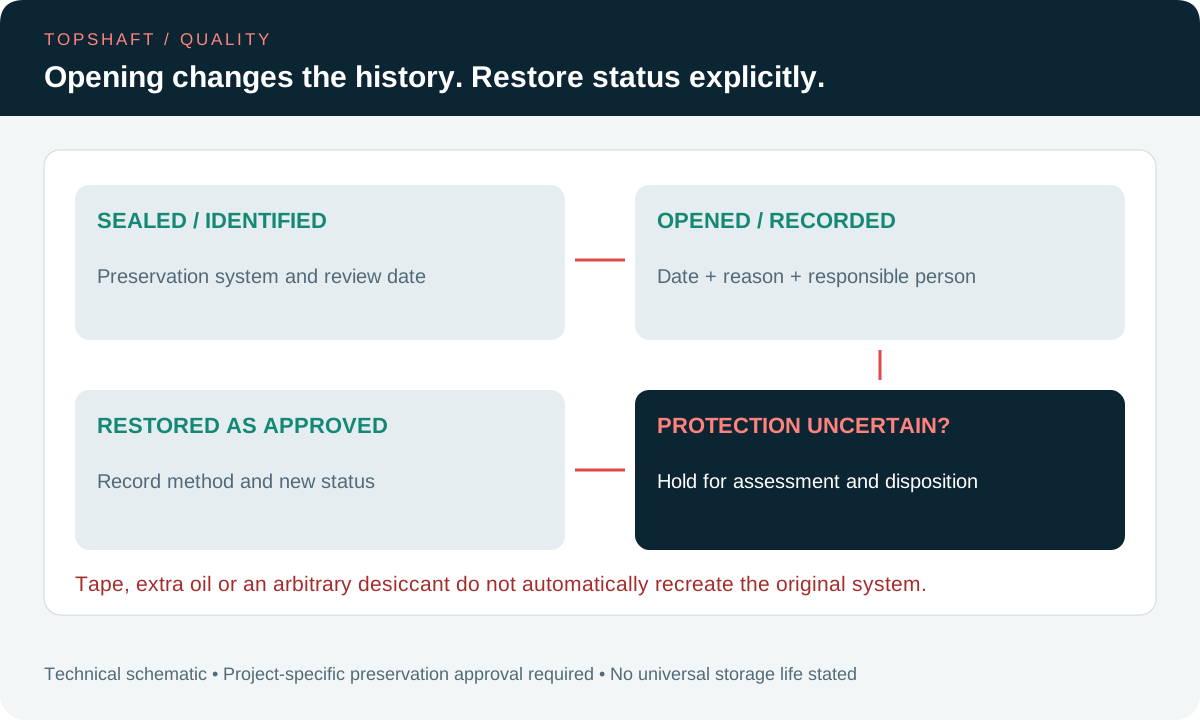
Define which activities require opening the package and how protection is restored afterward. Counting, sampling and identification checks may not all require the same exposure. Where inspection can be performed without disturbing the protective system, define that approach. Where opening is necessary, record the part identity, date, reason and responsible person sufficiently for later review.
An opened package should not silently retain the same status as an untouched one if the protection depends on a closed enclosure. Assess the actual change and follow the approved restoration procedure. Do not assume that adding tape, inserting an arbitrary desiccant or applying extra oil recreates the original system. The required response depends on how the protection works and what the project has approved.
Keep inspection preparation separate from storage restoration. A film removed to measure a journal may need to be reapplied before return to stock, but only through the agreed method. The shaft cleanliness guide helps define the presented condition and cleaning evidence. A clean measurement surface and a preserved storage surface are different stages that should be identifiable in the record.
6. Keep Identity and Review Dates With the Part
Preservation records should remain associated with the correct part or controlled lot. Include the drawing revision or other required configuration identity, application or packing date, opening history and next review status. The exact fields depend on the contract. A single loose warehouse note is not enough if similar shafts can be separated from their packages and mixed later.
Use a defined inventory rotation and review process rather than relying on staff memory. This does not mean every part has the same expiration date. The required review can depend on the approved preservation method, exposure and intended use. Distinguish a review date from a mandatory scrap date, and identify who decides whether continued storage or release is acceptable.
If identifiers or labels become unreadable, contain the affected stock until the association can be established through the approved process. Do not assign a familiar material certificate to an unidentified shaft because its dimensions look similar. The part marking guide explains the separate relationship between physical identification and the records it is meant to retrieve.
7. Define Reinspection Triggers Before They Occur
Agree the events that require a review. These can include a damaged enclosure, evidence of moisture, unexplained surface indications, loss of identification or storage beyond the approved plan. The list should reflect the actual system. An event should prompt assessment and disposition rather than an automatic assumption that every part is either acceptable or irrecoverably damaged.
State what the review evaluates. It may involve package condition, accessible surfaces, preservation records or additional inspection approved for the concern. Do not promise that a quick visual check verifies every dimension, hidden surface or material property. The visual inspection guide helps define observation conditions and the escalation of uncertain findings.
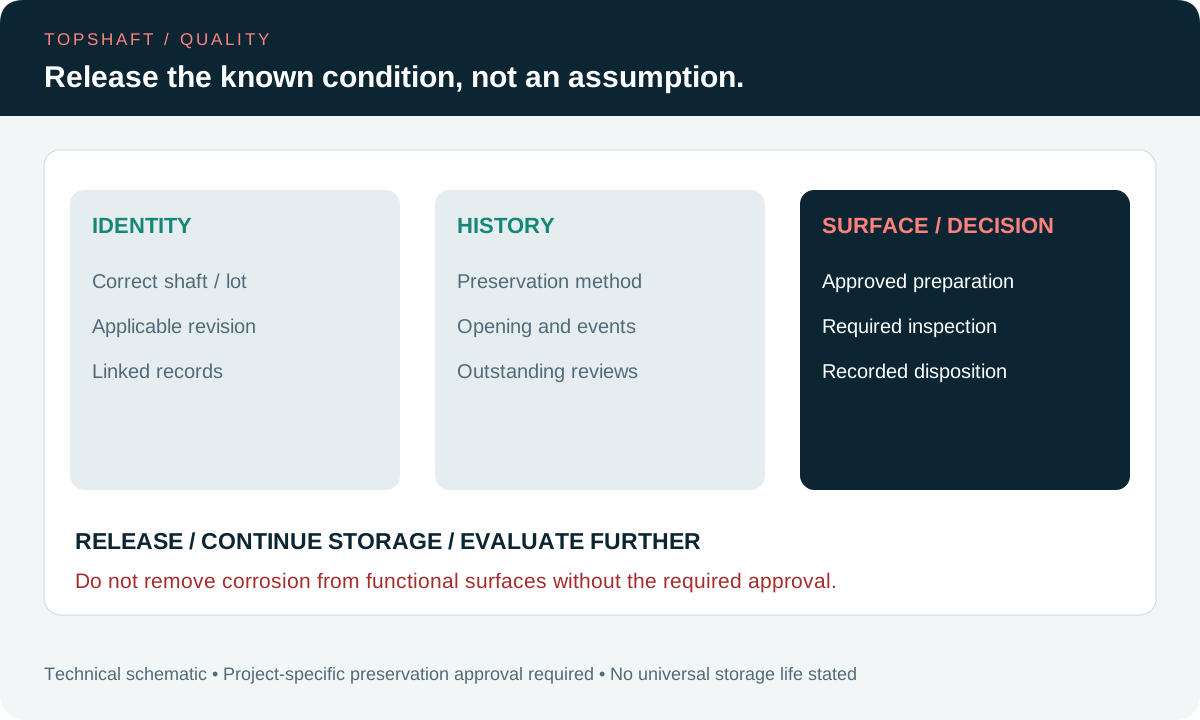
Record the outcome as continued storage, release, further evaluation or another approved disposition. Identify any required restoration and the new review basis. Do not simply move the old date forward without evaluating what changed. A revised label should be supported by a decision that explains why the new status is appropriate for the affected stock.
8. Avoid Unapproved Corrosion Removal
A corrosion indication should not trigger informal polishing until the surface looks acceptable. Material removal can change a journal size, local texture, coating or sealing behavior. First preserve the identification and evidence, define the concern and obtain the necessary authorization. The person cleaning the part should not be left to decide how much of a functional surface may be removed.
An approved recovery plan should state the permitted work and the inspections needed afterward. A visual improvement is not automatically restoration of every drawing requirement. Keep the original finding and final disposition linked to the affected parts. Where recovery is not approved or cannot demonstrate the required condition, follow the agreed nonconformance process instead of concealing the indication beneath fresh protection.
9. Release to Assembly in the Required Condition
Before release, confirm the part identity, applicable records, package history and any outstanding review. Carry out the agreed removal of protection and inspection in the specified condition. The receiving or assembly team should know whether a remaining film is intentional, whether a cleaning step is still required and which records support the release decision.
Do not equate release from the warehouse with approval of an assembly procedure. Interference fitting, sealing and other operations retain their own requirements. The bearing interference-fit assembly guide addresses a separate interface question. The storage release record should state what it establishes without implying that it approves every subsequent operation or operating condition.
10. Put Storage Requirements in the RFQ
Provide the expected holding interval and locations, material and treatment definition, sensitive surfaces, proposed preservation method and removal needs. Add opening permissions, environmental review expectations, identity fields and reinspection triggers. Ask the supplier to identify any assumptions or alternatives explicitly in the quotation, especially when the requested storage period differs from ordinary dispatch and immediate assembly.
For custom shafts, send the package through TOPSHAFT contact and confirm the actual preservation and inspection approach for the order. This article does not promise a particular inhibitor, warehouse environment or storage warranty. The precision shaft RFQ checklist helps assemble remaining requirements, while the packaging guide covers the separate transport-protection discussion.
FAQ
Does final inspection establish unlimited storage life?
No. It records the condition evaluated at that stage. Later storage, opening and handling need the approved preservation and review process. Do not infer an unlimited interval from a passing manufacturing report.
Can every shaft use the same rust preventive?
No. Confirm compatibility with the material, treatment, cleaning and assembly requirements. A familiar product category is not approval for every finished surface or downstream process.
Does an opened package always mean rejection?
No. It requires the response defined for the actual preservation system. Record what happened, assess protection and follow the approved restoration or inspection decision rather than assuming either automatic acceptance or automatic scrap.
May surface rust simply be polished away?
Not without the required approval. Review the effect on functional geometry, texture and treatment, authorize any recovery and complete the specified reinspection before release.