
Shaft Charpy Impact Test Requirements: Define The Conditions
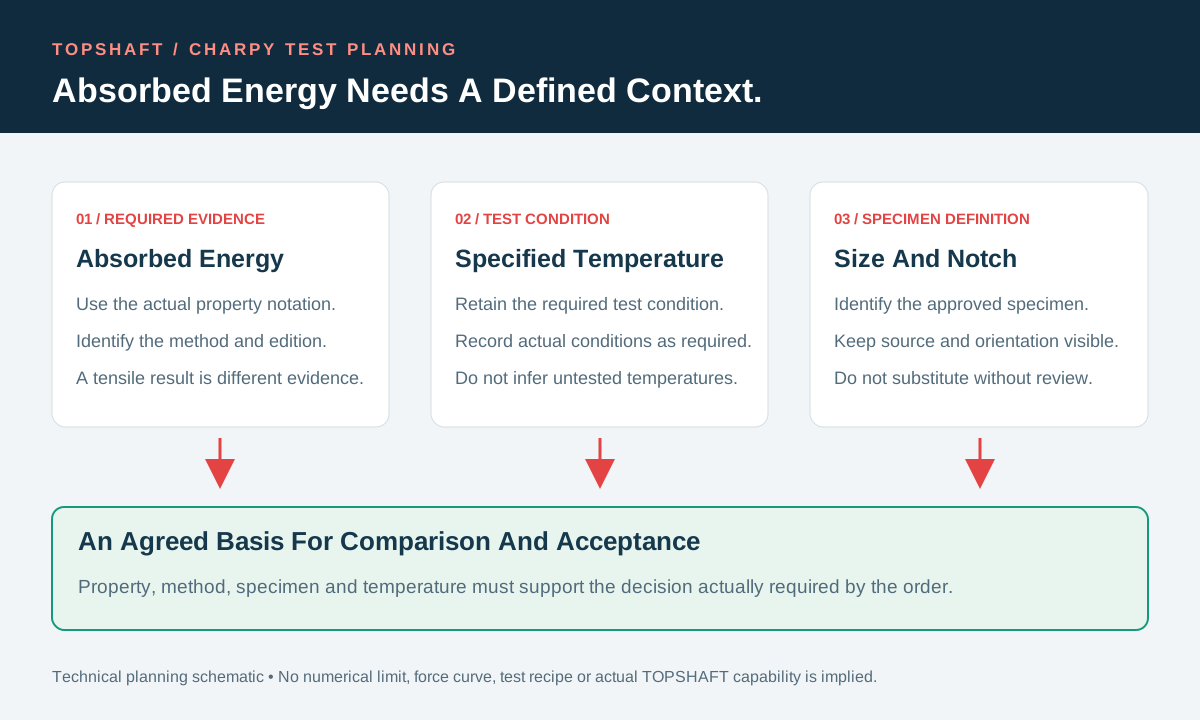
Shaft Charpy impact test requirements need a defined specimen, temperature and acceptance basis. Agree these before ordering. An energy number alone leaves essential questions unanswered. Connect material condition, sample source and evaluation rules to your requirement. Keep claims within the actual examination's scope.
Start With The Material Decision
Your impact-test request should identify the material decision that the examination supports. You may need specified Charpy evidence for a purchase requirement or an investigation of unexpected material behavior. State the purpose explicitly. Avoid requesting a general toughness certificate without naming the required test. The laboratory needs a defined question rather than an unexplained expectation of universal material suitability.
The ISO 148-1:2016 scope describes Charpy pendulum impact testing of notched metallic specimens to determine absorbed energy. Instrumented impact testing is outside that document's scope. This distinction helps identify what you are ordering. It does not supply your component's acceptance limit. Keep the result tied to the actual method and specified conditions rather than a broad claim about all impact behavior.
Keep other material questions separate. Your tensile-test requirements concern different reported properties and a different examination. A satisfactory tensile result does not automatically satisfy a required Charpy test. Conversely, impact evidence does not establish every tensile, fatigue or finished-component requirement. Identify the documents and examinations needed for each decision rather than treating any mechanical-test certificate as interchangeable evidence.
Fix The Method And Acceptance Basis
Your agreement should identify the test method, contractual edition and governing product requirement. The ASTM E23 overview includes both Charpy and Izod notched-bar impact methods. Naming impact testing alone can therefore leave the intended arrangement unclear. State the actual method required by your order. Do not assume a general standard reference answers every specimen and evaluation question.
Separate the method from the limits used to accept material. Identify the relevant drawing, material specification and customer instructions. Obtain the complete invoked documents when required. Resolve conflicting requirements before the supplier accepts the testing commitment. A public standard summary is not a complete laboratory procedure or permission to invent a missing product requirement.
Confirm which edition the contract actually invokes. A newly listed revision does not automatically amend an existing order. Equally, a copied historical designation should not pass through review without checking its intended use. Ask the responsible technical authority to approve any proposed alternative. Preserve the decision and its applicability so the laboratory and receiving team use the same basis.
Identify Source And Orientation
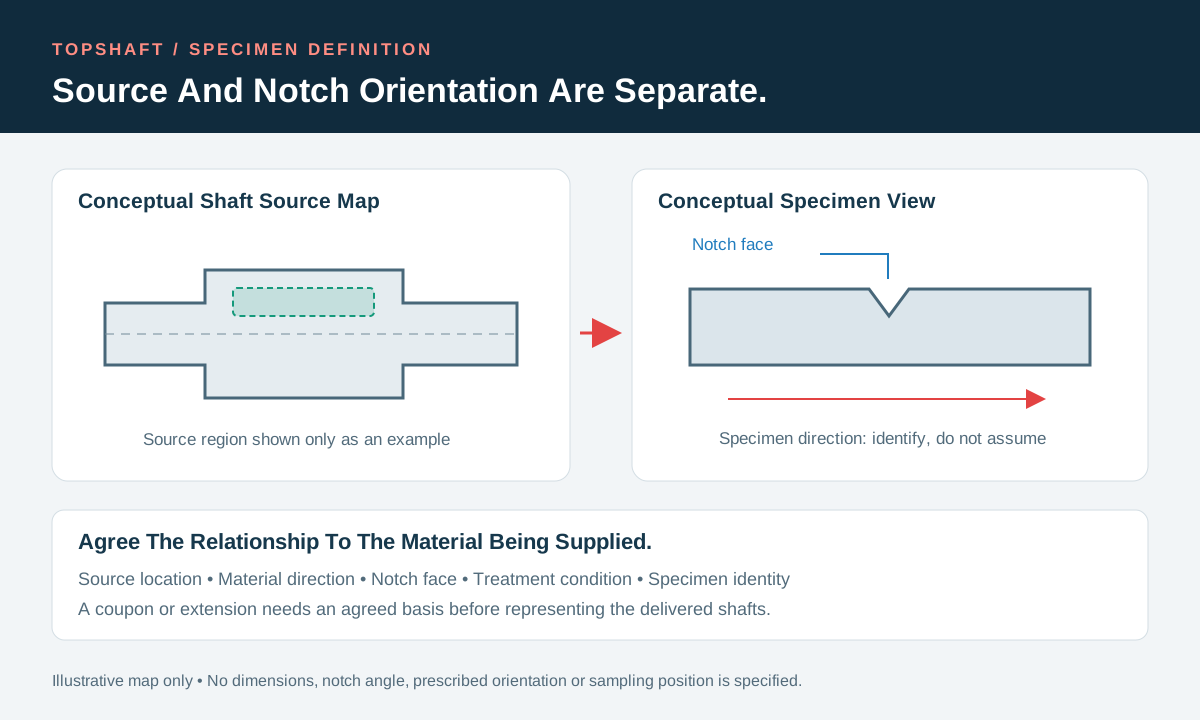
Your sampling plan should identify the material source and orientation represented by each specimen. State whether it comes from a component, an extension or another approved source. Describe the relevant location relative to the original shaft material. A specimen label without this relationship may be insufficient. Do not call separate material representative merely because its grade name matches the ordered shaft.
Use a controlled sketch or drawing when the location or direction needs clarification. Identify the required specimen direction and notch relationship through the applicable specification. These are separate details that should not be guessed from a photograph. Let the responsible technical team resolve the actual arrangement. A convenient cutting position does not automatically represent every direction or region relevant to your requirement.
Maintain identity throughout removal, preparation and laboratory transfer. Your material traceability plan should connect the original material, selected piece and individual specimens. If several locations are required, distinguish their records. Avoid merging different sources under one generic sample description. The report should let another reviewer reconstruct what was tested and how it relates to the material offered for delivery.
Define Notch And Specimen Size
Your procedure should identify the required notch and specimen geometry before preparation. The test designation should not substitute for the full approved definition. Ask the laboratory to confirm that the selected arrangement fits the actual material and requirement. Purchasing should not invent dimensions, notch details or preparation settings from an online illustration. Follow the complete invoked method and applicable product specification.
If the available shaft material cannot provide the required specimen, resolve that limitation before cutting. A smaller specimen may require an expressly permitted arrangement and appropriate acceptance rules. Do not assume its energy is directly comparable with a differently sized specimen. Obtain the authorized technical decision. A convenient sample that fits the available section should not silently inherit an unsupported acceptance interpretation.
Keep the actual specimen information with the reported result. Identify any approved departure from the originally requested arrangement. Do not convert one specimen size into another by an improvised proportional calculation. Where an applicable specification provides a permitted approach, retain that reference. The receiving team should understand the basis of comparison rather than seeing identical-looking energy columns with different meanings.
Specify Temperature And Actual Condition
Your request should state the test temperature and the material condition required by the acceptance specification. An energy result without its test conditions leaves an essential question unanswered. Do not assume a room-temperature result answers a specified lower-temperature requirement. The authorized laboratory should establish conditioning and execution through its procedure. This article does not prescribe cooling media, conditioning duration or transfer timing.
Connect the specimen condition to your heat-treatment requirements. Identify the relevant manufacturing stage and any processing remaining afterward. A specimen examined before a specified treatment does not automatically establish the later condition. Earlier evidence can still be useful for its declared purpose. Preserve that boundary rather than relabelling an intermediate result as final acceptance evidence.
For example, a hypothetical order requires Charpy results at an agreed temperature after the specified treatment. A supplied report instead records another temperature or an earlier condition. Identify the difference explicitly. Ask the technical authority what evidence is needed to close it. Do not change the report description to match the order or assume a favorable energy number makes the difference irrelevant.
Authorize Sampling And Representation
Your sampling agreement should authorize material consumption and define which production material the specimens represent. Identify who provides extensions, sacrificial pieces or another approved source. Clarify the impact on deliverable quantities. Destructive testing must not consume a customer's deliverable shaft without the required authorization. Resolve the source and quantity before a scheduling conversation becomes an unintended approval to remove material.
Separate the required specimen set from the wider production population. Your inspection sampling plan should identify selection and representation across the relevant material or processing groups. Several results from one source do not automatically verify every shaft in a shipment. Equally, several specimens within a set are not necessarily separate lot samples. Keep those decisions explicit in the approved plan.
Agree identification, custody and retention requirements for specimens and records. Include any witness requirements before arranging laboratory work. If the available material cannot support the required plan, obtain a decision before proceeding. A reduced convenience examination should not inherit broader approval. Clarify replacement responsibilities when agreed sampling consumes material originally intended for delivery. Keep that quantity decision separate from technical acceptance.
Keep Measurements And Validity Traceable
Your records should distinguish the actual specimen result from equipment verification and test-validity decisions. Identify the method, procedure revision and relevant equipment references as required. Ask the laboratory how its arrangement supports the requested examination. A machine certificate does not identify the shaft specimen. Conversely, a saved energy result does not replace required equipment checks or demonstrate every execution condition.
Retain the actual results and specimen details required by the agreed procedure. Include the reporting units, temperature, specimen source and relevant geometry information. Do not present an unexplained energy value as a complete test report. Where additional observations or supporting files are required, identify their controlled references. The report should reveal what was measured and which conditions governed the observation.
Ask how specimen problems, interrupted work or other departures will be documented and evaluated. The approved method should govern their significance. Do not invent a universal rule for every unexpected fracture or observation. Preserve the facts and the laboratory's explanation. A test-validity question and an unfavorable material result need distinct treatment, even when both require further review before acceptance.
Apply Individual And Set Rules
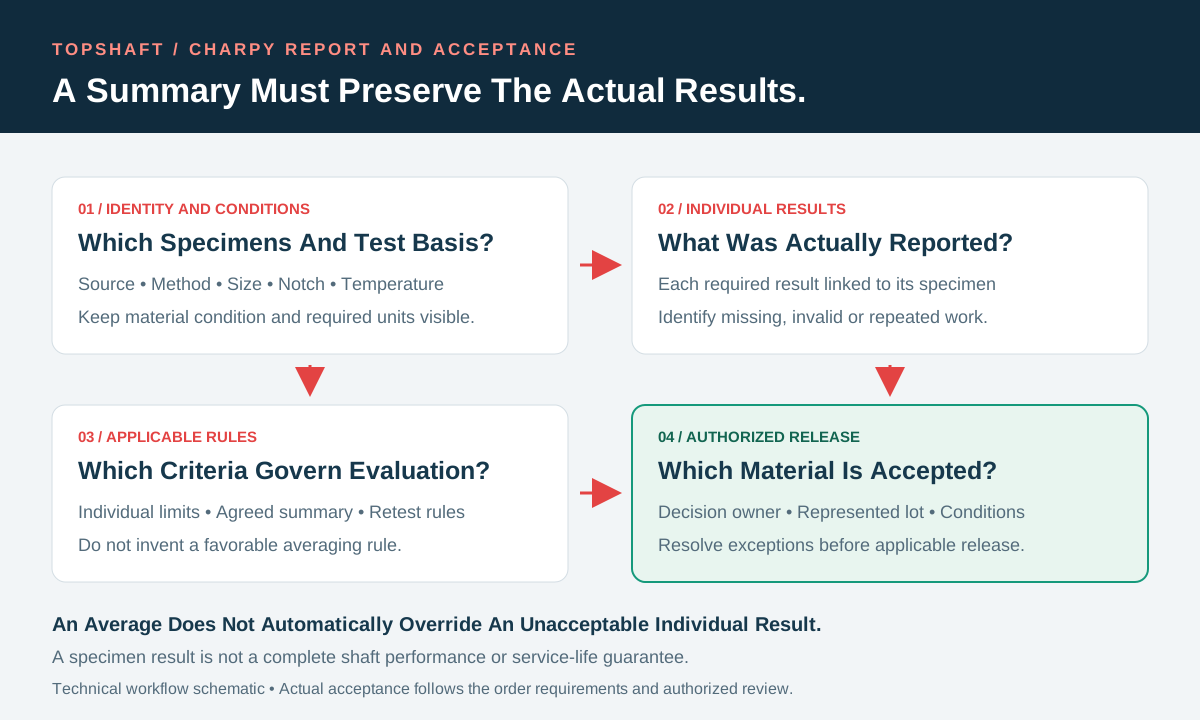
Your acceptance agreement should define how individual results and any specimen-set summary are evaluated. Identify the actual limits and the applicable rule before reviewing the numbers. A favorable average does not automatically waive an individual requirement. Equally, an individual value should be evaluated through the governing rule rather than an unrelated example. The responsible authority must resolve missing criteria before making a release decision.
Keep the required calculations and original observations together. Do not replace the individual record with only a selected summary. Preserve the specimen identities contributing to each set. If results from different sources or conditions appear in one table, distinguish them clearly. Combining them without an approved basis can hide the very difference that the examination was intended to assess.
Agree how ambiguous or disputed evidence will be reviewed. Your measurement uncertainty approach addresses related questions when a result is compared with a limit. Do not change rounding or reporting precision selectively to improve the conclusion. Obtain clarification through the approved route. The laboratory should not create a new acceptance rule after seeing which values would otherwise remain unresolved.
| Test Element | Agreement Needed | Evidence To Retain |
|---|---|---|
| Requirement | Method, edition and product limits | Approved contractual references |
| Specimen | Source, orientation, notch and size | Traceable specimen definition |
| Condition | Treatment stage and test temperature | Actual condition and execution records |
| Evaluation | Individual and set rules | Original results and required calculations |
| Release | Review authority and representation | Conclusion linked to delivered material |
Reconcile Unexpected Results Before Release
You should preserve unexpected results and control affected material while the authorized review remains open. Examine specimen identity, condition, preparation and execution before assigning a cause. A low result does not automatically prove every shaft in a wider group has the same condition. Another satisfactory specimen does not automatically clear the first observation. Define the affected population using the investigation and applicable requirements.
Apply the actual retest provisions and approval route. Additional work needs an identified reason, source and relationship to the initial examination. Do not continue testing until a convenient set appears while hiding earlier results. A repeated test does not automatically cancel a valid original observation. The final review should reconcile the full record against the agreed criteria and explain any authorized exclusions.
Keep proposed recovery, permission to act and verified outcome separate. Your rework and concession controls provide a related decision framework. If an action is approved, identify the necessary follow-up evidence. Connect the final report to specimen identities, actual conditions and the material being released. A generic pass statement cannot replace that traceable conclusion or waive other outstanding delivery requirements.
Prepare A Confirmed TOPSHAFT Request
Your inquiry should provide enough information to confirm the proposed Charpy examination. Send the released drawing, material specification and required treatment condition. Identify the method, temperature, specimen source, orientation and geometry requirements. Include order quantity, sampling expectations and reporting needs. Mark unresolved decisions clearly. Ask TOPSHAFT to confirm feasibility and responsibilities before treating testing as an accepted supply commitment.
This article does not verify particular TOPSHAFT impact machines, laboratories, qualifications, certifications or destructive-testing services. Do not infer those capabilities from an explanation of test planning. Confirm any proposed internal or external laboratory arrangement during order review. If the required scope cannot be supported, resolve that limitation before acceptance. A confirmed examination plan is more useful than an unsupported promise about every steel shaft.
Discuss quotation and scheduling factors without assuming a universal price or turnaround. Specimen availability, preparation, conditioning, laboratory arrangements, witnessing and document review can affect the plan. Agree who provides material, approves the method and evaluates findings. Use the shaft RFQ checklist to connect these needs with delivery commitments. Review applicability again when material, specimen arrangement, treatment or the contractual requirement changes.
Frequently Asked Questions
Your answers should follow the actual material requirement, specimen definition and approved Charpy method. These questions clarify common limits without prescribing universal energy values or specimen counts.
Does A Satisfactory Tensile Result Replace A Required Charpy Test?
Not without an approved change to the requirement. The examinations provide different evidence. Supply the test specified by the order. Do not treat a general mechanical-test certificate as proof that both requirements were met.
Can You Omit The Test Temperature From An Energy Result?
Not when it is required to interpret or accept the examination. Keep actual conditions with the result. A number alone does not demonstrate compliance with the specified temperature requirement.
Is A Smaller Specimen Automatically Comparable With A Larger One?
No automatic comparison should be assumed. Use the permitted specimen arrangement and applicable evaluation rules. Obtain technical approval for any alternative. Do not create an unsupported proportional conversion from the energy values.
Does A Favorable Set Average Cancel Every Low Individual Value?
No universal cancellation rule applies. Follow the approved individual and set criteria. Retain the original results and specimen identities. The authorized reviewer must apply the actual contractual acceptance basis.
Send Your Impact Test Package
You can reduce ambiguity by agreeing specimen conditions and evaluation rules before testing. Contact TOPSHAFT with your drawing and Charpy requirements. Request confirmation of sampling, reporting and acceptance responsibilities.