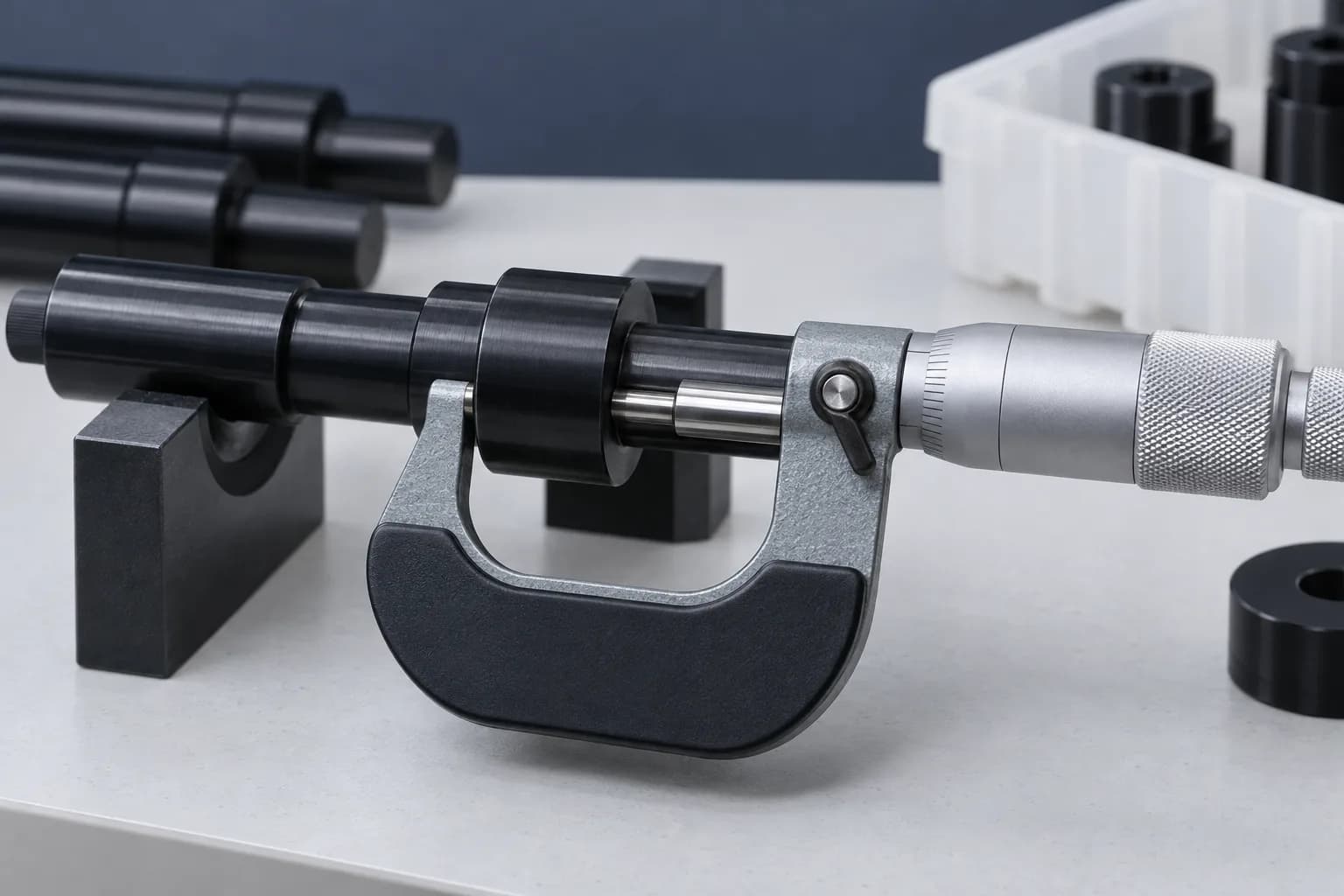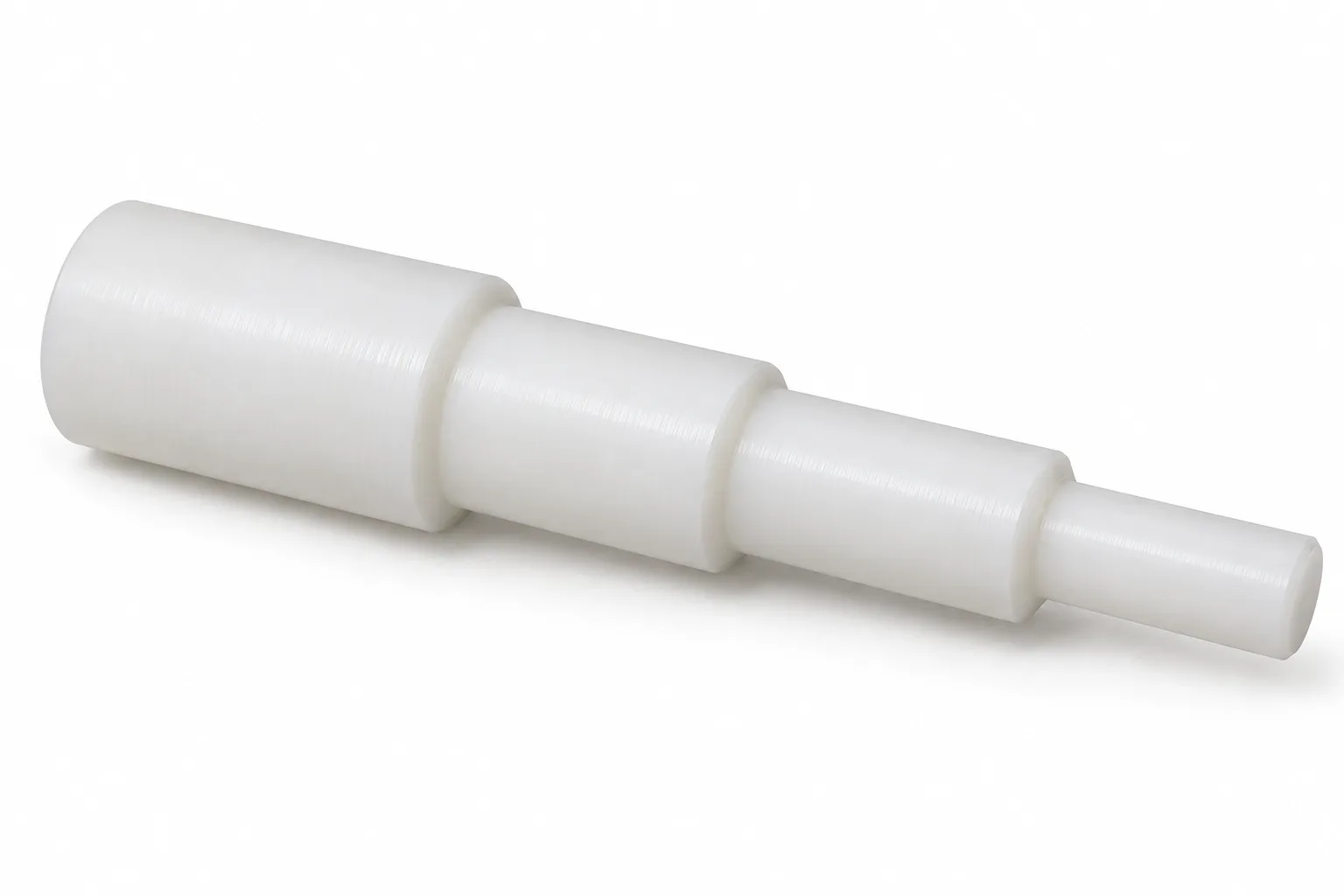
Stepped POM Shafts
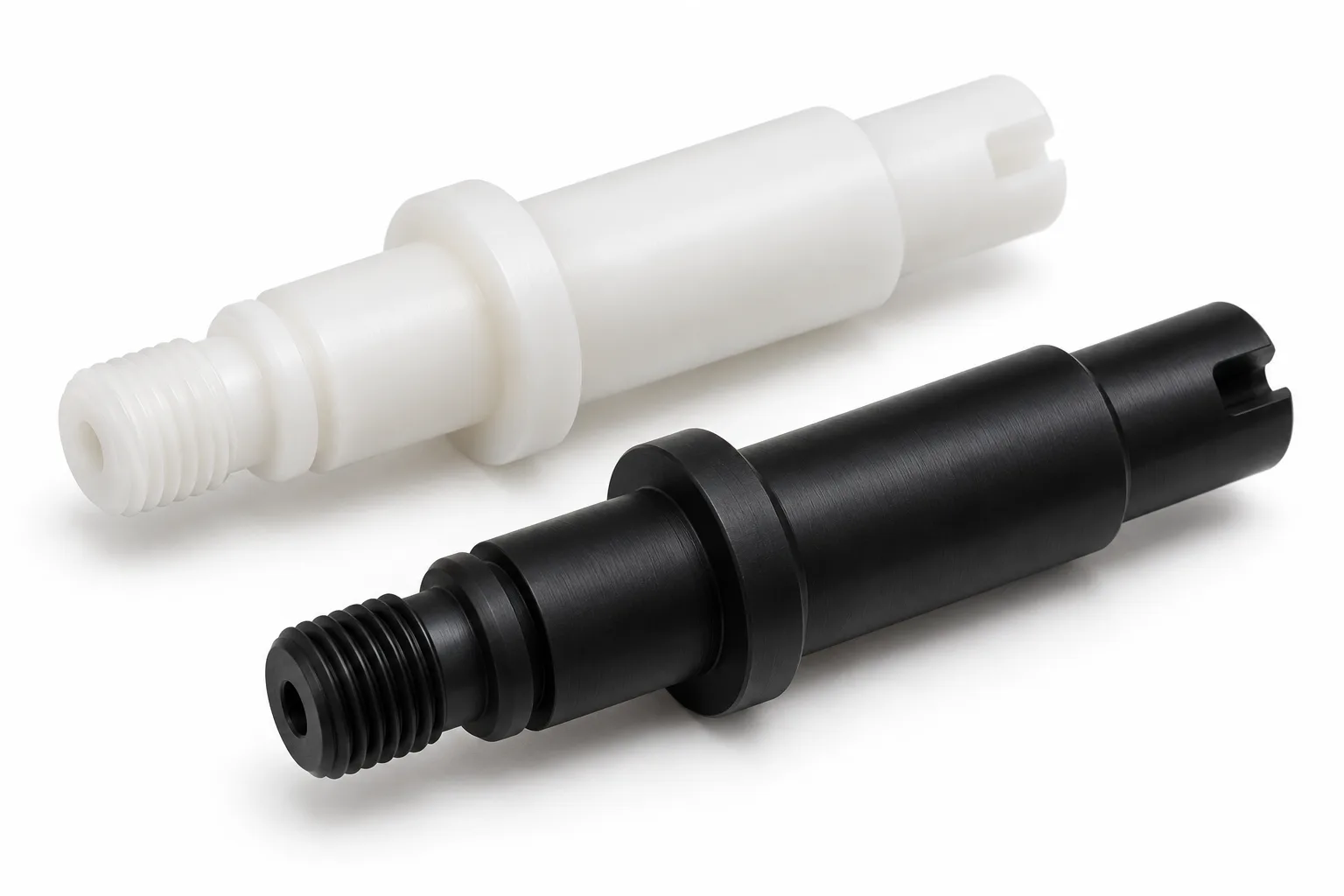
Multiple diameters and shoulders locate mating components. Define bearing seats, transition radii and the functional axis; the plastic stepped shaft must remain stiff enough for assembly and service.
Review shaft geometry
PRECISION ENGINEERING PLASTIC SHAFT MANUFACTURING
Topshaft provides custom CNC machining for Delrin and POM shafts used in industrial machinery, automation, and precision mechanical assemblies. We manufacture drawing-based acetal shaft components with stepped diameters, grooves, threads, and application-specific features, supported by dimensional inspection and material selection review.
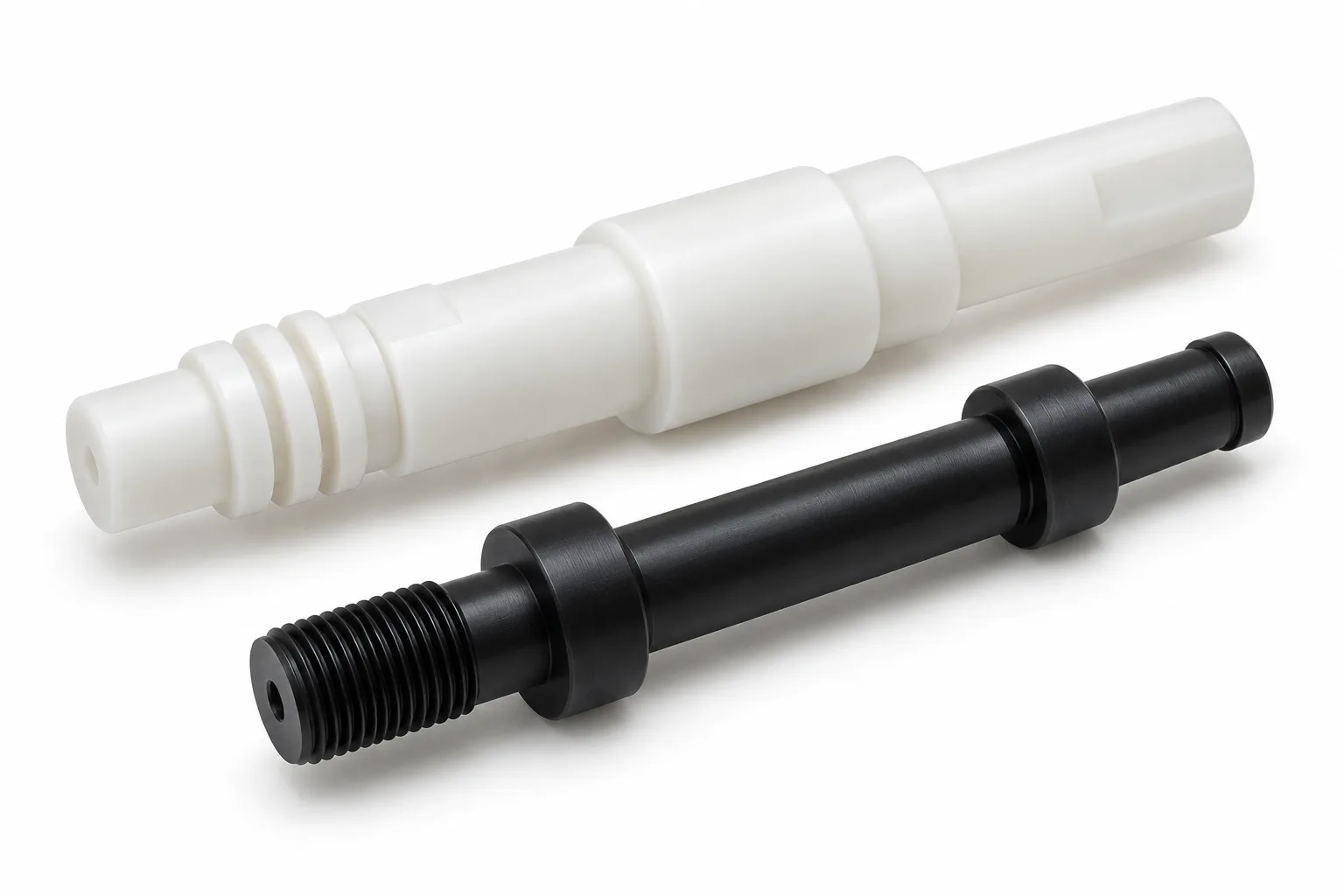
Delrin and POM shafts are precision-machined mechanical components manufactured from acetal engineering thermoplastics. They are used in applications requiring low friction, good wear performance, relatively low moisture absorption, and consistent dimensional performance under suitable operating conditions.
POM-C is acetal copolymer; POM-H is acetal homopolymer. Delrin is a trademarked homopolymer acetal brand, not a generic name for POM-C. Grade selection affects mechanical, chemical and thermal performance. Review the actual stock product and processing history, including centerline porosity where relevant; neither appearance nor a family label establishes stock integrity.
POM can offer better moisture-related dimensional stability than common nylon grades, but it is not a universal substitute for steel. Lower stiffness, creep and temperature limits require load and fit review. This page concerns finished custom Delrin shafts and POM components, not standard rods or cut-to-length stock.
Multiple diameters and shoulders locate mating components. Define bearing seats, transition radii and the functional axis; the plastic stepped shaft must remain stiff enough for assembly and service.
Review shaft geometry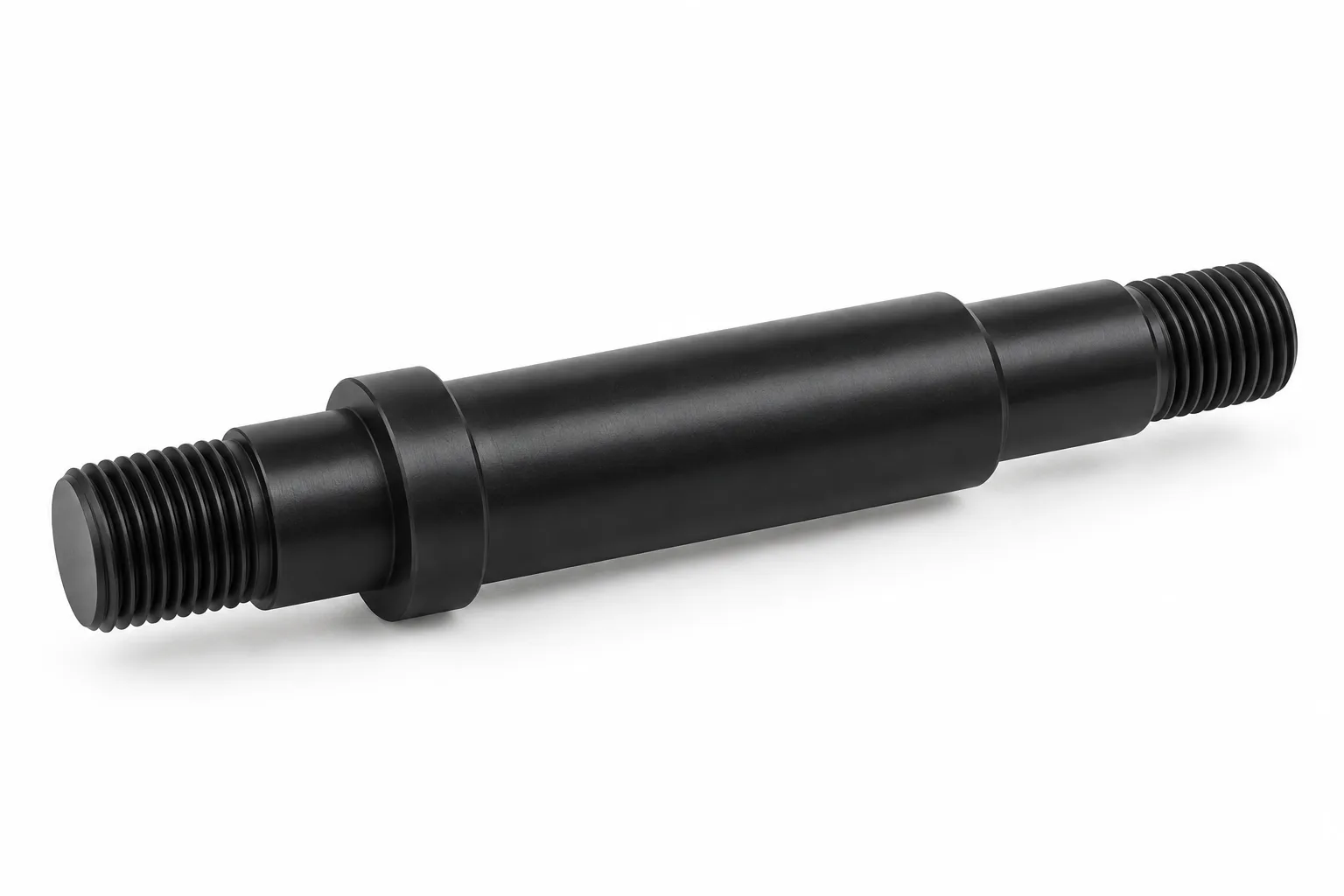
Custom threads and connection features suit appropriately loaded assemblies. Review engagement, tightening force, thread-root section and repeated installation rather than applying a metal fastener's torque unchanged.
Review shaft geometry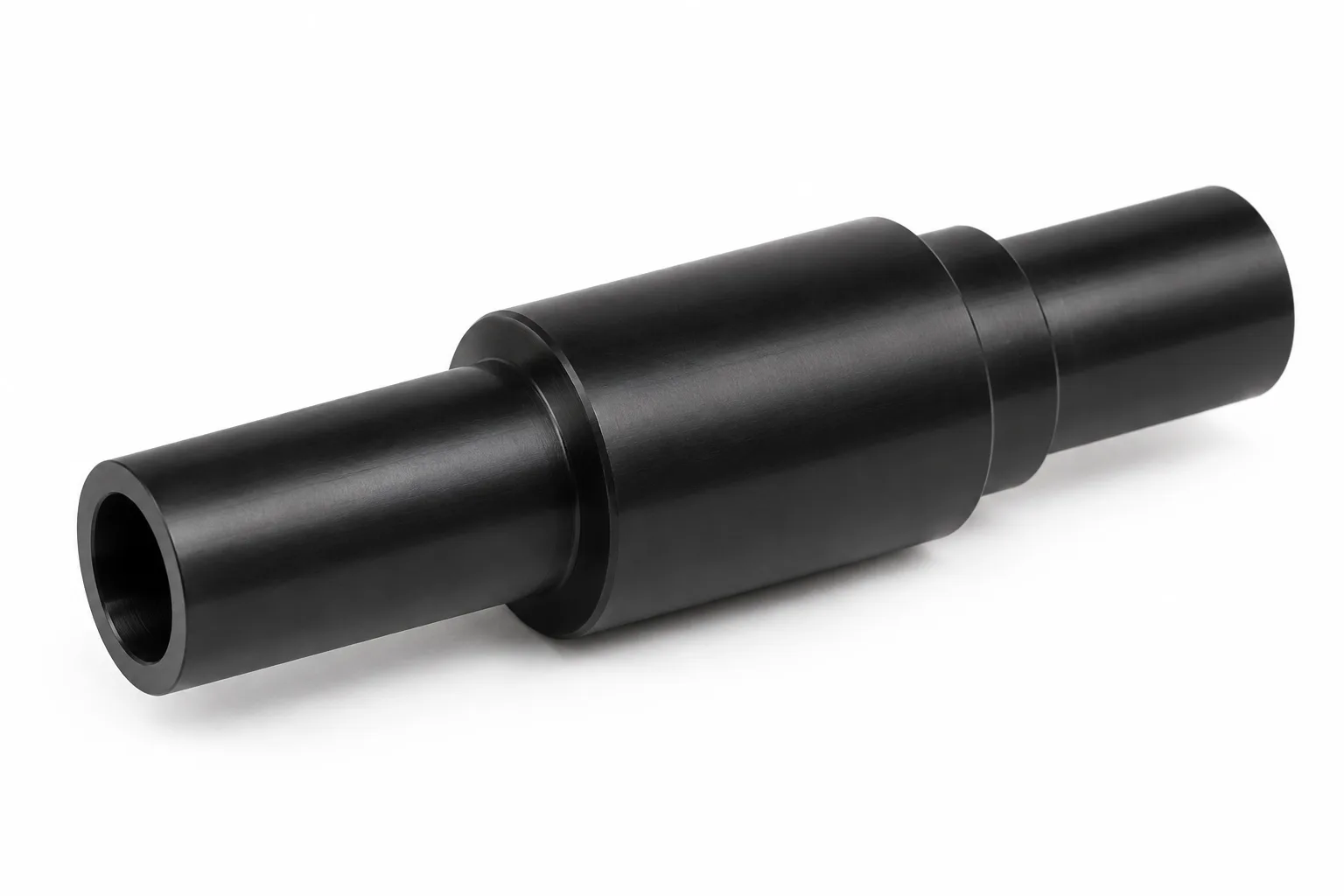
Tubular and bored components provide passages or reduce mass in specialized designs. Bore access, minimum wall, journal alignment and clamping deformation need consideration before machining.
Review shaft geometry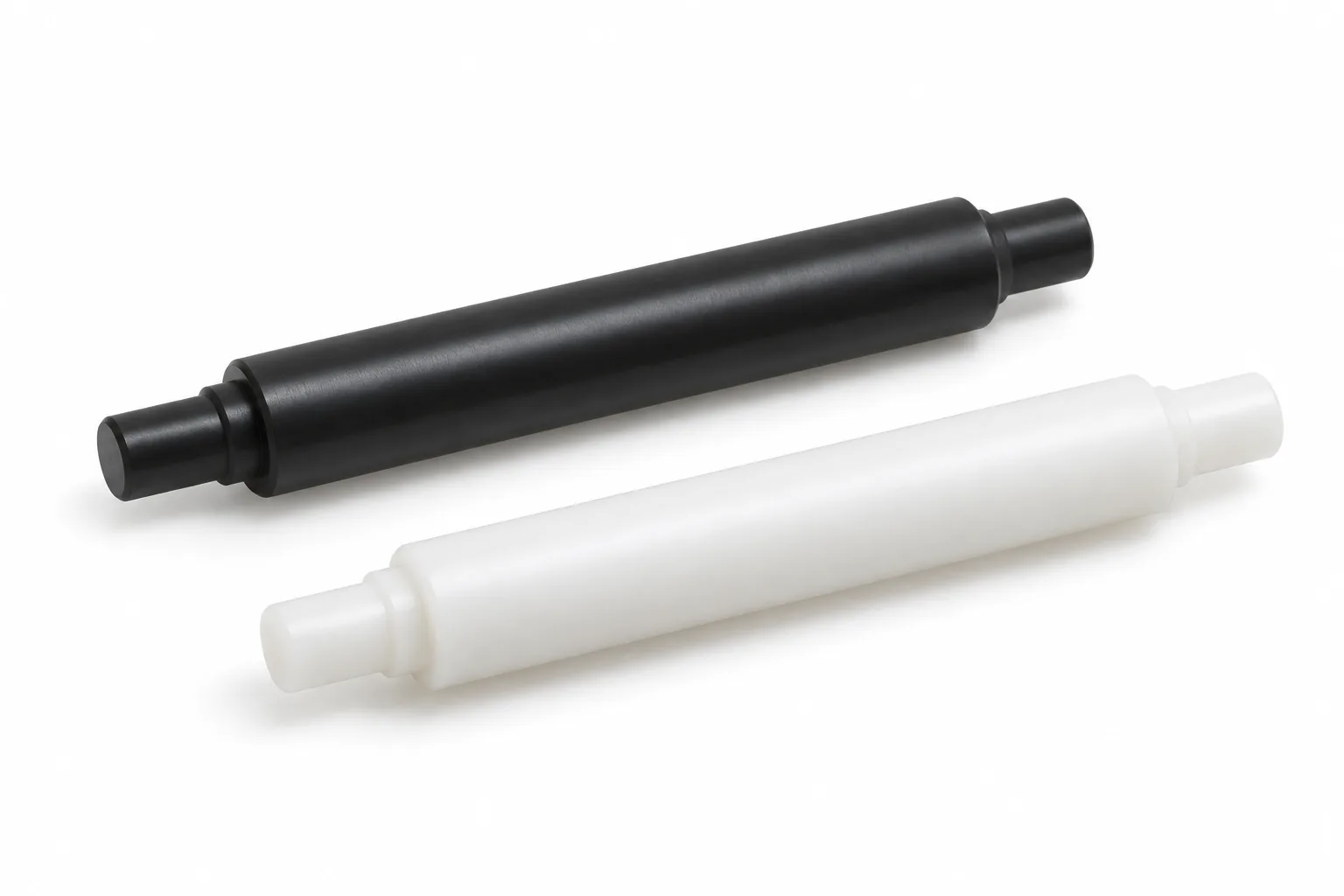
Positioning and guiding components can use POM in suitable low-load mechanisms. Check the unsupported span, contact pressure, clearance and lubrication against the actual duty cycle.
Review shaft geometry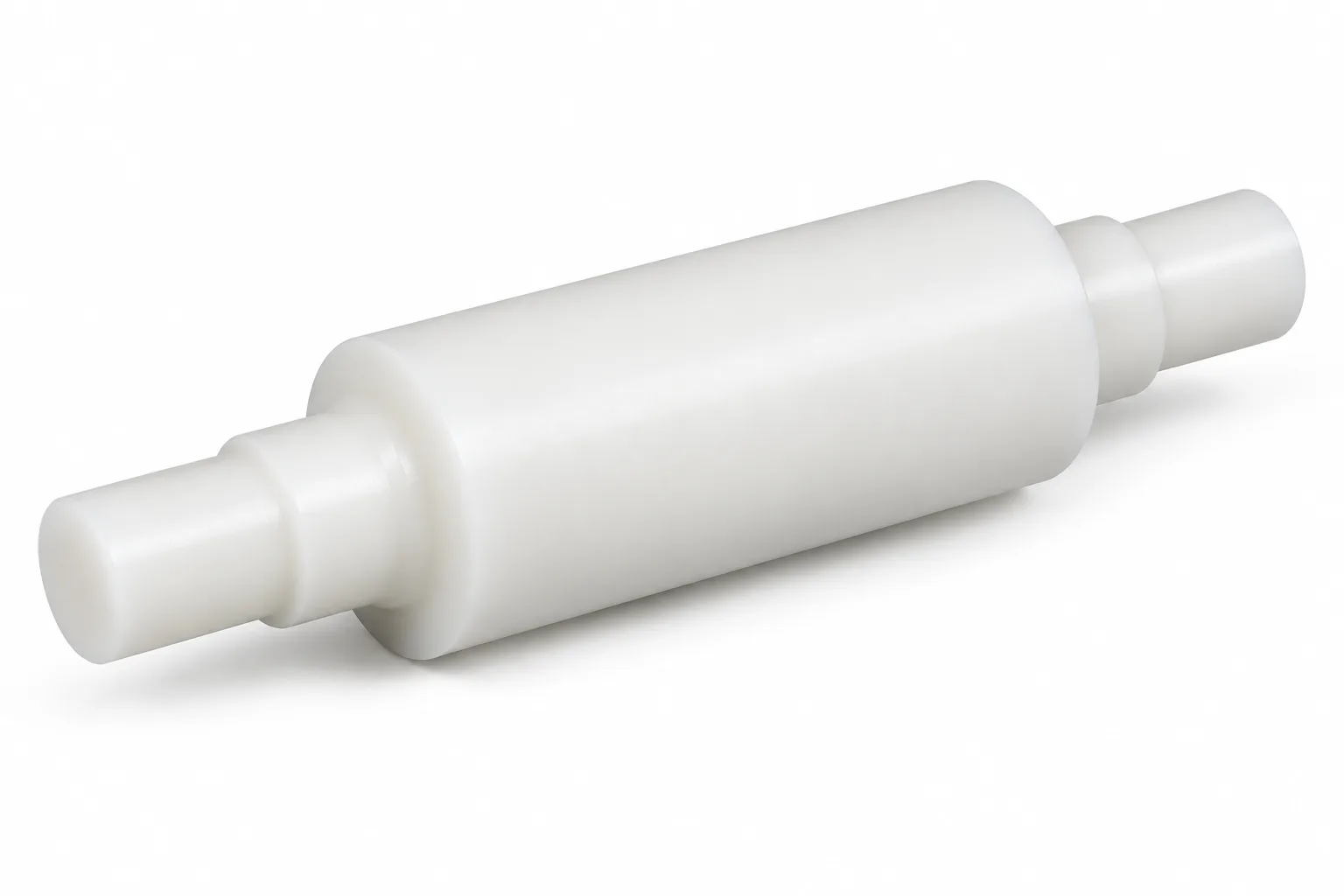
Custom rotating components support packaging and material-handling mechanisms. Review stationary loads, journal pressure, bearing arrangement and contact wear as well as the normal running condition.
Review shaft geometry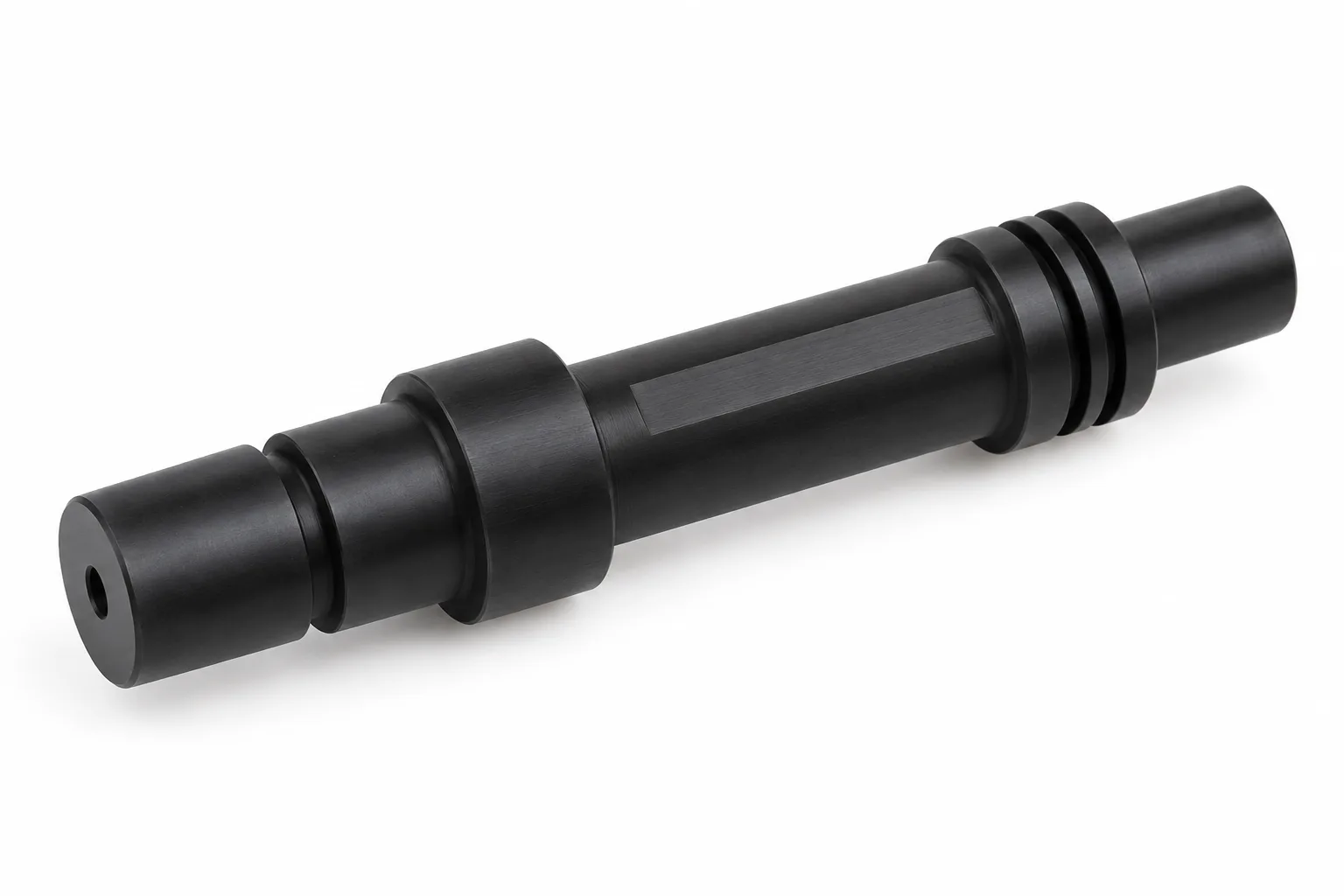
Grooves, flats, slots, keyways and special geometries connect the shaft to its assembly. Keep adequate section around notches and specify the datum relationship between secondary features and turned journals.
Review shaft geometryA practical review direction for general mechanical components, with chemical exposure and dimensional requirements evaluated for the exact grade.
Often selected for mechanical performance. A specified Delrin grade belongs to this family; brand and grade requirements must remain explicit.
Swipe horizontally to read all columns.
| Material | Characteristics | Typical selection considerations |
|---|---|---|
| POM-C (Acetal Copolymer) | Good chemical resistance, dimensional stability and machinability in suitable environments. | General industrial shafts and mechanical components; confirm the exact stock grade and exposure. |
| POM-H (Acetal Homopolymer) | Typically higher stiffness and strength than many comparable unfilled POM-C grades. | Precision shafts where mechanical performance matters; inspect stock integrity and final-condition requirements. |
| Delrin Homopolymer | Branded POM-H family with grade-specific mechanical properties. | Custom OEM components requiring a specified Delrin designation; no unapproved generic substitution. |
| PTFE-Filled POM | Modified friction and wear behavior, dependent on formulation and test conditions. | Sliding-contact components after evaluation of contact pressure, speed, counterface and compatibility. |
| Glass-Filled POM | Increased stiffness with possible directional effects and mating-surface wear. | Specialized dimensionally demanding components; consider exposed fibers, machining and counterface damage. |
| Food-Contact POM Grades | Specific formulations with relevant supplier documentation. | Food equipment requiring the exact grade, color and intended-use documentation; not blanket family compliance. |
Actual properties depend on supplier grade, processing history, temperature and service conditions. Listings are selection directions, not claims that every grade is routinely stocked or food-contact compliant.
Consult the Delrin product reference guide and Ensinger's POM-C stock-shape data for background. Use the supplied stock grade's current data and required documentation for acceptance; these references do not imply stock availability or endorsement.
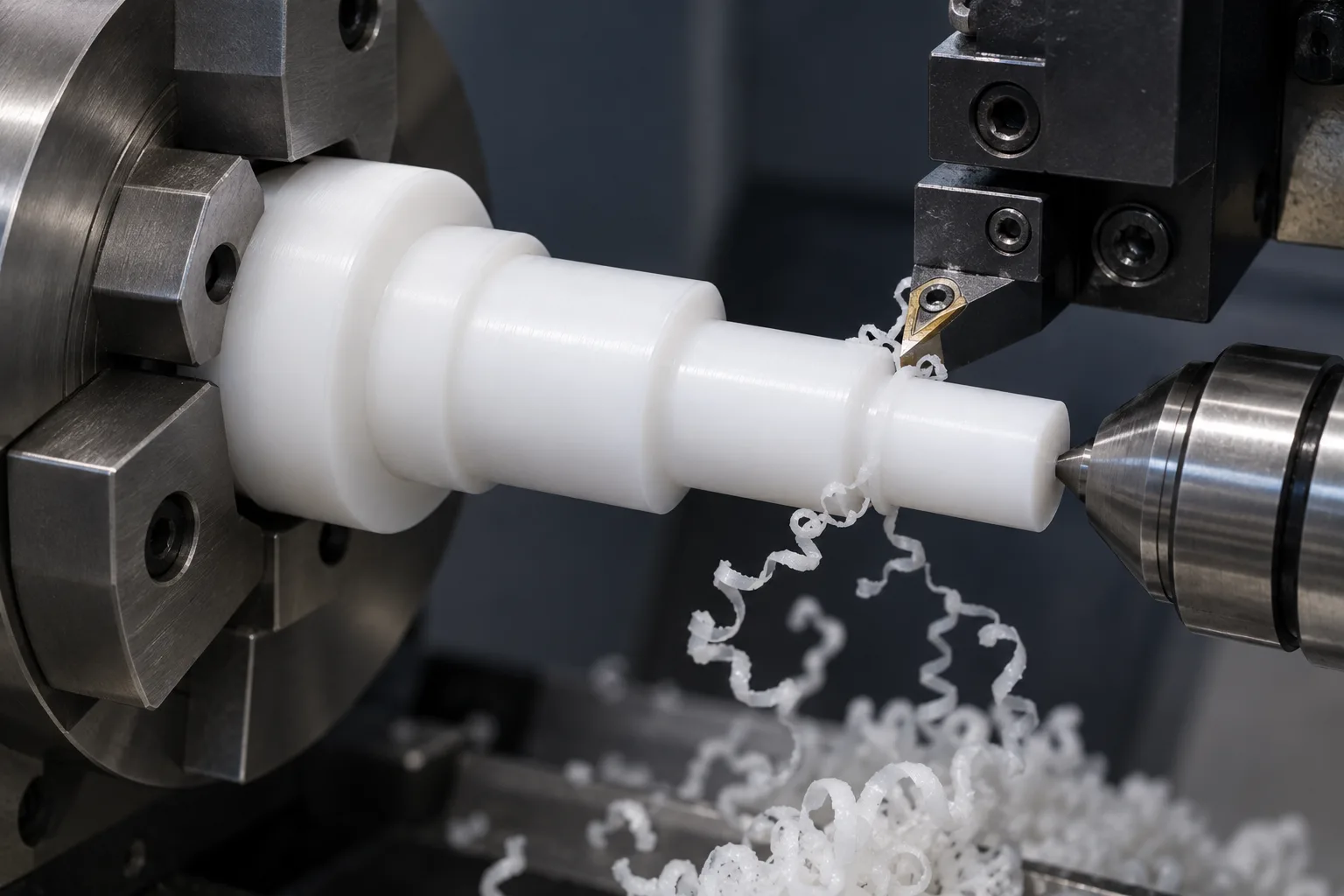
Produce stepped diameters, shoulders, grooves, threads and axial bores. Sharp tools, effective chip removal and controlled heat reduce rubbing and local deformation. Support long features without imposing excessive clamping pressure.
Related capability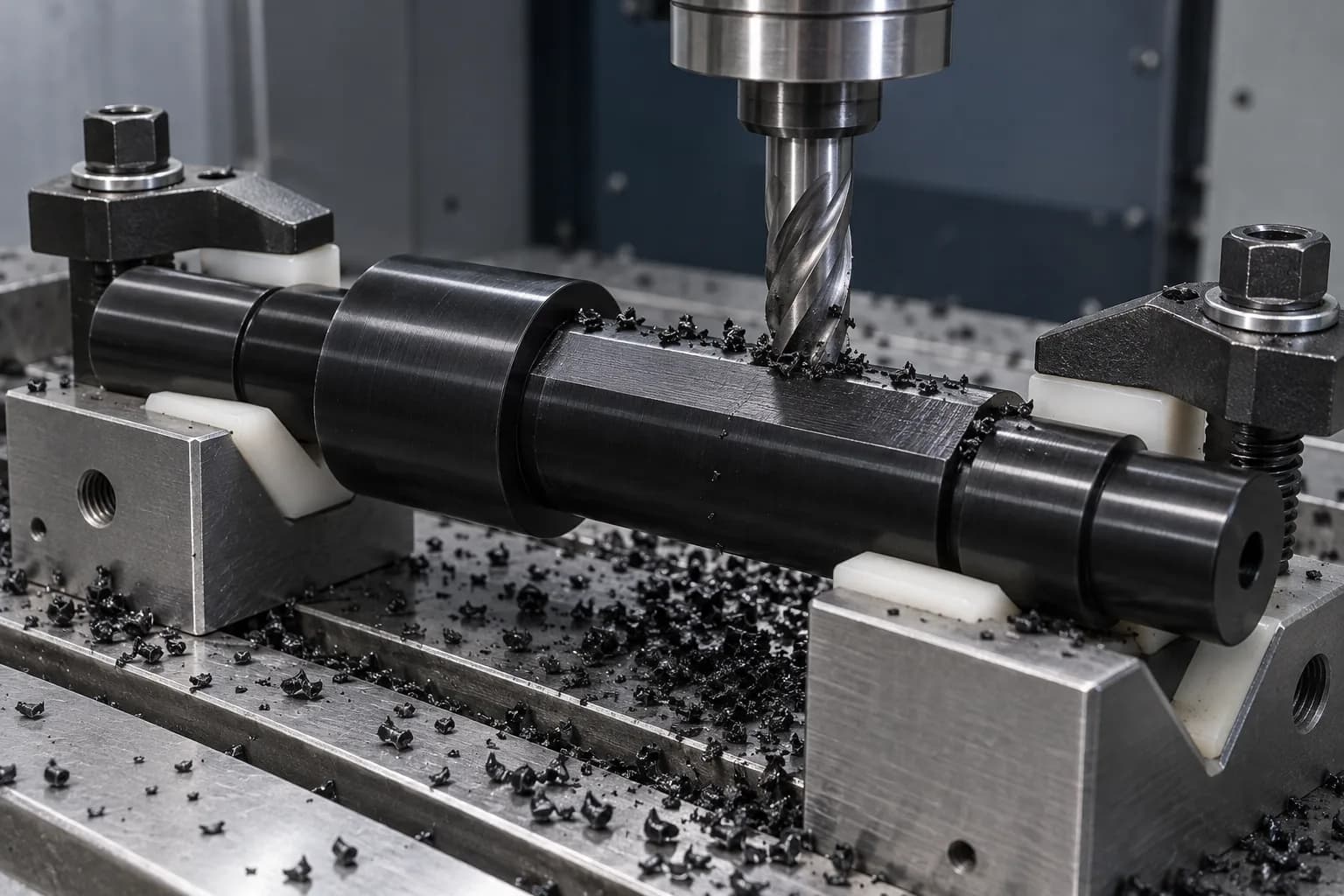
Machine flats, slots, keyways and complex profiles with stable, gentle workholding. Keep the journal axis related to the secondary features. Thin walls may spring back after release, so fixture pressure and machining sequence matter.
Related capability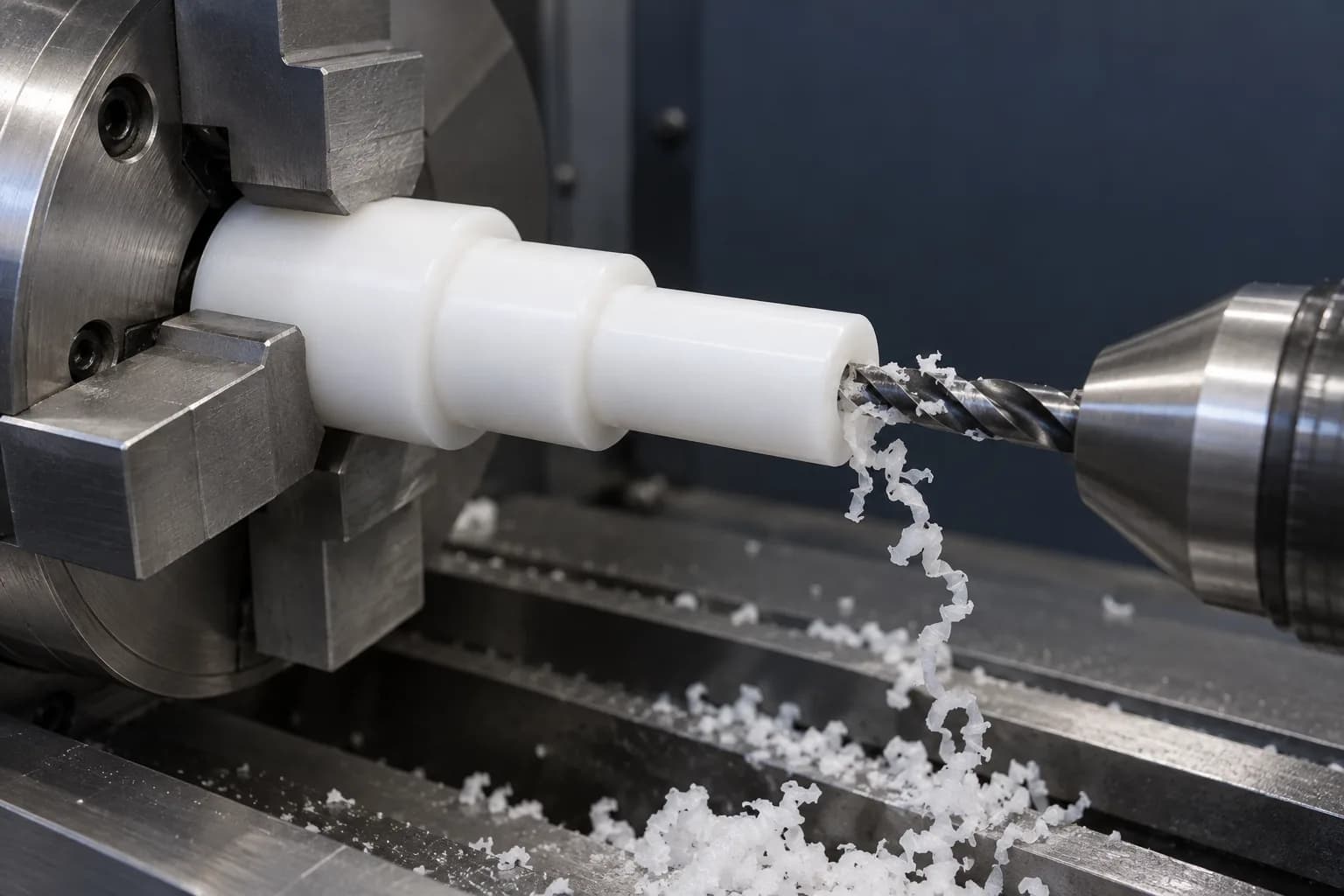
Create internal bores, cross holes and drawing-defined threads. Control heat and chip evacuation in deep holes; review breakout edges, thread engagement and the remaining wall around connected features.
Related capability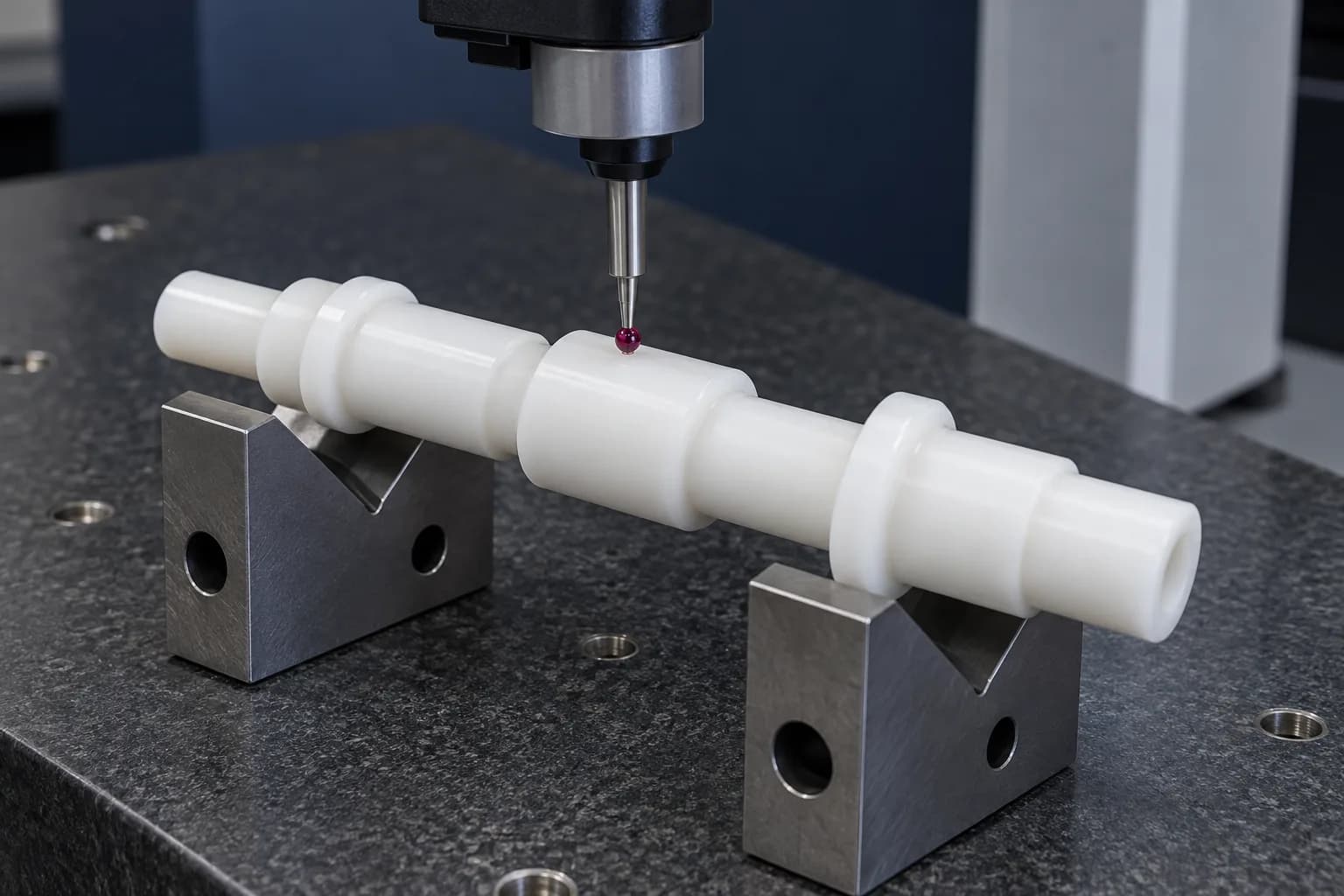
Check critical diameters, lengths, runout and functional interfaces after machining heat has dissipated. Suitable contact force and an agreed measurement condition help avoid confusing elastic compression or thermal expansion with machining error.
Related capabilityPOM shaft machining requires control of heat buildup, sharp cutting tools, burr formation, workholding pressure, thin-wall deformation and thermal expansion. Ensinger's machinable-plastics FAQ provides general background, not a fixed process recipe for every shaft.
Swipe horizontally to read all columns.
| Specification | Drawing-based requirement |
|---|---|
| Material options | POM-C, POM-H and specified Delrin grades; modified materials subject to sourcing and feasibility review. |
| Shaft diameter | Drawing-specific, subject to stock availability, workholding and confirmed machine capacity. |
| Shaft length | Evaluated against geometry, unsupported span and slenderness. |
| Dimensional tolerances | Confirmed after material, geometry and final-condition review. |
| Surface roughness | Based on the machining process and functional requirements of each surface. |
| Geometric tolerances | Runout, straightness, roundness and coaxiality referenced to defined datums. |
| Operating temperature | Dependent on exact grade, load, contact conditions and exposure duration. |
| Colors | Natural and black where material availability permits; color does not identify grade or compliance. |
| Production quantities | Prototype evaluation, small batches and repeat OEM orders, subject to project confirmation. |
| Inspection | Drawing-based dimensional and visual verification under agreed conditions. |
Do not transfer metal-shaft tolerance guarantees directly to POM components. Plastic thermal expansion, workholding deformation and creep must be considered alongside the final acceptance condition.
POM's elastic modulus is much lower than steel's, so a same-sized shaft deflects more under equivalent bending loads. Review bearing spacing, diameter and alignment using the selected grade's relevant properties.
Sustained stress produces time-dependent deformation. Include parked loads, continuous journal pressure and retained assembly forces. Short-term strength data alone cannot establish long-term clearance, alignment or useful life.
Temperature changes can alter shaft dimensions and fits. Separate machining temperature, inspection conditions and service temperature; assess mating-material expansion rather than compensating with a generic metal-shaft tolerance.
Evaluate friction, lubrication, load and speed together with counterface material and surface finish. Low friction does not mean zero wear or maintenance-free operation in every environment.
Excessive assembly force can damage threads, split thin walls or distort journals. Specify interference and installation method, consider adequate engagement, and assess inserts or another retention approach where appropriate.
Long, slender shafts may need intermediate support, a larger diameter or a different material. Check bending, vibration and time-dependent response across the full duty cycle rather than only at assembly.
For time-dependent behavior, see Delrin's creep and stress-relaxation guide. Short-term properties do not independently establish long-term shaft performance.
Potential applications, subject to grade and engineering review—not claims of completed projects or universal compliance.
Guide and positioning shafts in suitably supported, low-load mechanisms.
Rollers and lightweight rotating components; review wear, repeated motion and cleaning exposure.
Low-load conveyor mechanisms with defined journal pressure, support and duty cycle.
Insulating mechanical shafts where the specified grade, fillers and environment satisfy electrical requirements.
Wear-sensitive and corrosion-resistant mechanical components after medium and load review.
Suitable components from properly documented grades, with intended contact and cleaning conditions confirmed.
Lightweight mechanical positioning components where deflection, creep and retention are acceptable.
Dedicated pages are linked where available; other applications lead to related industrial machinery requirements. Food-contact suitability needs the exact formulation, color and intended-use documents. See the Delrin food-contact portfolio for grade-specific background, not a finished-part approval.
Swipe horizontally to read all columns.
| Factor | POM / Delrin | Nylon | PEEK | Steel |
|---|---|---|---|---|
| Moisture absorption | Relatively low. | Higher for common PA6 / PA66 grades. | Very low in many grades. | Not applicable as polymer moisture uptake; corrosion still matters. |
| Dimensional stability | Good under suitable operating conditions. | More moisture-sensitive. | Excellent in many applications; still condition-dependent. | Generally excellent; thermal expansion remains relevant. |
| Wear performance | Good in suitable contact conditions. | Good, grade-dependent. | Good, grade-dependent. | Depends on hardness, counterface and lubrication. |
| Temperature capability | Moderate; grade-, load- and duration-dependent. | Moderate; verify actual grade and conditioning. | High relative to POM in suitable grades and conditions. | Generally higher; grade and treatment determine limits. |
| Stiffness | Low compared with metal. | Low compared with metal. | Low compared with metal, even with higher thermal capability. | High compared with unfilled engineering plastics. |
Qualitative family-level guidance, not acceptance limits. Compare exact grades at the relevant moisture condition, load, temperature and duration. Chemical compatibility and the complete contact system also affect selection.
A coordinated manufacturing route for drawing-based finished components.
Confirm the controlled revision, functional features, mating parts, tolerances and service requirements. Resolve ambiguous grade or acceptance wording before quotation.
Agree POM-C, POM-H or the specified Delrin grade, color, stock form and required documentation. Obtain approval before substituting material.
Establish stable datums and main geometry while managing heat, support and residual-stress effects. Leave appropriate material for final passes where needed.
Complete shoulders, bores, threads and non-rotational features with controlled workholding. Deburr and clean without altering critical surfaces.
Allow temperature stabilization and check the finished features using agreed support and measuring force. Record required dimensions and document scope.
Protect functional surfaces and slender features without sustained bending loads. Supply the agreed records and identify the relevant drawing revision.
Verify critical diameters, lengths and shoulder locations after stabilization, using methods suited to the tolerance and the polymer's compliance.
Reference runout, straightness and other requirements to the drawing datums and support arrangement; these terms are not interchangeable measurements.
Check bores, threads, keyways, flats and assembly interfaces. Identify inaccessible features or special gauges during technical review.
Inspect burrs, damage, finish and specified chamfers. Smooth appearance does not establish a measured roughness value or wear-life result.
Agree temperature, stabilization, fixture support and appropriate contact force. Retain relevant conditions with inspection results when they affect acceptance.
Confirm grade identification and requested documents where agreed and available. Natural or black appearance is not proof of Delrin identity or food-contact status.
Evaluate the finished OEM component, its grade and operating conditions together. A controlled drawing and functional acceptance plan distinguish the project from a cut-to-length plastic-rod order.
Coordinate turning and secondary operations around heat, chip evacuation, clamping and slenderness. Discuss material-specific risks before committing to tolerances or a production route.
Focus checks on the features controlling fit and operation. Agree measurement conditions and documentation rather than transferring blanket metal-machining promises to a compliant polymer.
Confirm material records, inspection scope, revision control and delivery expectations during quotation. Prototype feedback can inform repeat production, with sourcing and feasibility confirmed individually.
TOPSHAFT is the precision shaft manufacturing division of Dongguan Tops Precision Manufacture Co., Ltd., operating alongside Topsbest Precision for shaft-focused OEM projects. Review company information and request project-relevant evidence during supplier evaluation.
Delrin and POM shafts are finished mechanical components machined from acetal engineering thermoplastics. POM includes homopolymer and copolymer families; Delrin is a branded acetal homopolymer family, not a generic label for all POM. Specify the actual material and grade, finished geometry and operating conditions so sourcing, machining and inspection can be reviewed without an unintended substitution.
POM offers relatively low moisture absorption, useful dimensional stability, machinability and favorable friction or wear behavior in suitable applications. These advantages depend on grade, geometry and service conditions. Lower stiffness than steel, sustained-load creep and temperature limits remain important. Evaluate the complete mechanism rather than treating low moisture uptake as a guarantee of unchanged dimensions or unlimited life.
Suitable applications include low-load guidance, positioning, rollers and lightweight mechanical components in automation, packaging and industrial equipment. Each needs review of load, support, contact pressure, speed, temperature and chemical exposure. Food-contact or insulating uses require the exact grade and supporting requirements; a material-family name or a white component does not establish regulatory or electrical suitability.
Tolerances are confirmed for the specified material, geometry and measurement condition. Heat buildup, workholding pressure, thin walls and thermal expansion can affect precision POM shafts. Mark critical fits and datums on the drawing and distinguish final acceptance from service behavior. A general metal-shaft tolerance is not automatically feasible for every CNC machined POM shaft or unsupported length.
Natural and black are common options where the specified material is available. Color, fillers and supplier designation should be confirmed together because appearance does not identify POM-H, POM-C or a Delrin grade. If food-contact, electrical or optical requirements apply, review the exact colored formulation and its documents. Availability and any proposed substitution are confirmed during quotation.
Inspection reports and material documents can be included where their scope and availability are agreed before production. Identify critical dimensions, geometric checks, surface requirements, drawing revision and any traceability needs. For plastic shafts, specify relevant measuring conditions and support. Do not assume that a standard dimensional report establishes food compliance, long-term creep performance or validated application life.
Lead time is confirmed after drawing, quantity, material sourcing and inspection review rather than promised as a universal number. Special grades, documents, slender geometry or prototype evaluation can affect the route. Share the required delivery date, destination and repeat demand so feasibility can be discussed. Approval of unresolved material or drawing requirements may be needed before production planning.
Upload the controlled drawing and useful CAD files with quantity, POM-C or POM-H designation, specified Delrin grade if required, and color. Identify critical tolerances, datums, surface finish, inspection documents and delivery expectations. Include loads, temperature, contact conditions and cleaning exposure. Where requirements are open, request a material review rather than allowing assumptions to become an unapproved specification.
Send your drawing, exact grade, quantity, critical tolerances and operating conditions for review. Include color, surface finish, inspection documents and delivery expectations.