
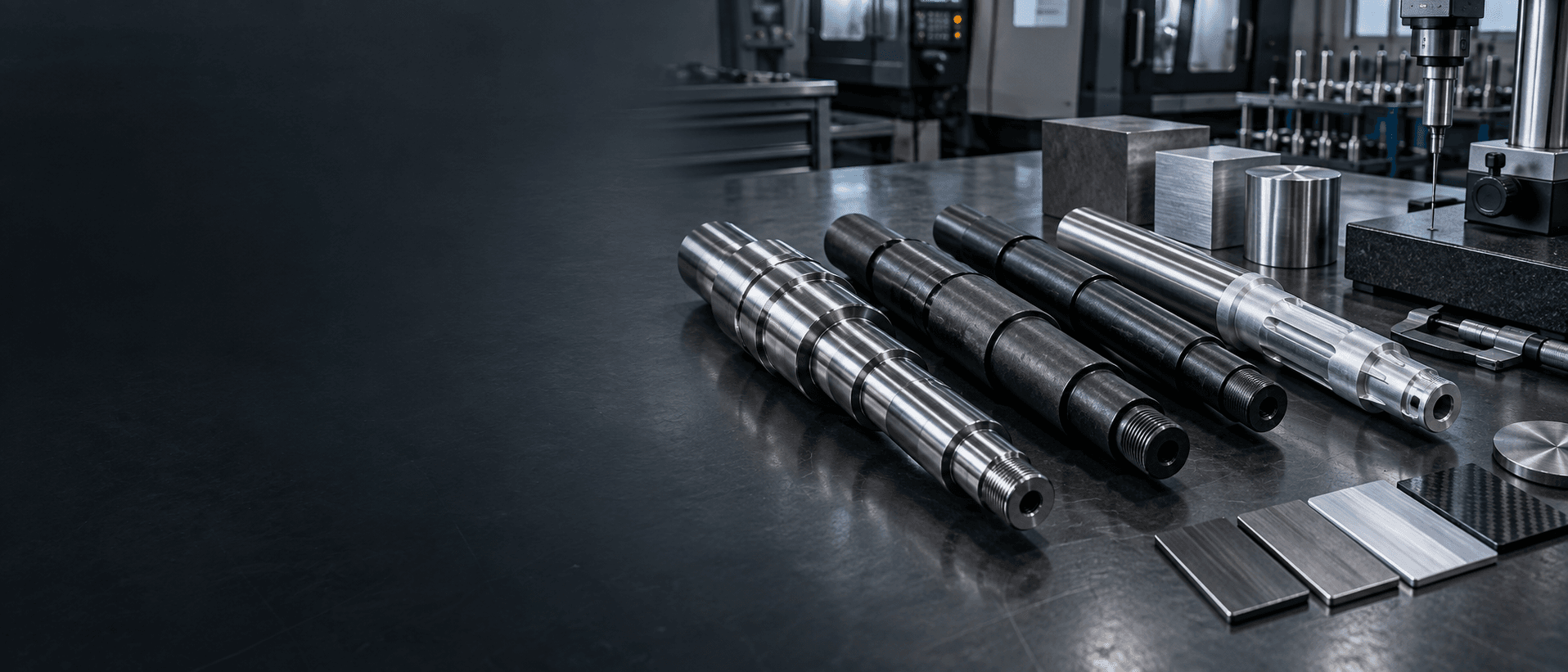
SHAFT MATERIALS & REQUIREMENTS
Materials & Engineering Requirements For Precision Shafts.
Start With The Material. Define The Function. Build The Shaft Around Both.
Topshaft manufactures custom precision shafts from carbon steel, alloy steel, stainless steel, aluminum and other engineering materials according to customer drawings and functional requirements.The right choice depends on torque, fatigue, wear, corrosion, temperature, bearing interfaces, heat treatment, hardness and manufacturing tolerances—not strength alone.Send your drawing, application requirements and quantity for a practical manufacturing review before quotation.MATERIAL SELECTION SNAPSHOT
Choose The Material For The Shaft’s Actual Job.
Materials are not a long generic list. Each direction below connects material behavior with a shaft’s load, functional surfaces, environment and manufacturing route.4140 / 42CrMo
Transmission, drive and higher-load shaftsToughness and heat-treatment responseCarburizing steel
Gear and spline shaftsHard case with tougher coreStainless steel
Corrosion-resistant shaftsEnvironment, strength and surface needs6061 / specialty alloys
Lightweight or application-specific shaftsMass, temperature or stabilityHOW TO CHOOSE
Start With The Application, Not An Alloy Name.
Shaft material selection cannot be separated from torque, fatigue, wear, corrosion, heat treatment, bearing fits, surface hardness, dimensional tolerance and operating conditions.We review the finished shaft requirement—not only the raw-material price.MATERIAL FAMILIES
Material Direction, Functional Trade-Off.
Material grade, condition and processing route need to work as one manufacturing specification. No single grade is automatically “best” for every shaft.1045 / C45 carbon steel
A general-purpose direction where moderate strength, machinability, availability and economical manufacture are important. Condition and treatment still control final properties.4140 / 42CrMo alloy steel
Often evaluated for transmission, gearbox, drive and spline shafts requiring stronger toughness, fatigue performance or heat-treatment response.Carburizing alloy steels
A practical direction for gear and spline interfaces when a hard wear-resistant case and a tougher core are needed.304 & 316 stainless steel
Corrosion-resistant options for wet, washdown or chemical environments; selection follows the actual exposure and functional requirement.17-4PH & 420 stainless
17-4PH combines strength and corrosion resistance in the specified condition. 420 is considered where hardenable stainless and wear resistance matter.6061 aluminum & specialty alloys
For low mass and application-specific needs. Titanium, nickel alloys, copper, brass, Invar, Kovar and engineering plastics are reviewed by requirement, not assumed equivalent.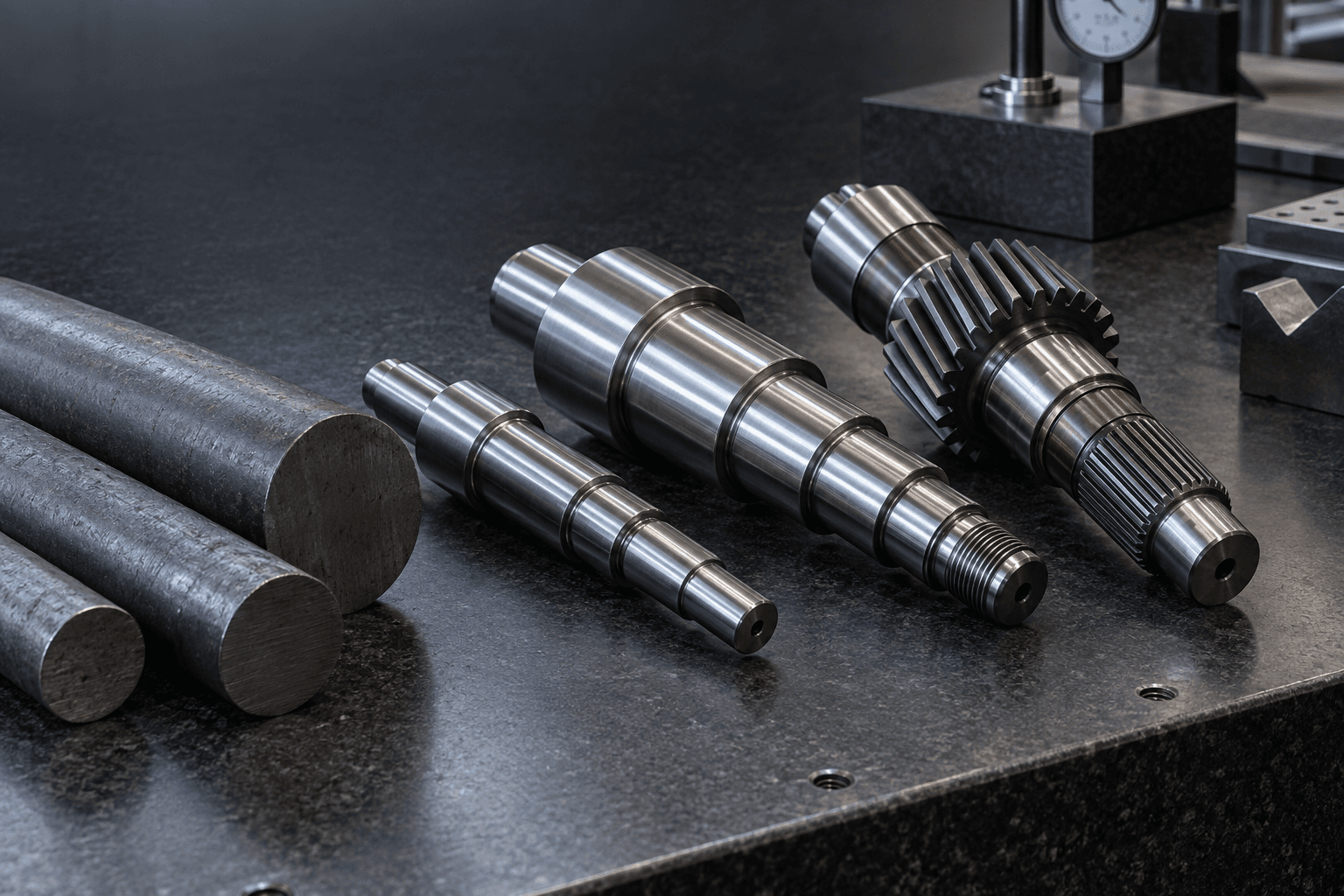
STEEL FOR SHAFTS
1045 Versus 4140 Is A Function Question.
1045/C45 is commonly considered for general-purpose shafts where cost and machinability matter. 4140/42CrMo is often evaluated for higher loads, tougher fatigue conditions or deeper heat-treatment response.There is no universal winner: final selection follows the drawing, heat-treatment condition and actual operating load. Carburizing steels are separately reviewed for gear and spline wear requirements.Explore transmission shafts →APPLICATION MATRIX
Typical Shaft Material Selection By Application.
These are application directions, not automatic recommendations. The customer drawing and operating conditions control the final choice.| Motor shaft | Carbon / alloy steel | Bearing fit, rotor load, runout |
|---|---|---|
| Gearbox shaft | Alloy / carburizing steel | Torque, fatigue, gear and spline wear |
| Pump shaft | Stainless / alloy steel | Corrosion, seal surface, stiffness |
| Robotics shaft | Alloy, stainless or lightweight alloy | Stiffness, mass, compact geometry |
| Spindle shaft | Heat-treatable alloy steel | Bearing accuracy, stiffness, grinding |
| Linear motion shaft | Hardenable steel / stainless | Surface hardness, wear, straightness |
| Agricultural shaft | Alloy steel | Shock load, fatigue, field environment |
| Medical equipment shaft | Stainless / specified alloy | Corrosion, surface quality, traceability |
| Aerospace shaft | Customer-specified steel, titanium or alloy | Strength-to-weight, fatigue, documentation |
WHAT TO DEFINE
Requirements Are Half Of The Shaft Specification.
A material grade alone does not define a functional shaft. Clear requirements align machining, treatment, finishing, inspection and total cost.Material Grade & Condition
Grade, standard, material condition, raw-material form and whether substitution is permitted. Similar names should not automatically be treated as interchangeable.Shaft Geometry
Overall length, maximum diameter, bearing journals, steps, bores, shoulders, grooves, threads, keyways, splines, gears and cross holes.Tolerances & Fits
Define bearing journals, rotor seats, gear, coupling and seal fits. Classes such as h6, g6, k6 or m6 must match the actual mating component.GD&T & Datums
Runout, total runout, straightness, roundness, cylindricity, perpendicularity, position and datum references control feature relationships beyond diameter.Heat Treatment & Hardness
Specify Q&T, induction hardening, carburizing, nitriding, age hardening or stress relieving; state final, surface/core hardness, case depth and local hardened areas.Surface Finish
Define functional surfaces separately: bearing and seal journals, gear seats, clearance diameters and cosmetic surfaces do not automatically need the same finish.Surface Treatment / Coating
Black oxide, zinc, nickel, electroless nickel, passivation, anodizing or other drawing-specified coatings must account for final dimensions, threads and press fits.Operating Conditions
RPM, torque, loads, duty cycle, temperature, corrosion and shock help when material is not final, DFM is requested or substitution is considered.Quantity & Production Stage
Prototype, validation, production quantity and annual demand can change tooling, procurement and process-control decisions.Inspection & Documentation
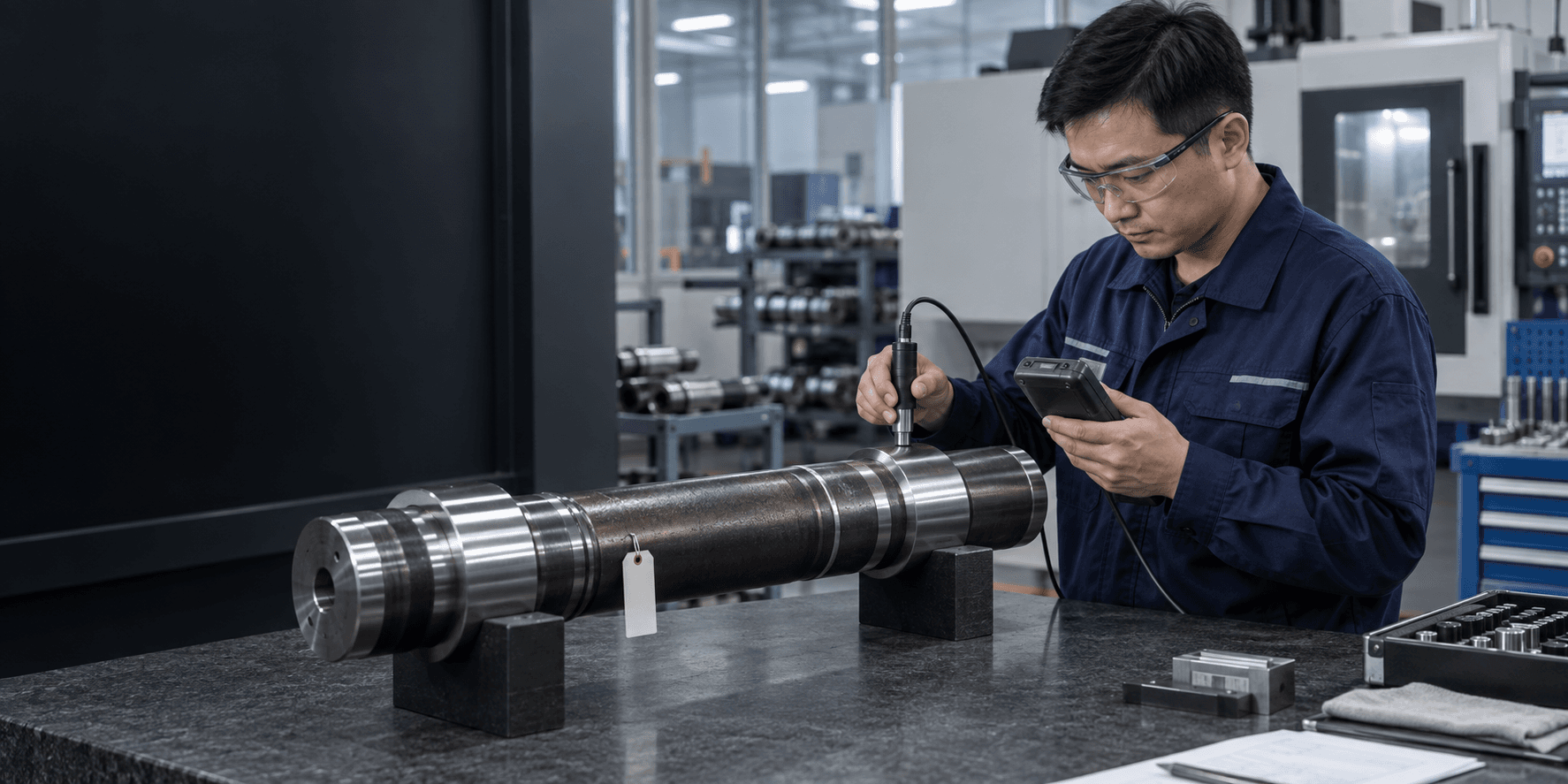
Confirm material certificates, FAI, dimensional/hardness/surface reports, treatment or coating records, C of C, traceability and customer-specific documents during quotation.HEAT TREATMENT, HARDNESS & TRACEABILITY
Define The Requirement Before Material Procurement.
Q&T, induction hardening, carburizing, nitriding, age hardening and stress relieving can change machining sequence and dimensional stability. Critical journals may require post-treatment finishing.Depending on the agreed order, records may include material grade certification, heat or lot information, mechanical-property documentation, supplier certificates and heat-treatment records.- Surface and core hardness
- Case depth and localized hardened areas
- Final dimensions before or after coating
- Material, treatment and inspection records
CORROSION & LIGHTWEIGHT OPTIONS
Stainless And Aluminum Are Not Simple Substitutes.
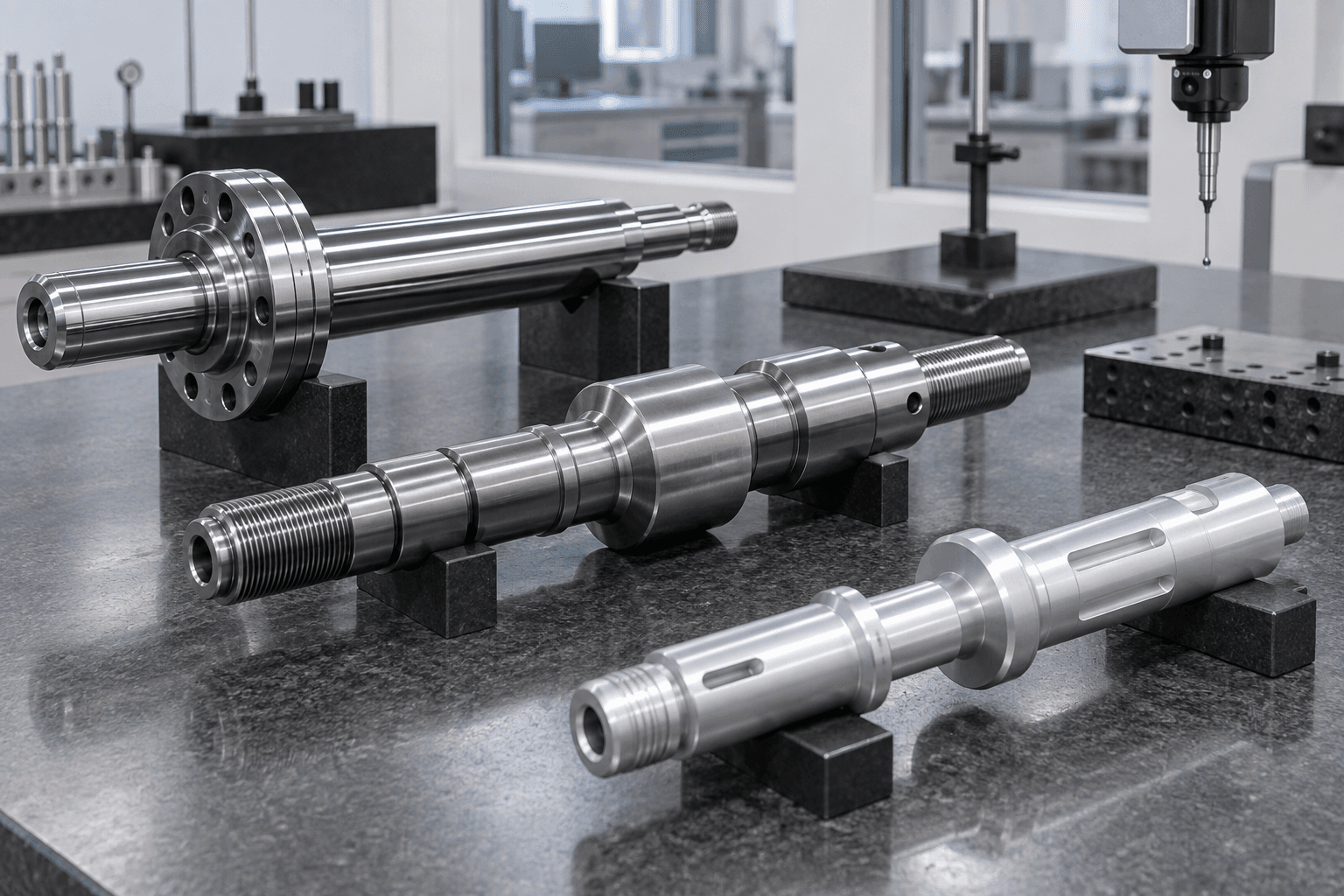
304, 316, 17-4PH and hardenable stainless grades serve different corrosion, strength, hardness and wear requirements. Aluminum can support low mass and lightweight mechanisms, but stiffness, fatigue and bearing contact must be checked.For specialty materials, the review considers temperature, corrosion, electrical, magnetic, weight and dimensional-stability requirements—not a generic material list.Explore pump applications →ONE MANUFACTURING SYSTEM
From Application Requirement To Finished Shaft.
The shaft specification should be reviewed as one connected manufacturing system—not as independent line items.Application requirement
Load, environment, speed, wear and function.Material & condition
Grade, standard, delivery condition and permitted alternatives.Machining & treatment
Turning strategy, heat treatment, distortion control and grinding.Finish, inspection & records
Coating, final surfaces, quality checks and agreed documentation.AVOID SPECIFICATION GAPS
Common Shaft Material Mistakes.
Clear technical intent avoids unnecessary cost, manufacturing ambiguity and inspection risk.Specifying only “steel”
This is too broad to define chemistry, strength, treatment or delivery condition.Naming material without condition
17-4PH, for example, needs its condition such as A, H900 or H1150 defined where relevant.Specifying hardness without a treatment route
Hardness alone can create manufacturing ambiguity and hide distortion risk.Ignoring heat-treatment distortion
Tight journals may need a post-treatment finishing route.Choosing stainless only because it “will not rust”
Stainless grades differ materially in corrosion behavior, strength, hardening and wear response.Over-specifying the material
An unnecessarily expensive alloy can increase cost without improving shaft function.MATERIALS & REQUIREMENTS FAQS
Direct Answers For Your Material Review.
Practical guidance for engineering and sourcing teams defining precision shaft requirements.What materials are commonly used for precision shafts?+
Common directions include 1045/C45 carbon steel, 4140/42CrMo alloy steel, carburizing steels, 304/316/17-4PH/420 stainless steels, 6061 aluminum and application-specific alloys. The drawing and conditions determine the final choice.
What is the best steel for a shaft?+
There is no single best shaft material. Torque, bending, fatigue, wear, corrosion, temperature, heat treatment, manufacturing requirements and cost must all be considered.
What is the difference between 1045 and 4140 for shafts?+
1045 is often considered where general strength, cost and machinability matter. 4140 is commonly reviewed for higher loads, tougher fatigue conditions or deeper heat-treatment response. It is not automatically the right upgrade.
When should stainless steel be used for a shaft?+
Stainless is considered when corrosion, washdown, wet or chemical exposure, surface requirements and the necessary strength or hardness support the application.
Is 17-4PH suitable for shafts?+
17-4PH can be suitable where a specified precipitation-hardening condition, strength and corrosion resistance are required. The drawing should identify the correct condition.
Can aluminum be used for a precision shaft?+
Aluminum can suit lightweight mechanisms, but it is not a direct steel replacement. Stiffness, fatigue, bearing/contact needs and clamping distortion must be checked.
How does heat treatment affect shaft dimensions?+
Treatment can affect size, straightness and runout. Critical journals may require an approved post-treatment grinding or finishing sequence.
Can shaft journals be hardened selectively?+
Yes, specified surfaces can be reviewed for localized hardening. The drawing needs to define the required area, hardness, depth and final dimensional requirement.
Does coating affect shaft tolerance?+
Yes. Coating thickness can affect dimensions, threads and press fits. The drawing should clarify whether limits apply before or after coating.
Can Topshaft provide material certificates?+
Documentation availability and scope, including material certificates, should be confirmed during quotation and order review.
Can Topshaft suggest an alternative shaft material?+
We can discuss manufacturing implications and possible directions when requested, but a substitution requires customer engineering approval if a grade or standard is specified.
What information is needed for a custom shaft quote?+
Send the drawing, material and condition, quantity, tolerances and GD&T, treatment, hardness, finish, coating, critical features, documentation and any special requirements.
READY TO DEFINE THE REQUIREMENT?