
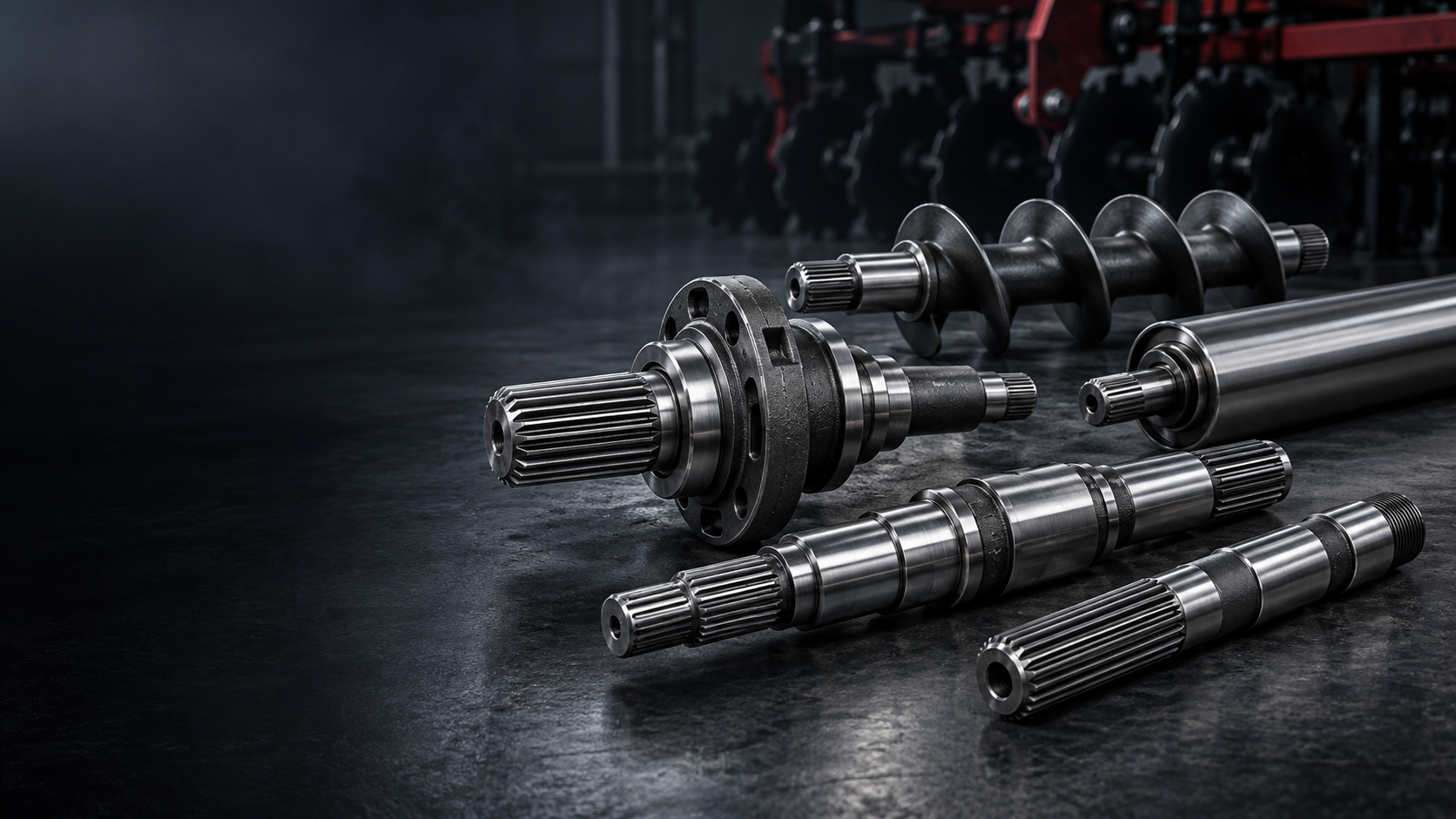
CUSTOM AGRICULTURAL MACHINERY SHAFT MANUFACTURER
Agriculture Precision,
Ready For The Field.
Custom drive, spline, transmission, gearbox, roller and implement shafts manufactured for the torque, shock, wear and field conditions of agricultural machinery.DRIVELINE / GEARBOX / AUGER / HARVEST / IMPLEMENTAGRICULTURAL SHAFT CAPABILITY SNAPSHOT
Built For The
Machine In The Field.
Topshaft manufactures custom precision shaft components for agricultural machinery, equipment OEMs, drivetrain suppliers and replacement-parts projects. Shaft requirements are reviewed around the drawing, working interfaces and the operating conditions of the machine.| Capability | TOPSHAFT support |
|---|---|
| Manufacturing type | Custom / OEM / made to drawing |
| Agricultural shaft roles | Drive, spline, transmission, gearbox, gear, roller, auger, stepped and implement shafts |
| Machining | CNC turning, milling, spline and gear features, grinding and finishing |
| Materials | Carbon, alloy, carburizing and selected stainless steels; aluminum where applicable |
| Heat treatment | Q&T, induction hardening, carburizing, nitriding, stress-relieving and drawing-specified routes |
| Field-relevant controls | Torque interfaces, straightness, runout, bearing and seal surfaces, hardness, wear and corrosion protection |
| Project support | Prototype, drawing/sample evaluation where appropriate, first article and repeat OEM production |
| Inspection | Dimensional, geometric, surface and drawing-specific inspection |
AGRICULTURAL MACHINE POWER PATH
Power From Prime Mover
To Implement.
The page focuses on precision shaft components used within agricultural driveline and implement systems. It does not represent a claim to supply complete guarded PTO assemblies.Tractor / Prime Mover ↓ PTO / Driveline ↓ Agricultural Gearbox ↓ Implement Shaft ↓ Cutter / Auger / Roller
Agricultural shafts work under changing conditions.
Torque, shock, contamination, outdoor exposure and intensive seasonal duty can all affect the required shaft material, interfaces, surface condition, treatment and inspection plan.
For field equipment, the required protection should reflect the actual working environment—not appearance alone.
PRECISION SHAFT SOLUTIONS FOR AGRICULTURAL MACHINERY
One Implement,
Several Shaft Roles.
Agricultural machinery includes field driveline, gearboxes, harvesting, crop movement, rotary implements and precision metering systems. Each system brings a distinct set of load and interface requirements.AGRICULTURAL MACHINERY SHAFT APPLICATIONS AT A GLANCE
Match The Shaft To
The Equipment Function.
| Agricultural equipment | Typical shaft components | Main engineering requirements |
|---|---|---|
| PTO / implement driveline | Drive / spline / transmission shaft | Torque, shock load, spline fit, fatigue |
| Agricultural gearbox | Gear / transmission / stepped shaft | Gear alignment, bearing journals, treatment |
| Harvester / baler | Drive / roller / gear shaft | Repeated load, debris, shock, bearing protection |
| Auger / conveyor | Drive / roller / stepped shaft | Span, bending, torsion, straightness |
| Tillage / mowing | Drive / spline / gear shaft | Impact, torque spikes, toughness, wear |
| Planting / seeding | Roller / threaded / custom shaft | Alignment, repeatable rotation, corrosion resistance |
| Feed mixer | Transmission / gearbox / auger shaft | Torque, bending, fatigue, contamination |
| Fertilizer equipment | Drive / roller / spline shaft | Corrosion environment, interfaces, serviceability |
WHAT MAKES AN AGRICULTURAL MACHINERY SHAFT DIFFERENT?
Field Conditions
Change The Requirement.
- 01Shock loadingStones, hard ground, crop jams and starts/stops can introduce high transient torque.
- 02Dirt, dust and mudContamination can increase the importance of bearing, seal and journal surfaces.
- 03Moisture and corrosionRain, washdown, fertilizer, manure and humidity can influence material and surface protection.
- 04Seasonal intensive dutyMachines may work continuously during planting or harvest periods.
- 05Field maintenanceServiceability, replaceable interfaces and reliable fit can matter in working equipment.
- 06WearSplines, gears, contact surfaces and journals may need drawing-specified treatment or finish.
WHAT LOADS ACT ON AGRICULTURAL MACHINERY SHAFTS?
Power Transfer Is
Not A Smooth Load.
The selected geometry, material and route should follow the supplied working conditions. Relevant inputs include machine type, RPM, continuous torque, peak torque where available, radial and axial load, duty cycle and environment.- Torsion: generated while shafts transfer power
- Bending: from gears, sprockets, belts, rollers, augers and overhung components
- Axial load: from helical gears, thrust mechanisms and auger processes
- Shock load: particularly relevant in field machinery and crop-jam conditions
- Cyclic fatigue: from thousands or millions of repeated load cycles
CRITICAL AGRICULTURAL SHAFT CHARACTERISTICS
Measure The Surfaces
That Keep Working.
Final CTQs are defined by the customer drawing. These are common controls for bearing support, gearbox operation, torque-transfer interfaces and field-facing durability requirements.Discuss Your Agricultural Shaft →| CTQ | Why it matters |
|---|---|
| Bearing Journal Diameter | Controls bearing fit |
| Shaft Straightness | Important on augers, rollers and long shafts |
| Runout | Controls stable rotation |
| Coaxiality | Aligns multiple functional diameters |
| Spline Fit | Transfers PTO and gearbox torque |
| Keyway Geometry | Controls keyed drive interfaces |
| Gear-to-Journal Alignment | Supports gearbox operation |
| Shoulder Position | Controls axial component location |
| Surface Roughness | Important for bearings and seals |
| Hardness | Supports wear and fatigue resistance |
| Case Depth | Important for hardened splines/gears |
| Corrosion Protection | Important for field exposure |
MATERIALS, HEAT TREATMENT & SURFACE PROTECTION
Choose The Route For
Load And Environment.
| Material | Typical use | Why it is selected |
|---|---|---|
| 1045 / C45 | General machine shafts | Strength and machinability |
| 4140 / 42CrMo | PTO, drive and transmission shafts | Strength and toughness |
| 4340 | Higher-load shafts | Higher mechanical performance |
| Carburizing alloy steel | Gear and spline shafts | Hard case with a tough core |
| 17-4PH stainless | Specialized components | Strength plus corrosion resistance |
| 304 / 316 stainless | Corrosive / washdown applications | Corrosion resistance |
| Aluminum | Lightweight mechanisms | Reduced mass |
Quenching & Tempering
Drive, transmission and heavy-duty mechanical shaft strength and toughness where specified.
Induction Hardening
Selected wear areas such as splines, bearing journals and contact surfaces.
Carburizing
Gear and spline components requiring a hard case and tougher core.
Nitriding
Hard wear surfaces on compatible materials where specified.
Surface Protection
Depending on material and drawing: black oxide, zinc/nickel plating, passivation, painting/coating or application-specific protection.
AGRICULTURAL SHAFT MANUFACTURING PROCESSES
Build The Drive Features
In The Right Route.
Turning, milling, spline and gear features, heat treatment, grinding and surface finishing are planned around the supplied drawing and equipment requirements.CNC Turning
Bearing journals, stepped diameters, shoulders, grooves and threads.
Milling
Keyways, flats, holes and specialized interfaces.
Spline Machining
PTO-related, drivetrain and gearbox torque-transfer interfaces.
Gear Machining
Agricultural gearbox, reducer and pinion shaft features.
Precision Grinding
Bearing journals, seal surfaces and hardened diameters where specified.
Heat Treatment & Finishing
Integrated around the drawing, working load and environmental requirements.
FROM AGRICULTURAL EQUIPMENT DRAWING TO PRODUCTION SHAFT
Review The Field Role
Before The Route.
The manufacturing sequence follows the relationships that the shaft needs to support in the implement, gearbox, auger, conveyor or rotating mechanism.- 01Machine & Application ReviewPlanned around the drawing and confirmed project requirements.
- 02Identify Load, Interfaces & CTQsConfirm load, spline/gear/coupling interfaces, bearing and seal requirements.
- 03Material / Heat-Treatment PlanningReview material, treatment, hardness, case depth and surface-protection requirements.
- 04CNC Shaft MachiningPlanned around the drawing and confirmed project requirements.
- 05Spline / Gear / Secondary FeaturesPlanned around the drawing and confirmed project requirements.
- 06Heat TreatmentPlanned around the drawing and confirmed project requirements.
- 07Grinding / Surface FinishingPlanned around the drawing and confirmed project requirements.
- 08Functional InspectionVerify drawing-defined geometry, surface and treatment requirements.
- 09Production & DeliveryPlanned around the drawing and confirmed project requirements.
Machine review → Loads & CTQs → Material route → Machining → Treatment → Finishing → Inspection
CUSTOM REPLACEMENT SHAFTS FOR EXISTING FARM EQUIPMENT
Support The
Equipment Lifecycle.
Agricultural equipment can remain in operation for many years. Original shaft components may eventually be difficult to source.Where suitable, project review can use
- Original, legacy or updated engineering drawings
- Physical samples for evaluation where an appropriate manufacturing assessment is possible
- Mating-component, bearing, gear or spline information
- Requirements for harvesters, feed mixers, augers, gearboxes or mower equipment
AGRICULTURAL SHAFT QUALITY CONTROL
Inspect The
Functional Interfaces.
Inspection methods and documentation are confirmed project by project during quotation and supplier qualification.Inspection may include
- Diameter, length, straightness, runout, coaxiality and roundness
- Spline geometry, keyway dimensions, gear features and threads
- Surface roughness, hardness and case depth where specified
- Agreed dimensional reports, first-article records and material / treatment documentation
DFM CONSIDERATIONS FOR AGRICULTURAL MACHINERY SHAFTS
Define The Working
Interfaces Early.
Better functional data supports a more useful manufacturing review and avoids applying unnecessary precision to non-critical dimensions.Useful engineering inputs
- Define torque interfaces: spline, keyway, coupling, gear and sprocket
- State if the shaft drives a tiller, cutter, auger, baler or mixer where relevant
- Define bearing and seal interfaces for contaminated field environments
- Provide RPM, continuous torque and peak torque where available
- Specify material, treatment, hardness, case depth and corrosion protection
- Include outdoor exposure, fertilizer, water, mud or chemical requirements
WHY TOPSHAFT FOR AGRICULTURAL SHAFT MANUFACTURING
Shaft-Focused,
Field-Aware.
Agricultural projects can bring turning, milling, spline/gear interfaces, treatment, grinding and finishing into one drawing-led route.Project approach
- Review torque transfer, peak-load conditions and critical shaft interfaces
- Support prototypes, engineering samples, validation quantities and repeat production
- Manufacture and inspect to the approved drawing and agreed quality requirements
- Use the specialized product and industry pages for deeper shaft-specific engineering detail
WHAT INFORMATION IS NEEDED FOR AN AGRICULTURAL SHAFT QUOTE?
Send The Data That
Defines The Field Role.
Complete drawing, geometry, transmission, load, environmental, material and commercial data enables a more useful engineering and process review.Upload Your Agricultural Shaft Drawing →| Information group | Include where available |
|---|---|
| Drawing / part information | 2D drawing, 3D CAD model, existing sample where relevant and part number |
| Shaft geometry | Overall length, diameters, bearing journals, shoulders, threads, bores and grooves |
| Transmission features | Spline, keyway, gear, sprocket/pulley seat and coupling interface |
| Operating conditions | Machine type, RPM, continuous torque, peak torque, radial load, duty cycle and outdoor/corrosive environment |
| Material / treatment | Material grade, heat treatment, hardness, case depth and surface protection |
| Commercial requirements | Prototype quantity, production quantity, annual demand, inspection documents and target delivery |
RELATED AGRICULTURAL SHAFT SOLUTIONS
Follow The Equipment Function,
Then Open The Product.
01Drive ShaftPTO / implement power transfer→02Spline ShaftPTO-related and gearbox spline interfaces→03Gearbox IndustryAgricultural gearbox system requirements→04Transmission ShaftGearbox and internal driveline shafts→05Gear ShaftIntegrated gearing→06Helical Gear ShaftHelical reducer applications→07Roller ShaftAuger and conveyor-related systems→08Stepped ShaftMultiple bearing and interface locations→09Hollow ShaftThrough-bore designs→
View All Precision Shaft Products →AGRICULTURAL MACHINERY SHAFT FAQS
Answers For The
Equipment Drawing Review.
Practical questions for agricultural equipment OEMs, drivetrain buyers and engineering teams.What types of shafts are used in agricultural machinery?+
Agricultural machinery can use drive, spline, transmission, gearbox, gear, roller, auger and stepped shafts depending on how the machine transfers power, conveys material or drives an implement.
What agricultural shaft components can TOPSHAFT manufacture?+
Custom projects can be reviewed from customer drawings and requirements for drive, spline, transmission, gearbox, gear, roller, auger, stepped and other shaft components.
Can TOPSHAFT manufacture PTO-related spline and drive shafts?+
PTO-related driveline component projects can be evaluated from the spline, drive, bearing, coupling, material, treatment and drawing requirements. The page describes shaft components, not complete guarded PTO driveline assemblies.
What materials are used for agricultural equipment shafts?+
Material selection follows load, fatigue, wear, treatment and environmental requirements. Typical choices include carbon, alloy, carburizing and selected stainless steels, plus aluminum for suitable lightweight mechanisms.
Why are agricultural shafts heat treated?+
Specified treatment can support strength, toughness, fatigue resistance and wear resistance on drive, gear, spline and bearing-related surfaces.
How do you manufacture shafts for high-shock agricultural equipment?+
The supplied application, torque, shock, material, geometry, transition, treatment and critical feature requirements are reviewed together. Final design responsibility remains with the customer or their engineering team.
Can TOPSHAFT manufacture auger and conveyor shafts?+
Auger and conveyor shaft projects can be reviewed from shaft span, torsional and bending load, bearing support, sprocket or pulley interfaces, straightness and environmental requirements.
Can you manufacture agricultural gearbox shafts?+
Gearbox shaft projects can be evaluated from the complete gear, spline, journal, material, treatment, torque and inspection requirements; see the Gearbox industry page for more system detail.
Can you make replacement shafts for older agricultural machinery?+
Where suitable, projects can be reviewed from an original, legacy or updated drawing, or a physical sample and mating-component data. Requirements are confirmed project by project.
What surface treatments are suitable for agricultural shafts?+
The selected surface protection should follow the material and actual environment. Depending on the drawing, options can include black oxide, zinc or nickel plating, passivation, painting/coating or other application-specific protection.
Can bearing journals be precision ground?+
Where specified, final grinding can control critical bearing, seal and hardened functional surfaces.
What information is needed for an agricultural shaft quotation?+
Provide the drawing or CAD model, geometry, transmission features, operating RPM, continuous and peak torque where available, environmental requirements, material/treatment, quantity and documentation needs.
NEED A CUSTOM AGRICULTURAL MACHINERY SHAFT?