
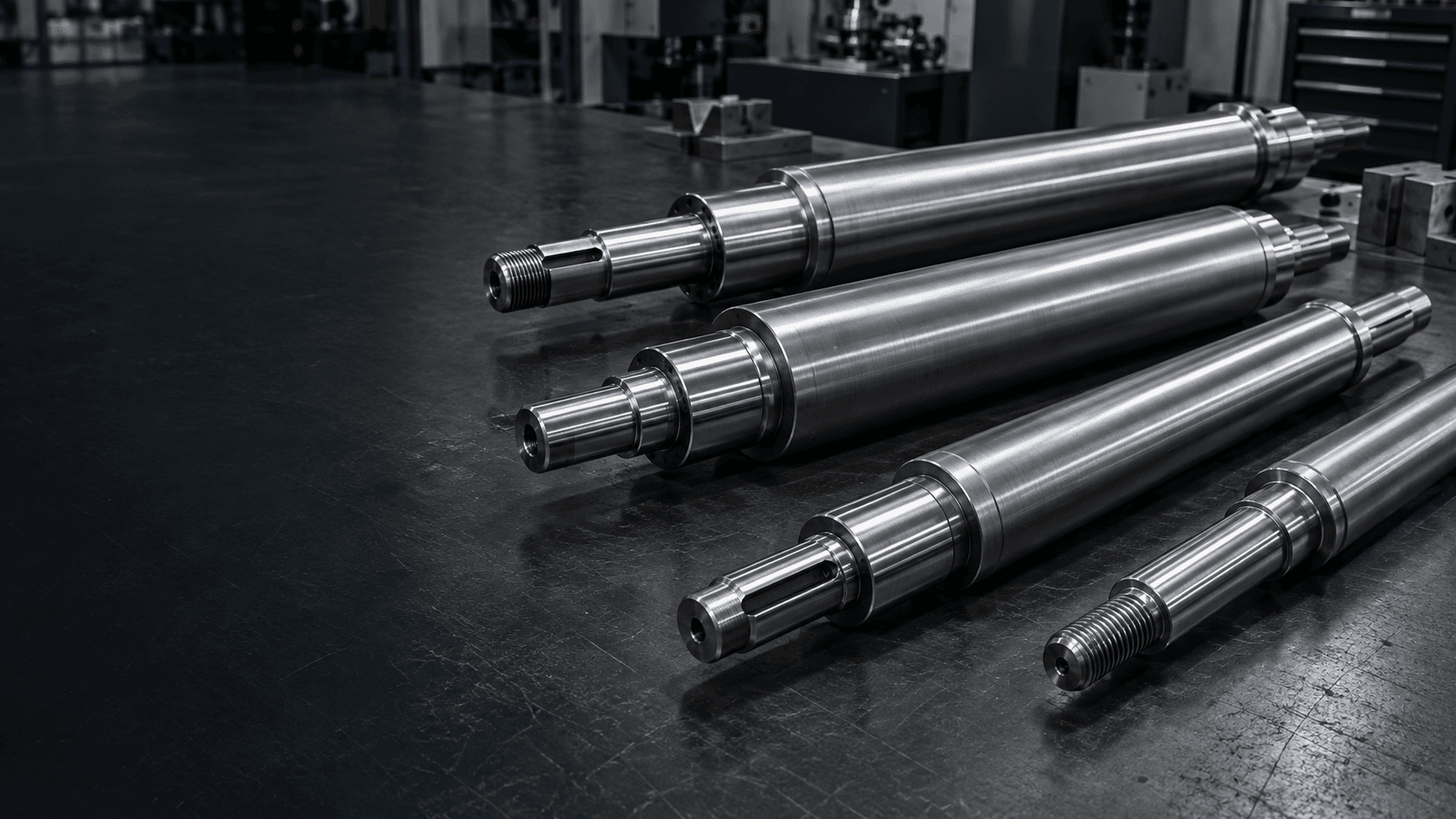
CUSTOM ROLLER SHAFT MANUFACTURER
Custom Roller
Shafts
Stable support for smooth, accurate roller rotation.
Custom roller shafts with precision bearing journals, controlled straightness and engineered drive or mounting features for conveyors, printing, packaging and industrial roller systems.We review the bearing arrangement, shaft span, roller interface, load, runout and material requirements around your drawing.
For long or precision rollers, include bearing span, operating load and maximum RPM whenever available.ROLLER SHAFT ENGINEERING SNAPSHOT
Support the roller over its complete working span.
Roller-related support, bearing fits, shaft stiffness and alignment are reviewed as one rotating system.- Core function
- Support, locate or drive an industrial roller assembly
- Critical geometry
- Bearing journals, shaft span, straightness, runout and roller-seat alignment
- Configurations
- Live shaft, dead shaft, driven roller and idler roller designs
- Drive interfaces
- Keyways, splines, sprocket seats, pulley seats, flanges and threads
- Manufacturing
- CNC turning, secondary features, treatment and selective journal grinding
- Project review
- Bearing span, load, maximum RPM and roller-to-shaft connection
WHAT IS A ROLLER SHAFT?
A shaft architecture built around roller support and alignment.
A roller shaft can support, locate or drive an industrial roller. It may carry the roller directly, connect through hubs or end plates, or remain stationary while a roller rotates on bearings around it.
Its engineering focus is not only torque transfer. Bearing locations, shaft span, radial loading, roller mounting and straightness determine how accurately the complete roller system runs.
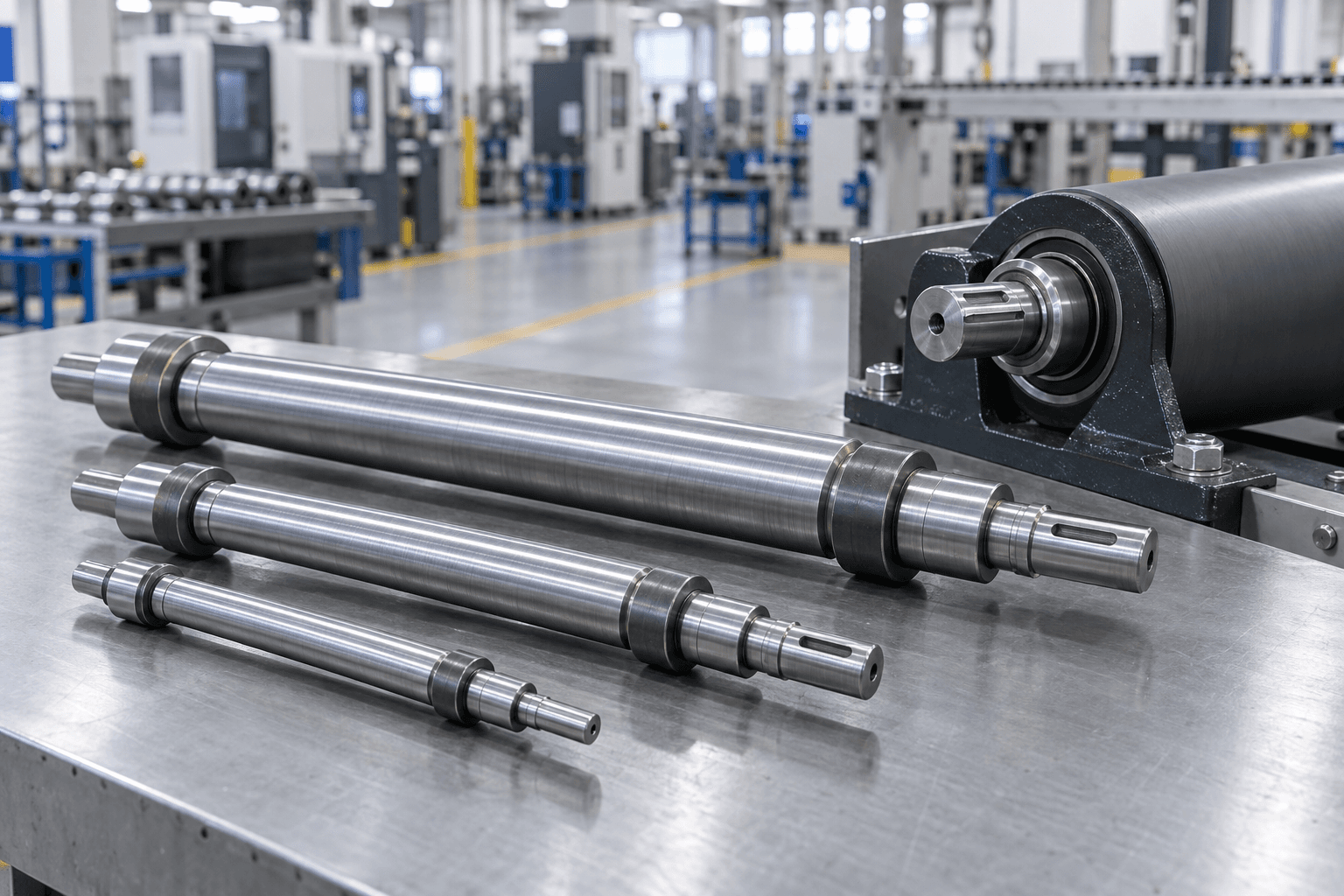
ROLLER SYSTEM FEATURES
What defines a custom roller shaft?
Roller mounting seats
Diameters and shoulders connecting the shaft to hubs, shells or end plates.Shaft span
The unsupported length that influences bending stiffness and deflection.Drive end
Keyway, spline, sprocket, pulley, coupling or drawing-defined torque interface.Live or dead architecture
Whether the shaft rotates with the roller or remains fixed inside it.Functional datum
Journal-to-journal alignment controlling the roller’s intended axis.LOAD—AXIS—SUPPORT WORKFLOW
How are roller shafts manufactured?
The route begins with the roller configuration and bearing arrangement, then matches the machining process to the shaft span and critical surfaces.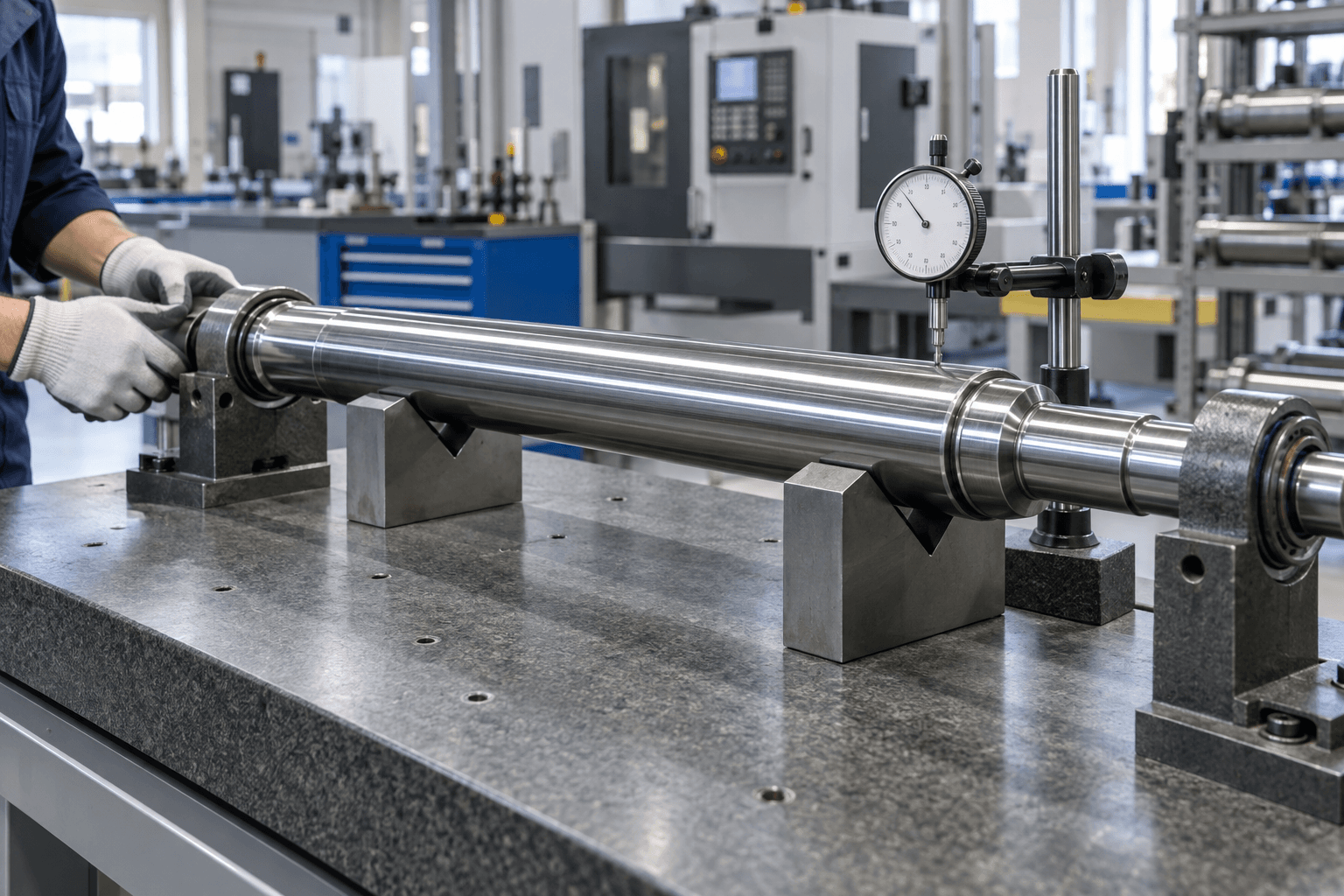
STRAIGHTNESS AND RUNOUT
Long shafts need the correct axis from end to end.
Length, radial load and bearing spacing can make deflection and geometric control important. Both bearing journals need to support the intended roller axis, while roller-mounting surfaces must locate the assembly concentrically.- Overall length, shaft span and bearing-journal diameters
- Journal roundness, cylindricity and bearing fit surfaces
- Journal-to-journal alignment, straightness and radial runout
- Roller-seat diameter and roller-to-shaft concentricity
- Drive-end geometry, shoulder locations and surface roughness
STIFFNESS AND CONFIGURATION
Roller function determines the manufacturing priorities.
A driven roller shaft may need a torque connection; an idler roller may not. A long shaft can need particular attention to support and straightness, while a hollow design may reduce mass but must be reviewed around stiffness and load.Driven vs. idler
Driven rollers use a drawing-defined power-transfer feature. Idler rollers focus on support, bearing arrangement and low-friction rotation.
Solid vs. hollow
Hollow geometry can reduce rotating mass or create internal space, but OD, ID, wall thickness, load and span must be assessed together.
APPLICATION CONTEXT
Where are custom roller shafts used?
Conveyor systems
Support or drive material-handling rollers.Printing equipment
Maintain web and roller alignment through production processes.Packaging machinery
Guide, feed and drive product or film-handling rollers.Web handling
Support rollers for film, paper, textile and converting systems.Food & washdown equipment
Material choices based on the actual corrosion and cleaning environment.Special-purpose machinery
Drawing-specific roller, hub and bearing arrangements.RELATED SHAFT TYPES
Roller support is different from a generic torque path.
Roller Shaft vs. Drive Shaft
A roller shaft supports or drives a roller assembly; a drive shaft principally transfers torque between mechanical units.Explore →Roller Shaft vs. Spindle Shaft
Spindles are engineered around a precision working axis and tool interface. Roller shafts focus on roller support, span and alignment.Explore →Roller Shaft vs. Stepped Shaft
Stepped shaft describes multiple diameter geometry. Roller shaft defines the roller-support application and its bearing arrangement.Explore →Roller Shaft vs. Hollow Shaft
Hollow describes bore geometry. A roller shaft can be solid or hollow depending on weight, stiffness and assembly requirements.Explore →PREPARE YOUR RFQ
What is needed for a roller shaft quote?
Roller configuration and operating data help us review the complete shaft system.- 01Overall length, maximum diameter, bearing journals and bearing spacing
- 02Live/dead shaft configuration, roller diameter, length and mounting connection
- 03Keyway, spline, sprocket, pulley, coupling, thread or flange details
- 04Radial load, maximum RPM, torque if driven and web/belt tension where relevant
- 05Fits, straightness, runout, coaxiality, surface roughness and GD&T
- 06Material, treatment, coating, quantity and inspection documentation
ROLLER SHAFT FAQS
Common engineering questions.
Practical guidance for conveyor, web-handling and industrial machinery teams.What is a roller shaft?+
A roller shaft supports, locates or drives an industrial roller in conveying, printing, packaging, web-handling and other rotating machinery.
What is the difference between a live and dead shaft?+
In a live-shaft roller, the shaft rotates with the roller body. In a dead-shaft roller, the shaft remains stationary while the roller rotates on bearings around it.
Why does roller shaft straightness matter?+
Straightness helps maintain the intended roller axis. Excessive bending or geometric error can affect bearing alignment, runout and roller position.
Can roller shafts be driven?+
Yes. Driven roller shafts can include keyways, splines, sprocket or pulley seats, couplings and other torque-transfer features according to the drawing.
Can bearing journals be ground?+
Yes. Grinding can be applied where bearing-seat diameter, roundness, cylindricity or surface-finish requirements justify it.
Can Topshaft evaluate long roller shafts?+
Long-shaft projects can be reviewed from diameter, length, material, bearing span, straightness and operating requirements. The correct route follows the supplied drawing.
READY TO START?