
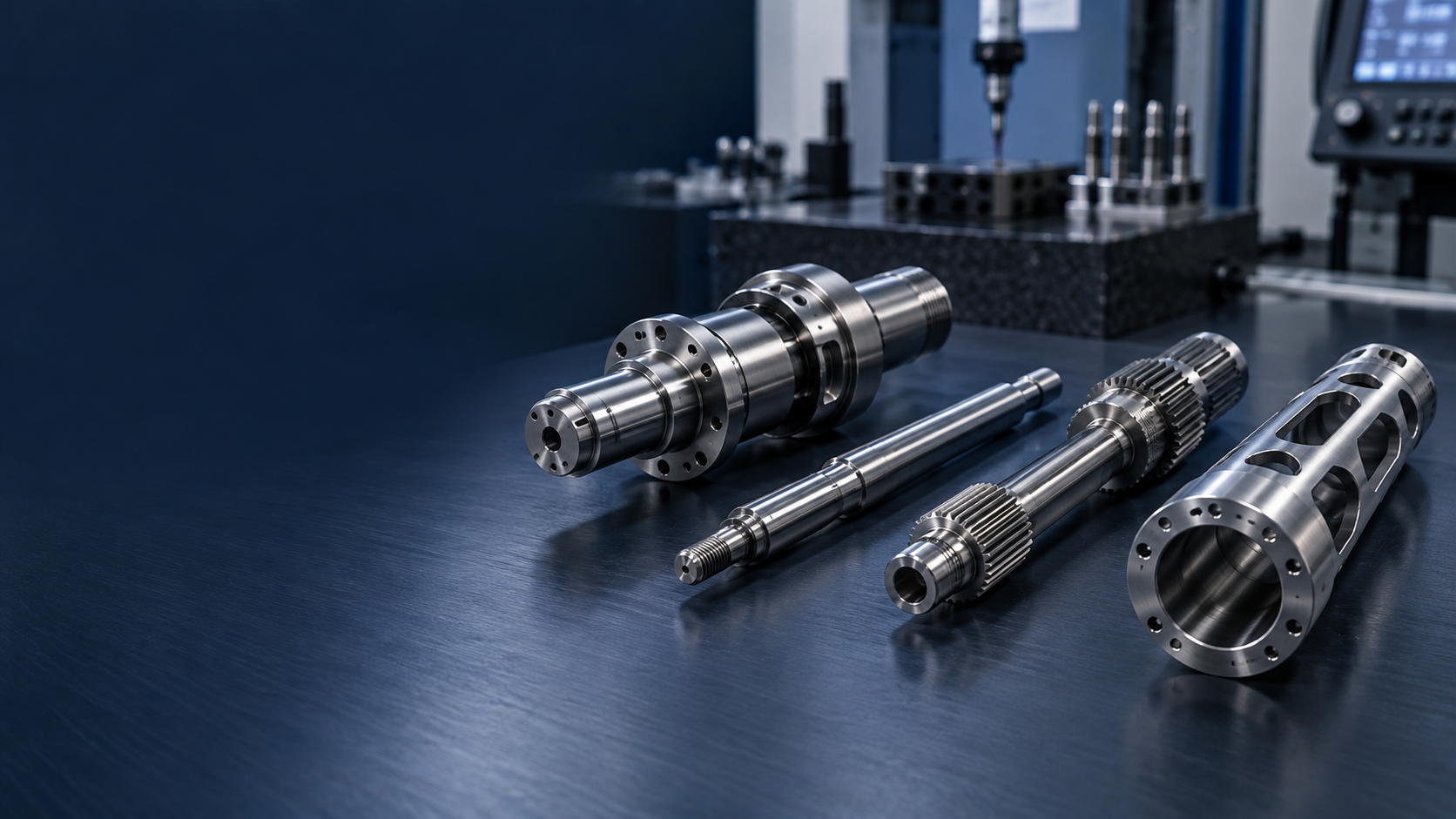
AEROSPACE SHAFT MANUFACTURING
Custom Precision Shafts
For Aerospace Systems.
Aerospace Precision, Made for Critical Interfaces. Custom actuator, motor, hollow, gear, spline and motion-control shaft components manufactured around approved material, dimensional, inspection and documentation requirements.ACTUATORS / MOTORS / GEARS / SPLINES / GRINDINGAEROSPACE SHAFT CAPABILITY SNAPSHOT
Precision Components
For Controlled Motion.
TOPSHAFT manufactures drawing-defined precision shaft components for aerospace systems and equipment. The focus is controlled mechanical interfaces—not unsupported claims of airworthiness approval, flight certification or full-system qualification.| Capability | TOPSHAFT support |
|---|---|
| Manufacturing focus | Custom precision shaft components for aerospace actuation, motors, gearboxes, UAV systems and precision mechanisms |
| Shaft roles | Actuator, motor, rotor, gear, spline, hollow, spindle, threaded and stepped shaft components |
| Functional geometry | Bearing journals, rotor seats, splines, gears, threads, shoulders, bores and output interfaces |
| Critical controls | Runout, straightness, coaxiality, bearing fit, surface finish, fatigue-sensitive transitions and revision control |
| Processes | CNC turning and milling, gear/spline features, deep-bore machining, grinding, finishing and inspection |
| Project support | Prototype, drawing review, agreed documentation, first article discussion and repeat OEM production |
PRECISION SHAFT SOLUTIONS FOR AEROSPACE SYSTEMS
Built Around
The Motion System.
Aerospace components work within defined actuation, motor, gearbox, UAV and precision-mechanism architectures. The drawing should identify interfaces, material condition, CTQs and documentation that control the component.AEROSPACE SHAFT APPLICATIONS AT A GLANCE
Match The Shaft
To The System.
A clear system → shaft component → requirement relationship supports better RFQ data and a practical manufacturing review.| Aerospace system | Typical shaft component | Main engineering focus |
|---|---|---|
| Flight-control / utility actuation | Actuator, motor and stepped shaft | Bearing fits, threads, runout, axial interfaces |
| Motor / servo system | Rotor or motor shaft | Bearing alignment, rotor seat, encoder end |
| Gearbox / rotary actuation | Gear, spline and transmission shaft | Torque interface, gear-to-journal alignment |
| OEM UAV system | Lightweight motor or drive shaft | Compact geometry, low mass, rotational accuracy |
| Landing-gear / steering utility | Actuator or threaded drive shaft | Load interfaces, wear geometry, traceability |
| Precision mechanism | Hollow, spindle or stepped shaft | Packaging, alignment, controlled motion |
| Ground-support / auxiliary equipment | Motor or drive shaft | Drawing-specified operational interfaces |
WHERE DOES THE SHAFT FIT IN AEROSPACE ACTUATION?
Controlled Motion.
Critical Interfaces.
TOPSHAFT manufactures the drawing-defined shaft components that connect functional interfaces in controlled-motion equipment. The finished system's certification, qualification and performance remain outside the scope of this component page.Control Input → Servo / Motor → Motor Shaft → Gear / Spline Stage → Output Shaft → Linkage
Typical shaft relationships
- Motor and rotor shafts establish bearing and encoder interfaces
- Gear and spline shafts transfer torque across controlled stages
- Actuator shafts connect drawing-specified output geometry
- Hollow or stepped shafts can support compact packaging requirements
WHAT MAKES AN AEROSPACE SHAFT DIFFERENT?
More Than An
Individual Diameter.
Aerospace buyers often need the relationship among bearing journals, gear or spline features and output interfaces controlled around the correct datums—not merely nominal diameters.Engineering themes
- Strength, stiffness and mass trade-offs
- Fatigue-sensitive shoulders, splines and threads
- Functional alignment and surface integrity
CONFIGURATION & TRACEABILITY
Make The Drawing
The Control Point.
Projects may need the manufactured component linked to the correct drawing revision, material condition, processing route and inspection documentation. Those requirements should be visible before quotation.Review points
- Controlled part number and revision
- Material, lot and process traceability where agreed
- FOD / cleanliness and marking needs defined by the customer
WEIGHT, FATIGUE & FUNCTION
Use The Material
For The Real Load Case.
Hollow geometry, compact interfaces and selected materials may be useful when mass, stiffness, fatigue or routing requirements drive the drawing. Final design substantiation belongs to the responsible customer team.Useful RFQ inputs
- Load, speed, duty-cycle and environment data where available
- Bearings, interfaces and functional datum scheme
- Material condition, treatment and surface requirements
QUALITY-SYSTEM REQUIREMENTS
Confirm The
Project Requirement.
Certification and documentation requirements must be agreed before quotation. TOPSHAFT does not state AS9100, AS9102 or Nadcap status on this page; project-specific requirements are reviewed against confirmed supplier controls.Potential documentation discussion
- Material certificates and heat / lot traceability
- Dimensional, CMM and certificate-of-conformance records
- First article, special-process and customer-specific documentation
CRITICAL AEROSPACE SHAFT CHARACTERISTICS
Inspect The Features
That Define The Axis.
The component is manufactured and inspected against its approved drawing, relevant datums and agreed project requirements. System-level performance is validated by the customer.| CTQ | Why it matters |
|---|---|
| Bearing journal diameter | Controls bearing fit |
| Journal roundness | Supports consistent rotation |
| Journal coaxiality | Defines the functional shaft axis |
| Runout | Influences rotor and actuator alignment |
| Straightness | Important for slender shaft components |
| Spline / gear relationship | Controls torque-transfer interface |
| Thread geometry | Controls actuator and retention interfaces |
| Shoulder position | Controls axial stack-up |
| Surface roughness | Relevant to bearings, seals and precision fits |
| Hardness | Supports drawing-specified wear and fatigue requirements |
| Bore / wall relationship | Important on hollow or lightweight components |
| Revision & traceability | Links manufacture to approved project requirements |
MATERIALS FOR AEROSPACE SHAFT COMPONENTS
Specified By The
Program And Drawing.
Aerospace materials should be purchased and processed to the exact customer-specified material standard and condition where required. The list below is a review framework, not a claim of universal material approval.Discuss Your Material Requirement →| Material direction | Potential use | Main consideration |
|---|---|---|
| Alloy steel | Actuation and gearbox shaft components | Strength, fatigue and heat-treatment direction |
| 17-4PH / 15-5PH-type stainless | Precision corrosion-resistant shaft components | Strength plus corrosion resistance |
| 300-series stainless | Corrosion-sensitive components | Environmental resistance |
| Aluminum alloys | Lightweight drawing-specified components | Low mass and specified grade/condition |
| Titanium alloys | Lightweight high-strength projects | Customer-specified alloy, condition and process route |
| Nickel alloys | High-temperature or special applications | Temperature and corrosion context |
| Customer-specified AMS material | Program-controlled aerospace work | Exact specification, condition and traceability |
AEROSPACE SHAFT MANUFACTURING PROCESSES
Linked Processes
For Controlled Geometry.
Turning, machining, applicable secondary processes, grinding and inspection are planned as one route around approved component requirements.CNC Turning
Bearing journals, steps, shoulders, rotor seats and threads.
Swiss-Type Machining
Miniature shafts, long slender components and compact servo features.
CNC Milling
Keyways, flats, slots, cross holes and functional interfaces.
Gear & Spline Machining
Torque-transfer geometry for actuator and gearbox components.
Deep-Bore / Hollow Machining
Drawing-specified through-bores, internal passages and lightweight layouts.
Precision Grinding
Bearing journals, rotor seats, hardened diameters and precision fits.
FROM AEROSPACE DRAWING TO FINISHED SHAFT
Control The Route
Before Production.
Projects are reviewed around drawing revision, functional datums, material, CTQs, processing, inspection, documentation and commercial requirements. Controlled-data and export-related arrangements should be established before transfer where applicable.- 01Drawing & Specification ReviewPlanned around the approved drawing and confirmed project requirements.
- 02Revision, Material & CTQ ReviewConfirm drawing revision, material condition, critical dimensions and project documentation needs.
- 03Manufacturing & Inspection PlanningPlanned around the approved drawing and confirmed project requirements.
- 04CNC Shaft MachiningPlanned around the approved drawing and confirmed project requirements.
- 05Special Processes / Heat TreatmentPlanned around the approved drawing and confirmed project requirements.
- 06Precision Grinding & FinishingPlanned around the approved drawing and confirmed project requirements.
- 07Final Inspection / First Article As RequiredInspect drawing-specified characteristics and first-article requirements where agreed.
- 08Documentation & Traceability ReviewPlanned around the approved drawing and confirmed project requirements.
- 09Controlled Packaging & DeliveryPlanned around the approved drawing and confirmed project requirements.
Drawing review → CTQs & datums → Process plan → Machining → Finishing → Inspection → Documentation
PROTOTYPE, QUALIFICATION & REPEAT PRODUCTION
Build Evidence
Around The Component.
Aerospace projects may progress from a drawing review and prototype through controlled repeat production. The customer remains responsible for program qualification, certification and final system validation.Typical project routes
- Prototype, engineering sample and validation batch
- First-article and documentation discussion where required
- Repeat OEM production to controlled revisions
- Material and process traceability expectations agreed upfront
DFM FOR AEROSPACE SHAFTS
Define The
Functional Requirements Early.
Good DFM makes clear which features truly drive function, cost, inspection and documentation effort.Useful drawing information
- Functional bearing / rotational axis and datum scheme
- Bearing fits, gear/spline data, thread details and transition radii
- Material condition, treatment, finish and special-process specifications
- Key characteristics, marking, traceability and packaging requirements
WHAT INFORMATION IS NEEDED FOR AN AEROSPACE SHAFT QUOTE?
Send The Data That
Defines The Requirement.
Complete revision, system, geometry, material, inspection, documentation and commercial information enables a more useful engineering review.Upload Your Aerospace Shaft Drawing →| Information group | Include where available |
|---|---|
| Drawing / revision | Controlled drawing or CAD, part number and current revision |
| Application | System, shaft role, interfaces and operating context |
| Geometry | Bearing journals, rotor seats, bores, shoulders, threads, gears, splines and GD&T |
| Critical controls | Runout, straightness, coaxiality, fits, roughness, hardness and key characteristics |
| Material / process | Material grade and condition, heat treatment, finish and special-process requirements |
| Documentation | Material, lot, inspection, first-article, marking, C of C and customer-specific records |
| Commercial | Prototype or production quantity, annual demand, delivery and packaging requirements |
RELATED AEROSPACE SHAFT SOLUTIONS
Follow The
Aerospace Architecture.
01Motor ShaftServo, rotor and actuator-motor interfaces→02Hollow ShaftThrough-axis and lightweight geometry→03Gear ShaftGear interfaces for rotary actuation→04Spline ShaftSplined torque-transfer interfaces→05Stepped ShaftMulti-diameter actuator geometry→06Spindle ShaftPrecision rotation and support features→07Threaded ShaftThreaded actuator interfaces→08Linear Motion ShaftPrecision linear mechanism context→09Gearbox IndustryActuation drivetrain context→10Robotics IndustryServo-motion and controlled-axis context→
View All Precision Shaft Products →AEROSPACE SHAFT FAQS
Answers For The
Drawing Review.
Practical questions for aerospace OEM, actuation and precision-motion procurement teams.What types of shafts are used in aerospace systems?+
Aerospace systems can use motor and rotor shafts, actuator shafts, spline shafts, gear shafts, hollow shafts, spindle shafts and custom stepped shafts in flight-control, utility-actuation, OEM UAV and precision-motion assemblies.
What aerospace shaft components can TOPSHAFT manufacture?+
TOPSHAFT reviews drawing-defined custom actuator, motor, rotor, gear, spline, hollow, spindle, threaded and stepped shaft components within verified capability and agreed project scope.
Can TOPSHAFT manufacture aircraft actuator shafts?+
Custom actuator-shaft components can be reviewed around approved drawings, material, interfaces, critical dimensions, inspection and documentation requirements. This page does not claim system certification or airworthiness approval.
Can you manufacture aerospace motor and servo shafts?+
Motor and servo shaft components can be reviewed for bearing journals, rotor seats, encoder ends, output interfaces, runout, straightness and drawing-specified surface requirements.
Can aerospace shafts include gears or splines?+
Yes. Gear and spline features can be reviewed as part of a drawing-defined shaft component, including the relationship of torque-transfer geometry to its bearing and datum interfaces.
Can TOPSHAFT manufacture hollow aerospace shafts?+
Hollow shaft components can be reviewed where the drawing specifies a bore, wall relationship, routing feature or lightweight geometry. Final design and system validation remain with the customer.
Which materials are used for aerospace shaft components?+
Material follows the customer's approved drawing and program requirement. Potential directions include alloy steel, stainless, aluminum, titanium, nickel alloy or a customer-specified material standard and condition.
Can TOPSHAFT machine titanium aerospace shafts?+
Titanium-shaft projects can be reviewed against the customer-specified alloy, condition, geometry, tolerances, processing requirements and available sourcing route before quotation.
What tolerances are important for aerospace shafts?+
Requirements can include bearing diameters, runout, coaxiality, straightness, roundness, gear or spline relationships, threads, shoulder locations and surface roughness relative to defined functional datums.
What documentation can be provided for aerospace projects?+
Documentation needs are confirmed before production. Depending on the agreed scope, projects may discuss material certificates, lot traceability, dimensional reports, CMM reports, certificates of conformance and customer-specific records.
Can First Article Inspection be supported?+
First-article and project-specific documentation requirements can be discussed during quotation. Availability depends on the approved scope, drawing requirements and supplier controls; this page does not claim AS9102 certification or a universal FAIR service.
How are aerospace key characteristics controlled?+
Customer-identified key characteristics should be clearly marked on the approved drawing and reviewed with functional datums, measurement method, sampling or documentation expectations before production.
Can special-process requirements be accommodated?+
Required treatment, coating, NDT or other special-process specifications should be identified in the RFQ. Applicable supplier qualification and documentation must be confirmed for the specific project.
Can TOPSHAFT support prototype and repeat aerospace production?+
Projects can be reviewed from prototype or engineering sample through repeat OEM production using controlled drawings and agreed requirements. Final product qualification remains the customer's responsibility.
What information is required for an aerospace shaft quotation?+
Send the approved drawing/CAD revision, application and shaft role, material and condition, interfaces, GD&T, treatment, inspection and documentation needs, quantity, packaging and any controlled-data handling requirements.
NEED A CUSTOM AEROSPACE SHAFT COMPONENT?