
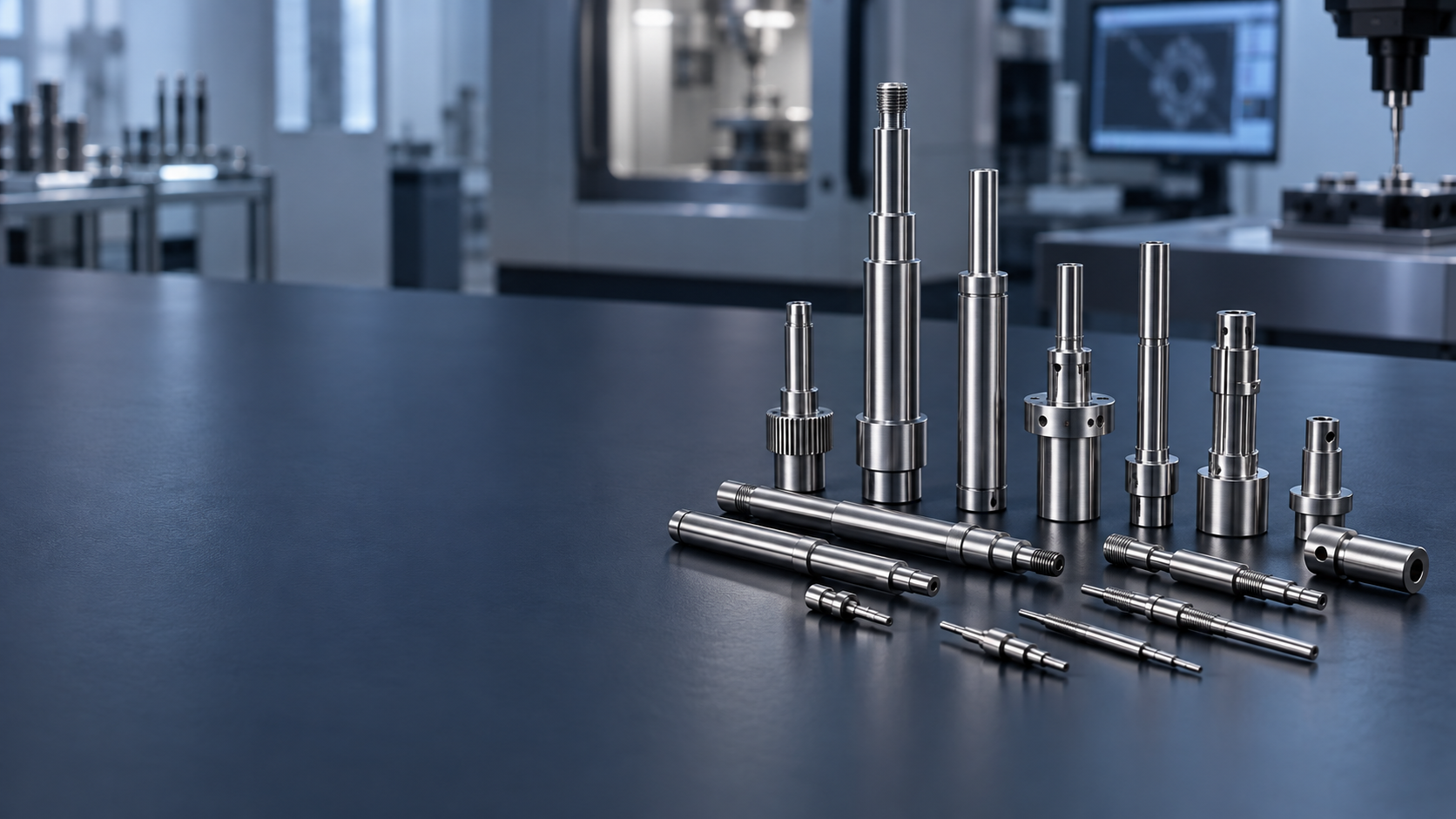
CUSTOM MEDICAL EQUIPMENT SHAFT MANUFACTURER
Medical Precision,
Built To Your Requirements.
Custom motor, spindle, linear-motion and miniature precision shafts manufactured around the dimensional accuracy, surface condition, material and quality requirements of medical equipment OEMs.MOTION / MINIATURE / SURFACE / CLEANLINESS / TRACEABILITYMEDICAL SHAFT CAPABILITY SNAPSHOT
Precision For The
Equipment Motion System.
TOPSHAFT supports medical equipment OEM projects as a custom precision shaft manufacturer, not as a complete medical-device manufacturer. Requirements are reviewed around the drawing, functional interfaces and project-specific quality documentation.| Capability | TOPSHAFT support |
|---|---|
| Manufacturing focus | Custom precision shafts for medical equipment OEM projects, made to drawing |
| Medical equipment roles | Motor, spindle, linear-motion, gear, spline, stepped, hollow and miniature shafts |
| Processes | CNC and Swiss-type turning, milling, grinding, EDM where appropriate, finishing and controlled inspection |
| Materials | Customer-specified 316/316L, 17-4PH, 420, 304, titanium, aluminum, carbon and alloy steels |
| Functional controls | Bearing fits, runout, concentricity, straightness, surface finish, edge condition and burr control |
| Quality inputs | Material, inspection, cleanliness, traceability, documentation and packaging requirements reviewed by project |
PRECISION SHAFT SOLUTIONS FOR MEDICAL EQUIPMENT
Built Around The
Medical System.
Medical equipment often combines compact geometry, precision motion, demanding surface requirements and project-specific documentation. The shaft role should be defined around the actual equipment function.MEDICAL EQUIPMENT SHAFT APPLICATIONS AT A GLANCE
Match The Shaft
To The Equipment.
Application context helps define the functional interfaces, inspection priorities and documentation needed for a more useful manufacturing review.| Medical equipment | Typical shaft components | Main engineering requirements |
|---|---|---|
| Surgical power tool | Motor / spindle / stepped shaft | Runout, bearing fit, hardness, surface finish |
| Surgical robot | Motor / spline / gear / linear shaft | Alignment, precision motion, interface fit |
| Diagnostic equipment | Motor / spindle / linear shaft | Low vibration, straightness, repeatability |
| Laboratory automation | Linear / motor / threaded shaft | Repeatability, smooth motion, corrosion resistance |
| Dental equipment | Motor / spindle shaft | Small diameter, runout, surface quality |
| Medical pump | Motor / drive / stepped shaft | Seal surface, corrosion, alignment |
| Optical / ophthalmic equipment | Motor / precision shaft | Low runout, smooth rotation |
| Medical actuator | Motor / gear / spline shaft | Torque interface, bearing fit, positioning |
WHAT MAKES A MEDICAL EQUIPMENT SHAFT DIFFERENT?
Several Critical Features.
One Functional Component.
Medical-equipment shafts can require accuracy across several features at once: journal diameter, runout, concentricity, straightness and surface roughness. A single ± tolerance does not describe the full functional requirement.Surface condition, burr control, cleaning, corrosion resistance and traceability should be specified by the drawing and actual equipment environment—not assumed.
Project-specific requirements may include
- Defined edge breaks, deburring, Ra/Rz and maximum-burr requirements
- Material and surface-treatment requirements for the actual environment
- Cleaning, particulate, oil-restriction and packaging requirements
- Material, treatment, inspection, batch or lot-traceability records
- Magnetic-property restrictions for sensitive equipment, defined before production
CRITICAL MEDICAL EQUIPMENT SHAFT CHARACTERISTICS
Inspect The Interfaces
That Affect Motion.
Critical-to-quality characteristics are selected around the drawing and equipment function. Not every component requires every control.| CTQ | Why it matters |
|---|---|
| Bearing Journal Diameter | Controls bearing fit |
| Runout | Supports stable precision rotation |
| Concentricity / Coaxiality | Aligns multiple shaft features |
| Roundness | Supports bearing and rotating interfaces |
| Straightness | Important for miniature and linear shafts |
| Surface Roughness | Influences friction, wear and cleaning |
| Edge / Burr Condition | Important for assembly and cleanliness |
| Hardness | Supports wear resistance |
| Material Condition | Confirms required alloy properties |
| Passivated Surface | Can improve specified stainless-steel surface condition |
| Cleanliness | May be customer-controlled |
| Traceability | Supports project-specific supply-chain requirements |
MATERIALS FOR MEDICAL EQUIPMENT SHAFTS
Specified For
The Actual Environment.
Material names alone do not automatically establish biological, regulatory or medical-device suitability. TOPSHAFT evaluates customer-specified material requirements for the intended equipment application.Discuss Your Material Requirement →| Material | Potential application | Main consideration |
|---|---|---|
| 316 / 316L stainless steel | Corrosion-sensitive equipment | Corrosion resistance and cleanability |
| 17-4PH stainless steel | Higher-strength precision shafts | Strength plus corrosion resistance |
| 420 stainless steel | Hardened shaft / wear applications | Hardness and wear resistance |
| 304 stainless steel | General corrosion-resistant components | Corrosion resistance |
| Titanium | Lightweight specialized components | Strength-to-weight and application-specific compatibility |
| Aluminum alloys | Lightweight equipment components | Low mass and machinability |
| Carbon / alloy steel | Internal non-corrosion-critical drive components | Strength, hardness and cost |
STAINLESS STEEL PASSIVATION
Specify The Treatment,
Then Verify It.
Passivation can be evaluated for stainless-steel shaft components where specified by the customer drawing or project requirements. Applicable treatment and verification requirements should be defined before production.Important controls
- Use the customer drawing or applicable standard to define the requirement
- Confirm treatment route and verification before production
- Do not assume every stainless-steel shaft requires passivation
SURFACE FINISH & BURR CONTROL
Define Surface Quality
By Function.
Bearing journals, seal surfaces, linear-bearing running surfaces, instrument interfaces and locating diameters may each require a different condition.Useful drawing inputs
- Ra or Rz by functional surface
- Edge-break, maximum-burr and intersecting-feature requirements
- Grinding, polishing or passivation where specified
MEDICAL EQUIPMENT SHAFT MANUFACTURING PROCESSES
Manufacturing Routes
For Small Precision.
As shafts become smaller, tool rigidity, burr control, inspection and handling become more demanding. The manufacturing route should follow geometry and the functional requirements—not a generic process list.Precision CNC Turning
Journals, steps, threads, grooves and primary shaft geometry.
Swiss-Type Turning
Small-diameter, slender and miniature repeated components where appropriate.
CNC Milling
Flats, slots, keyways, holes and custom interfaces.
Precision Grinding
Functional diameters requiring improved roundness, control or surface finish.
EDM
Selected difficult, small or hardened features where appropriate.
Surface Finishing
Polishing, passivation, electropolishing or other approved processes when specified.
FROM MEDICAL EQUIPMENT DRAWING TO FINISHED SHAFT
Plan The Process
Around The CTQs.
Medical equipment projects are reviewed against the customer's drawing, material, inspection, traceability and project-specific quality requirements. Any medical-device-specific supplier requirements should be confirmed during quotation.- 01Application & Drawing ReviewPlanned around the drawing and confirmed project requirements.
- 02Identify CTQs, Material & CleanlinessConfirm functional dimensions, material, finish, cleaning and documentation requirements.
- 03Process & Inspection PlanningPlanned around the drawing and confirmed project requirements.
- 04Precision MachiningPlanned around the drawing and confirmed project requirements.
- 05Grinding & Secondary FeaturesPlanned around the drawing and confirmed project requirements.
- 06Surface Treatment / CleaningPlanned around the drawing and confirmed project requirements.
- 07Final Dimensional & Surface InspectionInspect dimensions, geometry, surface and drawing-specified features.
- 08Documentation & Controlled PackagingPlanned around the drawing and confirmed project requirements.
- 09DeliveryPlanned around the drawing and confirmed project requirements.
Drawing review → CTQs → Process plan → Machining → Finishing → Inspection → Documentation
QUALITY CONTROL & TRACEABILITY
Quality Evidence
By Project.
Inspection methods and documents are selected around the approved drawing and customer requirements.Possible project controls
- Material certificate, alloy / heat number and material condition
- In-process checks for diameters, length, runout, straightness and small features
- Final inspection by gauges, optical measurement, CMM, roughness or hardness testing where applicable
- FAI, dimensional report, treatment certificate, conformance or lot records as agreed
CLEANING & PACKAGING REQUIREMENTS
Plan Beyond
Conventional Industrial Handling.
Medical equipment components may have cleanliness or packaging requirements beyond conventional industrial parts. These must be identified in quotation rather than assumed.Possible requirements
- Oil removal, particulate control or ultrasonic cleaning where specified
- Corrosion protection, separated parts and sealed packaging where specified
- Protection of polished and contamination-sensitive surfaces
- Customer-defined handling, labelling and delivery documentation
DFM CONSIDERATIONS FOR MEDICAL EQUIPMENT SHAFTS
Define The Functional
Datums Early.
Better engineering inputs support a clearer manufacturing route and avoid applying unnecessary precision to non-critical features.Useful engineering inputs
- Functional datums, bearing fits and mating-component information
- Burr requirements for holes, slots, threads and intersecting features
- Surface finish by functional surface instead of one finish everywhere
- Material condition, passivation, cleaning, traceability and packaging requirements
- Magnetic-property requirements for sensitive equipment when applicable
WHY TOPSHAFT FOR MEDICAL EQUIPMENT SHAFT MANUFACTURING
Shaft-Focused,
Drawing-Led.
Medical equipment projects can bring precision turning, miniature features, grinding, finishing and drawing-specific inspection into one controlled route.Project approach
- Review shaft geometry, interfaces and critical features with the equipment role in view
- Support prototype, validation, low-volume and repeat OEM production requirements
- Manufacture and inspect to the approved drawing and agreed documentation requirements
- Keep the page focused on medical equipment motion and transmission components, not implantable components
WHAT INFORMATION IS NEEDED FOR A MEDICAL EQUIPMENT SHAFT QUOTE?
Send The Data That
Defines The Application.
Complete geometry, precision, material, surface, documentation and commercial data enables a more useful engineering review.Upload Your Medical Shaft Drawing →| Information group | Include where available |
|---|---|
| Part geometry | 2D drawing, 3D model, dimensions, journals, threads, grooves, holes and special features |
| Precision requirements | Tolerances, GD&T, runout, concentricity, straightness, roundness, surface roughness and burr requirements |
| Material & finishing | Material grade/condition, treatment, hardness, passivation and surface treatment |
| Medical project requirements | Cleaning, packaging, traceability, material and inspection documentation, handling requirements |
| Commercial data | Prototype, validation and production quantities, annual demand and target delivery |
RELATED MEDICAL SHAFT SOLUTIONS
Follow The Medical
Equipment Function.
01Motor ShaftMedical motors and actuator assemblies→02Spindle ShaftSurgical and dental handpiece mechanisms→03Linear Motion ShaftLaboratory automation and positioning→04Stepped ShaftMiniature multi-diameter components→05Gear ShaftCompact motion transmission→06Spline ShaftTorque-transfer interfaces→07Hollow ShaftInternal routing and through-bore designs→08Threaded ShaftMotion and retention features→09Precision Shaft CollectionGeneral custom precision components→
View All Precision Shaft Products →MEDICAL EQUIPMENT SHAFT FAQS
Answers For The
Drawing Review.
Practical questions for medical equipment OEM procurement teams, engineering teams and motion-system buyers.What shaft types are used in medical equipment?+
Medical equipment can use motor, spindle, linear-motion, gear, spline, stepped, hollow and miniature custom shafts depending on whether the system requires rotation, power transmission, positioning or linear guidance.
What medical equipment shafts can TOPSHAFT manufacture?+
Custom medical equipment shaft projects can be reviewed from customer drawings and requirements for motor, spindle, linear, gear, spline, stepped, hollow and other precision shaft components.
Can TOPSHAFT manufacture miniature motor shafts?+
Miniature shaft projects can be evaluated around diameter, length-to-diameter ratio, features, material, tolerances, burr requirements, surface condition and quantity.
What tolerances are important for medical equipment shafts?+
Requirements may include journal diameters, runout, concentricity, coaxiality, straightness, roundness, surface roughness and edge condition. Functional requirements should be defined on the drawing.
Which materials are used for medical precision shafts?+
Customer-specified stainless steels, titanium, aluminum, carbon steel and alloy steel can be evaluated according to corrosion, strength, weight, wear and actual equipment requirements.
Can stainless-steel medical equipment shafts be passivated?+
Passivation can be evaluated for stainless-steel components where specified by the customer drawing or project requirements. Treatment and verification requirements should be confirmed before production.
Why is surface finish important on medical equipment shafts?+
Functional surfaces such as bearing journals, seal surfaces, locating diameters and linear-running surfaces may require a defined surface condition for friction, wear, assembly and cleaning reasons.
Can TOPSHAFT manufacture shafts for surgical robotics?+
Projects can be reviewed for motor, gear, spline, linear, hollow and spindle shaft components used in compact medical-equipment precision-motion systems.
Can you manufacture linear motion shafts for laboratory equipment?+
Linear-motion shaft projects can be evaluated around straightness, running surfaces, corrosion requirements, mounting features, handling and repeatability needs.
How are small medical shafts inspected?+
Inspection methods are selected around drawing requirements and can include dimensional gauges, dial indicators, optical measurement, CMM, surface roughness testing and hardness testing where applicable.
Can you provide material and inspection documentation?+
Material, treatment, dimensional inspection, first-article, conformance and lot-traceability documentation can be discussed according to the customer and project requirements.
Does TOPSHAFT support prototype and production quantities?+
Projects can be reviewed for prototype, validation, low-volume and repeat OEM production requirements, based on the drawing and commercial information provided.
What information is needed for a medical equipment shaft quotation?+
Provide 2D/3D geometry, tolerances and GD&T, material condition, heat treatment, surface and burr requirements, cleaning and packaging requirements, traceability, documents, quantities and target delivery.
NEED A CUSTOM MEDICAL EQUIPMENT SHAFT?